 August 7, 2026
 Categories: Headline / Features On The Jewish World
Pedigreed Pesach Paraphernalia


For this column, I will share some items related to Passover from my personal collection.
Seen here is a printed piece of cardboard measuring a modest four-and-a-half inches in diameter. On the outer rim, in remarkable, highly detailed scenes, are illustrations of the ten plagues that befell the ancient Egyptians. Working our way inward, there is a band of Hebrew wording which is the iconic verse sung at the Passover Seder about Eliyahu HaNavi. After this verse, going further toward the center, is the Hebrew blessing for drinking wine, and finally, a large building is depicted, titled “ISRAEL. WAISENANSTALT Postsch 15181 F/m” and above it “5694 Gut Pessach” (1934 Good Passover).
The Israelitische Waisenanstalt (Israelite Orphanage) in Frankfurt am Main, Germany was founded in 1874 and served the Jewish community. From 1933 onward, the number of children in the orphanage steadily increased due to the persecution of Jews by the Nazi government. During this period and especially after Kristallnacht, Isidor and Rosa Marx, the directors of the orphanage, worked tirelessly to transport the orphanage’s children beyond the borders of Germany. Thanks to the efforts of the Marxes, around a thousand children were saved. Rosa had all the necessary documents to leave Germany, but she chose to stay with the remaining orphans, and perished in the Holocaust. Her husband and their three children were able to flee and survived.
This little disc, so effectively utilizing the space allotted to it design-wise for use as a wine coaster for Kos Eliyahu – Elijah’s cup that is so prominently featured on the Seder table – was either given to German Jews as a solicitation device to encourage a donation to the orphanage, or perhaps as a small thank you gift for past donations. I cannot help but be both amazed by the creativity of this little item as well as moved by it, as neither the issuer nor the recipient could ever imagine that every year after 1934 would only increase the danger to themselves and their loved ones.
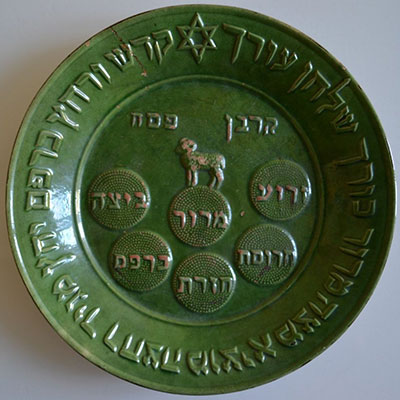
Next, we have a heavy ceramic dish made from a mold which was painted and glazed in a shade of green. It is a Seder tray for Passover – namely, featuring small circular sections which are individually labeled for the ritual foods, with the order of the Seder service inscribed on the rim (along with a Star of David) and a depiction of a horned lamb that is titled “Korban Pesach” (the Passover sacrifice). While a handful of other examples of green-painted earthenware have appeared in auctions of antique Judaica during the last 50 years, I was unfamiliar with this piece and ultimately, could locate only one similar model that is publicly documented, which is pictured and described on the website of the Israel Museum in Jerusalem. That example, not painted in green but rather a chocolate-like brown, was gifted to the museum by the JRSO (Jewish Restitution Successor Organization).
Beginning in 1947, the JRSO searched out heirless Jewish assets and unclaimed property in the American-occupied zone of Germany and distributed them to Jewish institutions and organizations, primarily in the USA and Israel. The brown Seder plate appears to have been made by the same unknown ceramics factory as my green Seder plate. As to age and place of origin, the Israel Museum states “Poland, early 20th century,” which makes sense, as the aforementioned green-colored ceramics offered in past auctions were described as hailing from Galicia, which was a territory comprised of sections of Eastern Poland and Western Ukraine.
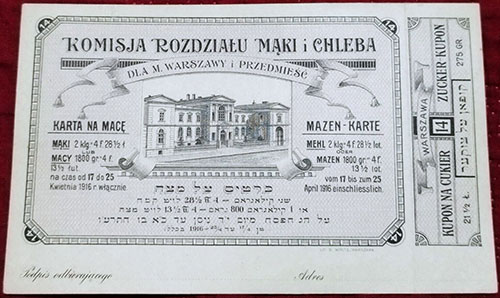
Pictured next is a postcard-sized piece of thick paper. Titled in Polish, this is a redeemable token for matzah and sugar for those who were too poor to purchase them.
Between 1914 and 1918, Poland was divided by Russia, Germany, and the Austro-Hungarian Empire. The country became the setting for many battles during World War I, and there were immense human and material losses because of this. During the German occupation of Warsaw (from which Russian forces had retreated) in the years 1915-16, there were severe food shortages for the civilian population, and advertisements for the giving of free bread to those who could not afford it were distributed throughout the year.
This piece of paper features a luxurious estate in the center and above it “KOMISJA ROZDZIALU MAKI I CHLEBA DI. A M. WARSZAWY I PRZEDMIESC” (flour and bread distribution, commission of the city of Warsaw and its suburbs). Then, in German, Hebrew, and Polish, it states: “Ticket for matzah. Two kilograms per person for flour. Two kilograms per person for matzah. For the holiday of Passover, April 17th to the 25th, 1916.” At the edge is a narrow band of text that states “Coupon for 275 grams of sugar” in German, Hebrew, and Polish.
There are two lines to be filled out at the bottom of this piece of paper which are labeled in Polish: “Name of Family” and “Address.” Because the spaces have been left blank, this food coupon was never used, which is the reason it exists today. I acquired it from a dealer of old ephemeral items who is based in Ramat Gan, Israel. This was likely kept by a Jewish individual or family who emigrated from Poland to Israel before the Second World War, as a memento of their “previous life.”
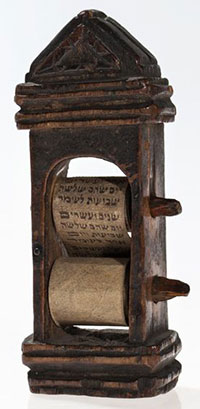
The final item shown is a miniature calendar for counting the Omer. Standing only four inches tall, this carved wooden case with movable knobs contains a piece of parchment that displays the blessings to say for every one of the 49 days of the Omer. The parchment, hand-inked by a scribe, is only half an inch wide. While a substantial number of miniature books for counting the Omer are known (the most sought-after being 18th-century examples done by hand from Italy, Germany, and the Netherlands), this example would not be considered a book.
After consulting an expert in Hebrew manuscripts, who told me that there is nothing remarkable about the letters on the parchment – “typical for 18th- and 19th-century Europe” – based on the type of wood used in the casing, this probably hails from Germany and dates to the early 19th century. There are a number of freestanding Omer calendars in various museums, and a few are small in stature, but I cannot locate any that are anywhere near as diminutive in size as my example, which I can only assume was made not so much as an amusing trinket to be placed on a desk or nightstand, but to be used when traveling, perhaps by a merchant.
Let us continue to pray for the safety of those living in and fighting for Eretz Yisrael. Chag Pesach Same’ach to all!