 July 24, 2026
 Categories: Headline / Front Page / Perspectives
American Orthodox Jewry: A ‘State of the Kehilla’ Address


Just as the President gives an annual State of the Union Address, I think we as a community owe it to give ourselves a periodic State of the Kehilla address. This is not a “top down” Shabbos Shuva derasha but is actually a “bottom up” message, based on what you – hundreds of people in our frum community – have said about how we’re doing these days.
In summary, we have significant successes – “good news” – but we also face significant challenges – “bad news.” So, what do you want to hear first? A recent study stated that most people prefer giving good news first, but that about 80% of people prefer to hear the bad news first. So here goes…
Our recent (April 26-29) Nishma Research survey of 500 Orthodox Jews asked what they see as major challenges we are facing. The top ones are:
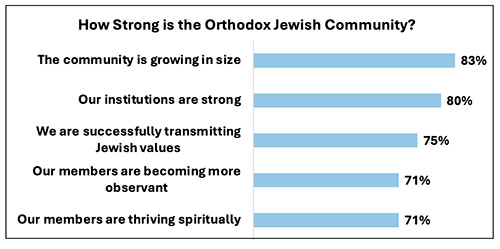 However, it is the very success of Orthodox life, across economic and moral domains – its growth, affluence, and institutional strength – that has produced new social pressures that risk displacing its spiritual core. So, I would like this to be more than just a data report, but also to include some thoughts for the future.
As a complicated and diverse people, we will always face challenges and issues to address. May I pick one? I would like to suggest that we face and need to confront a decisive opportunity of this moment in our history, in the area of moving away from the all-too-pervasive materialism and competitive consumption. As some commented:
“Certain communities are too focused on gashmius and keeping up with others. Fancy cars, fancy watches, etc.”
“This is replacing Torah values and a Torah life with something else that is just weird and spiritually harmful.”
Across Nishma Research surveys (such as of family finances and middos bein adam l’chavero), respondents have frequently pointed to materialistic and competitive behaviors as pervasive and harmful, and have rated our community poorly in the areas of interpersonal behaviors, such as anivus – humility – and being same’ach be-chelko – happy with what we have, and thankful for it.
I would suggest that we have a decisive societal opportunity to address the materialism issue, by shifting from an emphasis on gashmius to identifying and exalting the ruchnius (spirituality and connection to Hashem) to which we aspire.
Who we honor, hold up as role models, seek to emulate… these all shape our values, attitudes, and behaviors. I’m not saying we should discourage big donations to our organizations, but maybe we need to moderate the personal ostentatious spending? I would further suggest that we re-examine what we choose to celebrate. Why not equally honor not only our major donors but also those who exemplify what we most value?
Why not have a shul kiddush, sponsored with $18 donations by many, honoring the woman who looks after and accompanies her 93-year-old widow neighbor to all of her doctor appointments (and no one even knows about this)? Or one for those who staff the Chevra Kadisha? The young father who gets up two hours early every Friday to check his community’s eruv? There are so many opportunities to recognize those who exemplify the ruchnius we aspire to.
These may seem like small steps, but we need to start to create a shift in what people see as important.
The future of Orthodox flourishing will depend not only on what we build, but on what we choose to value.
The surveys cited above may be found at http://nishmaresearch.com/social-research.html.
However, it is the very success of Orthodox life, across economic and moral domains – its growth, affluence, and institutional strength – that has produced new social pressures that risk displacing its spiritual core. So, I would like this to be more than just a data report, but also to include some thoughts for the future.
As a complicated and diverse people, we will always face challenges and issues to address. May I pick one? I would like to suggest that we face and need to confront a decisive opportunity of this moment in our history, in the area of moving away from the all-too-pervasive materialism and competitive consumption. As some commented:
“Certain communities are too focused on gashmius and keeping up with others. Fancy cars, fancy watches, etc.”
“This is replacing Torah values and a Torah life with something else that is just weird and spiritually harmful.”
Across Nishma Research surveys (such as of family finances and middos bein adam l’chavero), respondents have frequently pointed to materialistic and competitive behaviors as pervasive and harmful, and have rated our community poorly in the areas of interpersonal behaviors, such as anivus – humility – and being same’ach be-chelko – happy with what we have, and thankful for it.
I would suggest that we have a decisive societal opportunity to address the materialism issue, by shifting from an emphasis on gashmius to identifying and exalting the ruchnius (spirituality and connection to Hashem) to which we aspire.
Who we honor, hold up as role models, seek to emulate… these all shape our values, attitudes, and behaviors. I’m not saying we should discourage big donations to our organizations, but maybe we need to moderate the personal ostentatious spending? I would further suggest that we re-examine what we choose to celebrate. Why not equally honor not only our major donors but also those who exemplify what we most value?
Why not have a shul kiddush, sponsored with $18 donations by many, honoring the woman who looks after and accompanies her 93-year-old widow neighbor to all of her doctor appointments (and no one even knows about this)? Or one for those who staff the Chevra Kadisha? The young father who gets up two hours early every Friday to check his community’s eruv? There are so many opportunities to recognize those who exemplify the ruchnius we aspire to.
These may seem like small steps, but we need to start to create a shift in what people see as important.
The future of Orthodox flourishing will depend not only on what we build, but on what we choose to value.
The surveys cited above may be found at http://nishmaresearch.com/social-research.html.
- Affordability, Materialism, Status Pressure. This includes school tuitions, housing, kashrut, camps, simchas, weddings, costs in general. But many also mention widespread gashmiyus, conspicuous consumption, competitiveness, and external markers of success that eclipse inner avodah. So I’m combining true spending needs with those that derive from communal competitive pressures.
- Antisemitism, Safety, America’s Future. Rising antisemitism from both the left and right (we can argue which is worse, but there is widespread understanding that it emanates from both), fear of danger, and uncertainty about long‑term safety in the U.S.
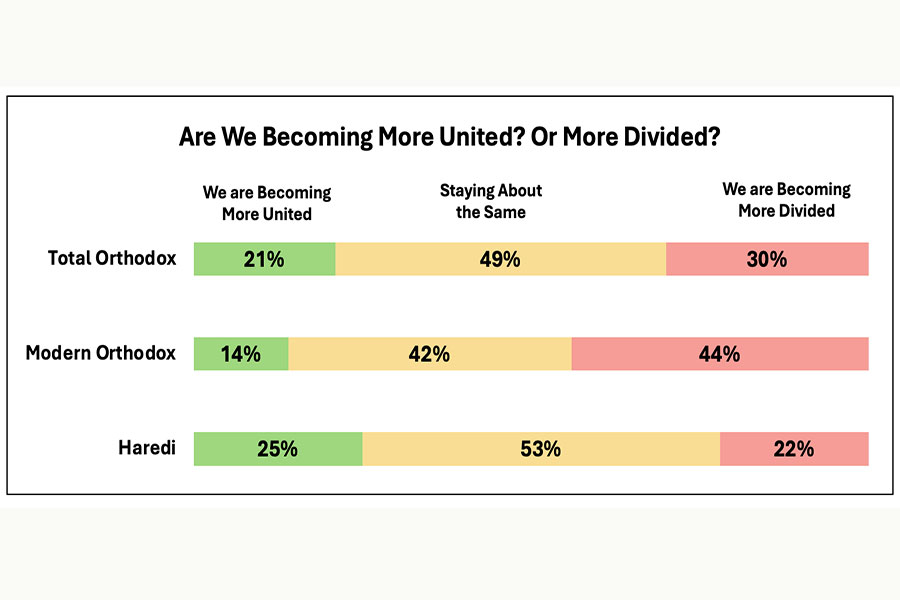
- Internal Division, Lack of Achdus. Splits within Orthodoxy, political polarization, and the difficulty of maintaining unity.
- Technology, Internet, Media. Smartphones, social media, the internet, and now AI, all presenting spiritual and social threats, especially for youth.
- Chinuch, Youth. Concerns about whether our schools and home life are effectively transmitting emunah, values, and commitment to the next generation. The threats of technology (as noted above) are part of the problem here.
However, it is the very success of Orthodox life, across economic and moral domains – its growth, affluence, and institutional strength – that has produced new social pressures that risk displacing its spiritual core. So, I would like this to be more than just a data report, but also to include some thoughts for the future.
As a complicated and diverse people, we will always face challenges and issues to address. May I pick one? I would like to suggest that we face and need to confront a decisive opportunity of this moment in our history, in the area of moving away from the all-too-pervasive materialism and competitive consumption. As some commented:
“Certain communities are too focused on gashmius and keeping up with others. Fancy cars, fancy watches, etc.”
“This is replacing Torah values and a Torah life with something else that is just weird and spiritually harmful.”
Across Nishma Research surveys (such as of family finances and middos bein adam l’chavero), respondents have frequently pointed to materialistic and competitive behaviors as pervasive and harmful, and have rated our community poorly in the areas of interpersonal behaviors, such as anivus – humility – and being same’ach be-chelko – happy with what we have, and thankful for it.
I would suggest that we have a decisive societal opportunity to address the materialism issue, by shifting from an emphasis on gashmius to identifying and exalting the ruchnius (spirituality and connection to Hashem) to which we aspire.
Who we honor, hold up as role models, seek to emulate… these all shape our values, attitudes, and behaviors. I’m not saying we should discourage big donations to our organizations, but maybe we need to moderate the personal ostentatious spending? I would further suggest that we re-examine what we choose to celebrate. Why not equally honor not only our major donors but also those who exemplify what we most value?
Why not have a shul kiddush, sponsored with $18 donations by many, honoring the woman who looks after and accompanies her 93-year-old widow neighbor to all of her doctor appointments (and no one even knows about this)? Or one for those who staff the Chevra Kadisha? The young father who gets up two hours early every Friday to check his community’s eruv? There are so many opportunities to recognize those who exemplify the ruchnius we aspire to.
These may seem like small steps, but we need to start to create a shift in what people see as important.
The future of Orthodox flourishing will depend not only on what we build, but on what we choose to value.
The surveys cited above may be found at http://nishmaresearch.com/social-research.html.