October 2, 2026
 Categories: Arts / Collecting / Headline
Reading Frank L. Baum’s The Wizard Of Oz Through A Jewish Lens


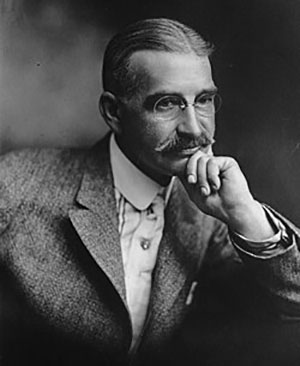
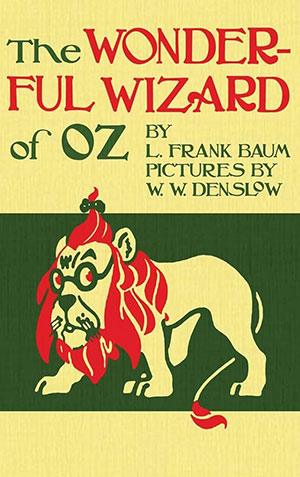
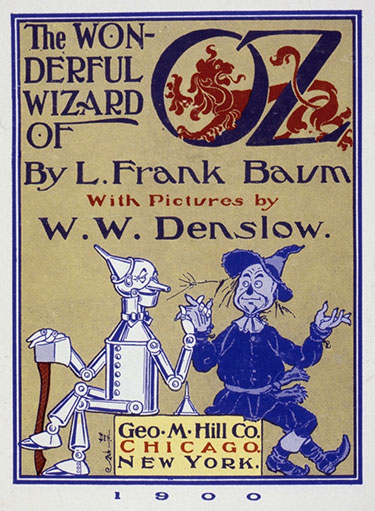
Lyman Frank Baum (1856-1919) was an American writer whose name is inextricably and forever linked with The Wonderful Wizard of Oz, a book he published on May 17, 1900 that would eventually become an enduring cornerstone of American popular culture. His early life was shaped by the rhythms of the Gilded Age and the social expectations of the Midwestern bourgeoisie and he was raised in a prosperous family, ventured into business and theatrical production, struggled through financial failures, and only late in the 1890s began to find success as a writer for children and magazines. His breakthrough came with Mother Goose in Prose (1897) and Father Goose, His Book (1899), works that mixed whimsy with a new American sensibility and enjoyed commercial success, enabling Baum and his wife Maud to leave more conventional work behind and focus on writing. It was in this creative period that he conceived and published The Wonderful Wizard of Oz, partnering with the illustrator W. W. Denslow; the book sold well enough to launch a series of thirteen sequels and to turn Baum into a professional author whose imagination and prolific output gave shape to the fictional Land of Oz.
Baum was not a theologian, a political theorist, or an intellectual activist; rather, in his own estimation, he was a teller of modern “wonder tales,” written to delight children by stripping away what he considered the darker, moralizing features of older fairy tales and replacing them with enchantment and optimism. In a foreword to early editions, he insisted the book was written “solely to please children,” aspiring “to be a modernized fairy tale” that retained “wonderment and joy” while avoiding “heartaches and nightmares.”
Baum’s personal religious journey was eclectic. Born into a Christian milieu, he affiliated with the Methodist Church and later the Episcopal Church when social involvement made that expedient. Eventually, influenced by his wife and especially by his mother-in-law, the feminist activist Matilda Joslyn Gage, he and Maud became members of the Theosophical Society, a spiritualist movement that blended Eastern thought, mysticism, and metaphysical speculation. His children attended Ethical Culture Sunday School in Chicago, an institution that offered moral education rather than doctrinal religion.
The public response to The Wonderful Wizard of Oz at the time of its publication was generally positive in mainstream American media, praised for its imaginative power and its appeal to young readers. The New York Times’s 1900 review celebrated the book’s charm and the enjoyment it offered its intended audience, but literary scholars largely ignored the work for much of the twentieth century, partly because fantasy was viewed as less serious than realist or didactic children’s literature; only later did critics begin to reassess the book’s literary, cultural, and symbolic significance.
Baum himself insisted that The Wonderful Wizard of Oz was born out of childlike imagination and personal storytelling, rather than any grand political or theological program, and he told readers that it was meant to be “a modernized fairy tale in which the wonderment and joy are retained, and the heartaches and nightmares left out,” and that it came to him as “pure inspiration... right out of the blue.” He said that he sometimes felt “the Great Author had a message to get across and He was to use the instrument at hand,” reflecting a blend of creative spontaneity and a kind of intuitive faith in inspiration rather than systematic theology.
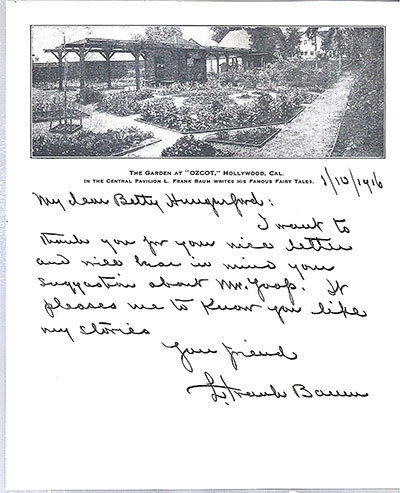
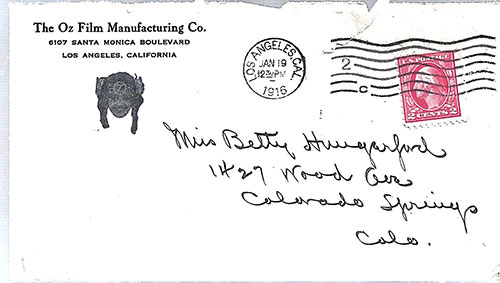
In this very rare handwritten January 10, 1916 correspondence on his illustrated “Ozcot” letterhead, Baum writes:
I meant to thank you for your nice letter and will bear in mind your suggestions about Mr. Yoop! It pleases me to know you like my stories.
Ozcot – a whimsical combination of “Oz” and “cot” (short for “cottage”) – was the name of Baum’s personal residence in Hollywood, California. Purchased and built with his wife around 1910, he wrote many later Oz books and other writings there.
In Baum’s Oz universe, Mr. Yoop is a giant introduced in The Patchwork Girl of Oz (1913), the seventh book in the Oz series, described as a humorous and somewhat grotesque figure, about 21-feet tall with a voracious appetite for meat, people, and orange marmalade. In the story, he is captured and imprisoned in a mountain cave, and his reputation serves both as a comedic threat and a bizarre obstacle to the protagonists. The character, who is also referenced in The Tin Woodman of Oz (1918), is part of Baum’s playful and imaginative take on fantasy, mixing whimsical elements with grotesque exaggeration.
Baum’s personal life and experiences contributed directly to elements of the Oz stories. According to his son and later biographers, many characters and images were drawn from his personal memories, relationships – and even childhood fears: he had a recurring nightmare as a child in which a scarecrow chased him, a motif absorbed into the character of the Scarecrow. The Tin Woodman originated from Baum’s own creativity with scrap materials; he had once constructed a metal figure for a window display from odds and ends such as wash boilers, stovepipes, and pans.
Baum named his heroine Dorothy after his wife’s little niece, Dorothy Louise Gage, who died in infancy; the book was dedicated to his wife, Maud Gage Baum, in part as a tribute to her and her attachment to the child. His own father-in-law, quiet but hardworking, was the model for Uncle Henry and scholars also note that his mother-in-law Matilda Joslyn Gage left an imprint on the story’s witches: two are good and two are wicked, a depiction that reflects Gage’s own writings challenging the persecution of accused witches and her broader critique of patriarchal church authority.
Some of the landscape and setting may likewise have roots in Baum’s lived experience. The yellow brick road appears to have been inspired by real Cobblestone or yellow brick roads that he saw in places he lived or visited, such as Peekskill, New York, where he attended military school, and the town of Holland, Michigan, where his family summered and where yellow brick pavement existed. The Emerald City’s castle imagery may derive from a castle-like structure in Holland, Michigan, or from Baum’s impression of the World’s Columbian Exposition (“White City”) in Chicago, whose dazzling buildings contrasted with everyday life and are widely cited as shaping Baum’s sense of wonder and architectural spectacle.
As for the figure of the Wizard himself, scholars have proposed that Baum may have been inspired by real-world characters and cultural figures: one is Thomas Edison, known in his day as “The Wizard of Menlo Park,” and another is a circus balloonist and showman named Washington Harrison Donaldson, who disappeared in a storm, echoing the mysterious, theatrical wizard who arrives in Oz by balloon and manipulates perception with illusion.
Despite all these personal influences, Baum maintained that he did not plan multiple layers of hidden meaning beyond crafting an imaginative tale for children. In the earliest decades after publication, there is no indication that he viewed Oz as an allegory of spiritual, political, or economic doctrine; instead, he emphasized the joy of fantasy, free of “heartaches and nightmares.”
However, later interpreters have argued that themes in the book align with Baum’s broader interests later in life, particularly his association with the Theosophical Society, a spiritual movement blending ideas from Buddhism, Hinduism, and Western esotericism. Some critics see in the novel the structure of a soul’s journey toward realization, with the Yellow Brick Road representing a path of effort and self-discovery and the companions’ quests for heart, brain, and courage echoing spiritual virtues rather than external rewards. In this view, Oz becomes a metaphor for inner transformation, an idea resonant with Theosophical emphasis on self-knowledge and latent spiritual potential.
Yet, it is critical to emphasize that such readings are interpretive and not documented in Baum’s own statements. Although he wrote that the story was inspired and that he believed it carried “sympathy and understanding, joy, peace and happiness,” there is no definitive evidence that he intended specific theological or philosophical symbolism, whether Buddhist, Theosophical, or otherwise. His creative process seemed rooted in the imaginative, the familial, and the playful, not in systematic doctrinal encoding. Because of this, interpretations that posit deep allegory, whether in terms of money, politics, spiritual enlightenment, or cultural identity, need to be treated as reflective readings imposed from outside rather than expressions of Baum’s own conscious design.
When Baum published The Wonderful Wizard of Oz in 1900, he could not have anticipated that his children’s fantasy would become one of the most symbolically mined works in American literature. Political historians have read it as Populist allegory, cultural critics have interpreted it as a meditation on American modernity, and psychoanalytic readers have traced its dream-logic and archetypes. Yet, one possible interpretive strand, speculative but not unreasonable, invites us to consider whether the structure, imagery, and emotional arc of Oz resonate with Jewish historical experience and Jewish modern consciousness at the turn of the twentieth century. Thus, to be clear, while what follows is not meant as serious analysis of the Jewish and Zionist symbolism in Oz, I sure did have fun expanding my imagination and writing it!
While there is no archival evidence that Baum consciously embedded Jewish allegory in his tale, and no documentation tying him to Zionist circles or Jewish theological study, literature often absorbs the atmosphere of its age and he wrote at a moment when exile, homeland, assimilation, false messianism, and national rebirth were not abstract theological ideas but, rather, urgent contemporary debates within global Jewish life. When one reads Oz against that background, its themes of displacement, wandering, utopian spectacle, illusion, self-discovery, and homecoming begin to echo, sometimes faintly, sometimes strikingly, the rhythms of Jewish historical memory.
The narrative begins with catastrophe. Dorothy is lifted from Kansas by a cyclone and deposited in a strange land; the violence is sudden and disorienting and she clearly does not choose to leave, nor is she prepared for exile. This forced displacement bears structural resemblance to the foundational Jewish memory of expulsion, from the Babylonian exile to the Roman destruction of Jerusalem and the long Diaspora that followed. Jewish history, especially as understood in liturgy and collective consciousness, is punctuated by involuntary uprooting. The child in exile, wandering in foreign territory yet clinging to memory of home, is a deeply embedded image in Jewish imagination. Dorothy’s defining trait is not ambition or conquest but longing, and her famous refrain, “there is no place like home,” is not a casual sentiment but an existential orientation. Kansas is described in drab tones, flat and gray, devoid of the lush color that characterizes Oz; yet, the very absence of splendor underscores a profound truth: home is not defined by aesthetic brilliance but by belonging. The Zionist argument emerging in the 1890s similarly insisted that the Jewish homeland need not be a paradise; it need only be one’s own.
Dorothy’s very name, translating into Hebrew as Matanat Elokim (“Gift of G-d”), highlights a symbolic resonance within the narrative. Her sudden arrival in Oz and her role in resolving conflicts position her as a providential figure, a “gift” who restores balance and aids those in need; from a Jewish interpretive perspective, the name underscores her function as an agent of benevolence and moral guidance, echoing motifs of divine assistance and purposeful journeying found in biblical narratives. In this light, Baum’s heroine can be seen not merely as a whimsical adventurer but as a character whose very name reflects the story’s deeper ethical and guiding forces.
Dorothy does not seek dominion in Oz, nor does she aspire to remain in the Emerald City or to rule the Winkies; rather, her sole desire is return, a posture that parallels the long Jewish liturgical and emotional attachment to Jerusalem, encapsulated in the phrase repeated at the conclusion of the Passover Seder and Yom Kippur service: “Next year in Jerusalem,” a formula that sustained hope across centuries of exile, even when practical return seemed impossible. We learn that Dorothy ultimately possessed the means of return all along, as the silver shoes (ruby in the film adaptation) carry within them the power to transport her home, but she lacks knowledge of their efficacy. This detail resonates suggestively with the Zionist insistence that the Jewish people possessed latent national capacity all along; what was missing was political consciousness and will. In other words, the means were always present, but the recognition was not, and Herzl’s great contribution was to fuel that which was already there.
The companions that Dorothy meets along the Yellow Brick Road deepen this symbolic field. The Scarecrow believes himself brainless; the Tin Woodman laments his lack of heart; the Cowardly Lion is convinced of his deficiency in courage – each internalizes a narrative of absence, yet throughout the journey, each demonstrates precisely the quality he believes he lacks. The Scarecrow devises clever strategies; the Tin Woodman displays tenderness and moral sensitivity; the Lion repeatedly performs brave acts; and the Wizard’s gifts, a diploma, a silk heart, a medal, are symbolic affirmations of what was already present such that the structure of this revelation parallels a core theme in modern Jewish self-reflection. Nineteenth-century European discourse frequently cast Jews as intellectually cunning but morally suspect, commercially adept but physically weak, lacking the martial courage of “normal” nations. But Zionist thinkers, from Herzl to Nordau, challenged these stereotypes, arguing that Jewish deficiency was not inherent but historical. Courage and vitality had been suppressed by exile; they could only be reawakened through national self-assertion.
The Wizard himself can also be placed within a pattern familiar to Jewish historical memory: the phenomenon of the false redeemer. Jewish history contains several infamous episodes in which charismatic figures convinced large numbers of followers that redemption was imminent, only for their promises to collapse. The most famous case is the seventeenth-century messianic claimant Sabbatai Tzvi, whose dramatic rise and sudden conversion to Islam devastated Jewish communities across Europe and the Ottoman Empire, and later figures such as Jacob Frank similarly generated waves of excitement followed by disillusionment. In Oz, the Wizard – the “man behind the curtain” – occupies a comparable structural role: he appears as a majestic authority capable of solving every problem, yet behind the curtain he is merely an ordinary man, a fraudster, manipulating machinery and illusion. The companions’ discovery of this truth mirrors the painful historical process by which Jewish communities learned to distrust spectacular promises of instant redemption. Significantly, however, Baum’s story resolves the crisis not with despair but with maturation; once the illusion is exposed, the travelers realize that their hopes must ultimately rest on their own inner capacities rather than on theatrical saviors.
The Emerald City can be read as symbolizing the glittering allure of assimilation in modern cosmopolitan centers. In the decades surrounding the publication of Oz, cities such as Vienna, Berlin, and New York offered Jews unprecedented opportunity and apparent security; yet these spaces often required adaptation, intellectual, social, sometimes even religious, to fit into dominant norms. The green spectacles in Oz function as devices that standardize perception; everyone must see the city through the same lens and, while Dorothy and her companions are impressed, they are not transformed. The city does not define their identities; they pass through it rather than dissolve into it, and for Jewish immigrants navigating American modernity, the tension between integration and preservation of distinctiveness was acute. The Emerald City’s beauty is real enough, but it is not ultimate.
The Yellow Brick Road, winding toward the city, evokes pilgrimage. Jewish tradition is saturated with journey motifs: Abraham’s departure from Ur, the Exodus from Egypt, the wandering in the wilderness, the repeated expulsions and migrations across continents. The road in Oz is purposeful but not straightforward, as it twists, branches, and confronts obstacles. Along it, community forms. Dorothy does not travel alone; she gathers companions whose fates become intertwined with hers. Jewish peoplehood historically functioned as a nation-in-motion, sustained by shared narrative and law rather than territory, and the covenant traveled with the people. Thus, in Oz, the road itself is formative, and identity emerges through the act of walking together toward promise.
The Wicked Witch of the West represents tyrannical power that enslaves and terrorizes and, while it would be irresponsible to map her onto any specific historical persecutor, the structural role she plays, oppressor of a vulnerable population and wielder of arbitrary cruelty, mirrors patterns familiar in Jewish memory. (Haman, anyone?) Her dissolution by water suggests the fragility of seemingly invincible regimes; and in Jewish liturgy, oppressive empires rise and fall; ultimate power belongs not to the tyrant but to a deeper moral order. Dorothy’s defeat of the Witch is not a military triumph but an almost accidental act of self-defense, underscoring the theme that liberation sometimes arrives through unexpected channels and through the hidden hand of G-d. (Purim story, anyone?)
And the Wicked Witch is destroyed by water, almost begging comparison to the Egyptians being destroyed through drowning in the Red Sea. Alternatively, water plays an important role in Judaism as a purification agent, and Dorothy’s act of splashing water on the Wicked Witch serves as an unexpected and purifying force, eradicating evil and restoring balance, symbolically mirroring how divine or natural intervention can liberate the oppressed and destroy forces of injustice.
The story does not end with the book. The 1939 MGM film adaptation, now more culturally dominant than Baum’s original text, was produced within a Hollywood studio system heavily shaped by Jewish émigré founders and executives. Louis B. Mayer of MGM, the Warner brothers, and other studio heads were Jewish immigrants or children of immigrants who had themselves navigated questions of belonging and identity in America. The film’s transformation of the silver shoes into ruby slippers, its lush Technicolor rendering of Oz, and its emotional emphasis on “home” as the ultimate good were shaped within an industry that often balanced American patriotism with subtle outsider sensibility. While it would be simplistic to definitively label the film “Jewish,” the emotional pitch of displacement and longing resonated with creators whose families had experienced migration and marginality.
Moreover, Jewish audiences in the mid-twentieth century sometimes appropriated Oz imagery in creative ways. The notion of journey toward a promised city lent itself naturally to sermons and essays reflecting on Zionism and later the establishment of the State of Israel and, while no canonical Zionist text treats Dorothy as allegory, the structural parallels made such comparisons available. In American Jewish children’s literature and educational discourse, the emphasis on inner worth and perseverance harmonized with communal narratives of survival and renewal.
The film’s most iconic line, “there’s no place like home,” acquired unimagined poignancy in 1939, the year of its release, when European Jewry stood on the brink of catastrophe. For Jewish viewers aware of unfolding events abroad, the affirmation of home carried weight beyond pastoral nostalgia; home could mean America and, for some, it meant the fragile Yishuv in Eretz Yisrael. The rainbow motif in the song “Over the Rainbow” evokes yearning for a place where troubles “melt like lemon drops,” a line that, while universal, resonated deeply in a Jewish world darkened by persecution.
What makes the Jewish reading plausible is not secret code but structural affinity. Jewish historical consciousness is organized around exile, wandering, false hope, resilience, and return, and Oz is clearly organized around the same arc. Dorothy begins in displacement, travels in community, confronts illusion, discovers inner resources, and returns home empowered by knowledge she did not initially possess, and the companions’ journey from self-doubt to self-recognition mirrors communal movements from internalized stereotype to renewed confidence. The Emerald City’s exposure demystifies authority without abolishing hope, and the narrative affirms that dignity precedes recognition and that belonging is not bestowed by spectacle but rooted in origin.
Thus, one can make a measured but meaningful case: The Wizard of Oz is not a Jewish allegory in the strict sense, yet it is a story whose patterns harmonize strikingly with Jewish historical experience at the dawn of modernity. It speaks of exile without despair, of spectacle without surrender, of community forged on the road, and of home cherished not for grandeur but for belonging. That Jewish readers and Jewish filmmakers found in it emotional depth is no accident: Baum’s fairy tale tapped into currents larger than any single tradition and, in so doing, it produced a narrative that, while quintessentially American, remains hospitable to Jewish interpretation – a testament to the universality of longing for home and the enduring hope that the power to return lies, sometimes unnoticed, at our own feet.
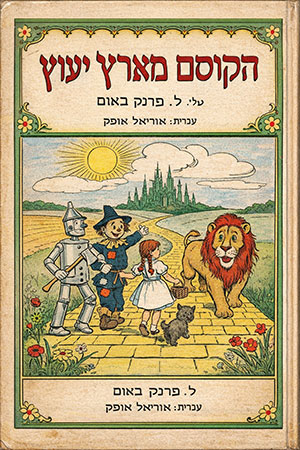
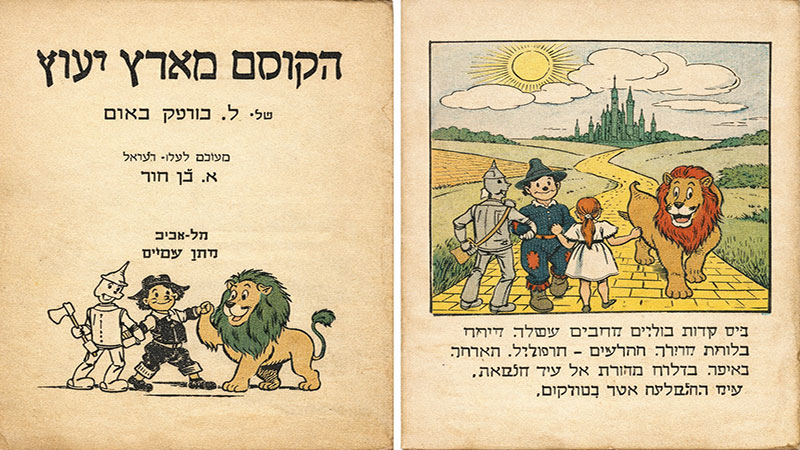
The earliest major Hebrew translation of The Wonderful Wizard of Oz was by Uriel Ofek and published in Israel, and his edition became influential in how the story and terminology (such as “Eretz Uz”) were rendered into Hebrew with subsequent translations often following its choices. His translation was published posthumously in 1988 and helped to define the Hebrew version of this beloved classic, and, because Baum’s original work entered the public domain in the mid-20th century, this subsequently made Hebrew translation and publication easier.
Ofek (1926-1987) was a central figure in Israeli children’s literature, both as a writer and as a translator. Born in Tel Aviv, he grew up in the Giv’atayim neighborhood and attended the Hebrew Gymnasium in Herzliya before serving as a medic in the Palmach during the 1940s, including during Israel’s War of Independence, when he was captured and held for about nine months. He became editor of Davar L’iladim (the children’s supplement of the newspaper Davar), where he influenced generations of young readers; he became deeply involved in building reference works and bibliographies for children’s and youth literature; and he translated numerous major works of children’s literature into Hebrew.
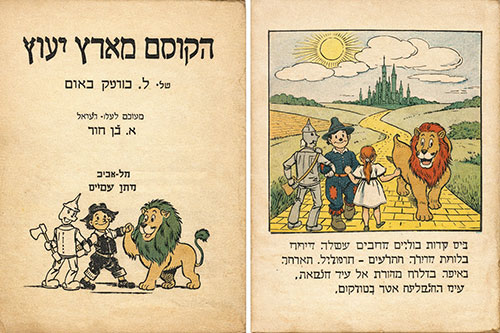
Although Ofek’s was the first widely recognized Hebrew edition, The Wizard of Oz continued to see multiple new translations in Hebrew over the years, including annotated and modern versions by later translators such as Gili Bar-Hillel Semo, who is better known for her English-to-Hebrew translations of other works. Her association with Oz is more recent and not the first translation, but it demonstrates the ongoing appeal of Baum’s story in Hebrew literary culture.
In addition to formal translation and literary adaptation, imagery from Oz occasionally appeared in Israeli journalism and educational discourse as a metaphor for aspects of the Zionist experience, as writers and educators sometimes drew playful comparisons between the Yellow Brick Road and the long historical journey of the Jewish people toward national restoration. Because Baum’s story was widely known among Hebrew readers by the late twentieth century, its imagery provided a convenient symbolic vocabulary through which journalists and teachers could evoke the emotional structure of a long journey culminating in a hoped-for destination.
The metaphor was particularly attractive because the Oz narrative emphasizes perseverance and self-discovery rather than conquest, much as early Zionist ideology often framed the return to the Land of Israel not primarily as an act of political domination but as a process of national renewal achieved through labor, courage, and cooperation. In that sense, Dorothy and her companions, who overcome obstacles through friendship, ingenuity, and moral resolve, could easily be viewed as embodying virtues admired in Zionist youth culture, and the journey along the Yellow Brick Road, filled with dangers yet sustained by companionship and determination, loosely paralleled the image of pioneering immigrants who traversed geographic and historical obstacles to build a new society.
The figure of the Wizard himself sometimes appeared in political commentary within Israel as a humorous metaphor for leaders whose authority depended heavily on spectacle or rhetoric, and journalists occasionally invoked the image of the “man behind the curtain” to describe situations in which political power seemed impressive from a distance but less formidable upon closer inspection. This usage parallels the broader international adoption of the phrase as a shorthand for hidden manipulation or theatrical authority, yet it also resonates with Jewish historical sensitivity toward charismatic figures who promise sweeping solutions.
The persistence of these references illustrates the flexibility of Baum’s narrative symbolism. Although Oz originated as an American fairy tale, its central images, including the road, the fellowship of travelers, the deceptive wizard, the radiant city, and the longing for home, proved sufficiently adaptable to enter the cultural vocabulary of societies far removed from Baum’s original context. In Israel, where national identity itself was shaped by stories of exile, journey, and return, these motifs could be appreciated not merely as elements of fantasy but as imaginative reflections of historical experience.