 September 25, 2026
 Categories: Headline / Business/Finance / Money Matters
Give Your Children Money Without Killing Their Ambition


"My wife and I are doing well financially, and we would like to use some of our wealth to help our children. The question we have been struggling with is how to support our kids financially without destroying their ambition, motivation, or making them spoiled. Do you have any suggestions?"
Your concerns are well founded. A 20-year study conducted by The Williams Group found that financial mistakes and poor legal advice account for only about 3% of failed wealth transfers. Sixty percent result from breakdowns in family communication and trust, while another 25% stem from heirs who were simply never prepared to receive what they inherited. Families rarely lose their wealth because of the markets. They lose it because money is transferred without preparation, purpose, or structure.
That finding would not have surprised Chazal. Three thousand years before behavioral economists began publishing papers on sudden wealth syndrome, the Torah was already treating this question as a serious concern. In Parshat Eikev, Moshe warns Bnei Yisrael that after their houses are built and their silver and gold have multiplied, their hearts will become haughty and they will forget Hashem. Wealth is not presented as a neutral result of success. It is presented as a test that amplifies the character already within a person. Give money to someone anchored in gratitude, responsibility, and purpose, and it often becomes a blessing. Give the same money to someone without that foundation, and it can become destructive.
That perspective should shape not only our parenting, but also our financial planning. Rather than simply question how much to give our children, we should ask what kind of adults we are trying to raise and how our financial decisions support that goal.
Here is a framework that can help parents use wealth to strengthen their children rather than weaken them.
Teach the trade before you transfer the fortune: The Gemara in Kiddushin teaches that a father is obligated to teach his son a trade. Failing to do so, the Gemara warns, is akin to preparing him for a life of theft. Someone with no ability to support himself may eventually be driven to desperate choices.
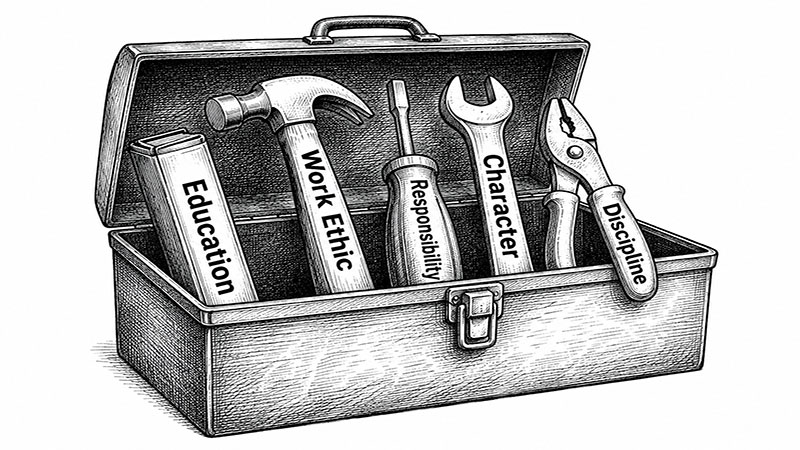
Before receiving meaningful financial gifts, children should develop the ability to earn their own living through a college degree, vocational training, professional licensing, or meaningful work experience. They should know they can support themselves, even if they won’t necessarily need to rely on those skills forever. The confidence that comes from earning one's own success creates a strong psychological foundation. A child who knows he can succeed without family money will almost always become a better steward of family wealth.
In my own practice, many successful business owners insist that their children and grandchildren spend several years working outside the family business before joining it. Learning under someone else's supervision, receiving constructive criticism, and earning promotions without special treatment develops humility, confidence, and a work ethic that cannot be inherited.
Fund capability, not lifestyle: Rambam's famous eight levels of tzedakah do not place the largest gift at the top. The highest form of giving is helping someone become self-sufficient through a loan, a job, or a business partnership.
The same principle applies to our own children. Education, professional training, seed capital for a legitimate business, assistance with a reasonable down payment on a first home, and medical or mental health needs all increase a child's ability to build a successful future. By contrast, unlimited allowances, luxury purchases, and continually subsidizing an expensive lifestyle often reduce motivation because they remove the incentive to strive.
There is also an important tax planning opportunity. Direct payments made to educational institutions or medical providers are generally exempt from gift tax regardless of the amount. This is completely separate from both the annual gift tax exclusion and the lifetime gift and estate tax exemption, making education and health care among the most tax-efficient gifts parents can provide. In addition, annual exclusion gifts, currently $19,000 per recipient or $38,000 for a married couple electing to split gifts in 2026, allow parents to transfer wealth gradually without dramatically changing a child's financial outlook overnight.
Stage the money to the person, not the calendar: Mishlei instructs parents to educate each child according to his own way. That wisdom extends naturally to financial planning.
Readiness for wealth is not determined by age alone. Some children demonstrate financial maturity in their late twenties, while others still may not be ready decades later. This reality argues against rigid trust provisions that distribute assets automatically at ages 25, 30, and 35.
Many families instead use discretionary trusts administered by an independent trustee. A trustee who is not emotionally involved in day-to-day family dynamics can approve funding for graduate school while declining to purchase an extravagant luxury vehicle without turning that decision into a source of lasting family conflict.
Some families also tie distributions to meaningful milestones such as completing a degree, maintaining steady employment, starting a business, or building a family.
Incentive trusts can reinforce these goals, but they should be drafted carefully. A formula that rewards only earned income may unintentionally penalize a child who chooses education, the rabbinate, or nonprofit work. Broad discretionary standards often produce better results because they allow trustees to distinguish between a child pursuing a meaningful vocation and one who simply refuses to accept responsibility.
Build friction into the giving itself: Growth requires effort. Parents who solve every problem with money unintentionally teach their children to stop solving problems themselves.
One strategy used by many successful families is matching rather than replacing. Parents may match savings toward a first home, invest alongside a child's contribution to a new business, or pay for advanced education after the child has completed the necessary prerequisites independently. Matching rewards initiative while preserving the discipline and satisfaction that comes from personal effort.
Involve them in giving before they receive: Long before children receive meaningful financial gifts, they should learn that money carries responsibility.
In our own home, my young children place a few coins into the tzedakah box before Shabbos. My wife provides the coins, but the goal is not the amount; it is developing the habit of giving.
As children mature, they can help decide which organizations receive family tzedakah or manage a modest charitable budget of their own. These experiences teach that wealth is not simply something we own. It is something we are entrusted to use wisely.
Say the reasoning out loud: Kohelet captures the anxiety every successful parent eventually feels. Shlomo HaMelechlaments that he must leave everything he built to a successor without knowing whether that person will prove wise or foolish.
Families that preserve wealth across generations rarely keep financial decisions a mystery. They explain why the family has wealth, what it is intended to accomplish, and what values should guide its use. A written family letter, accompanied by an open conversation, explaining what parents will support, what they will not support, and the reasoning behind those decisions often has a greater long-term impact than another page of legal language.
The most important transfer of all: The essence of this entire framework can be summarized by Warren Buffett's well-known advice: “You want to give your kids enough so they can do anything, but not so much that they can do nothing.”
Money can provide opportunities. It can open doors and reduce unnecessary hardship. What it cannot buy is character, values, resilience, gratitude, and ambition. Trust documents, gifting strategies, matching formulas, and tax planning all play an important role. Yet, the greatest inheritance parents leave their children is not measured in dollars. It is the discipline, values, and sense of purpose that allow wealth to become a blessing instead of a burden.