 July 31, 2026
 Categories: Arts
Letters Shed Light on 20th Century Halachic Master
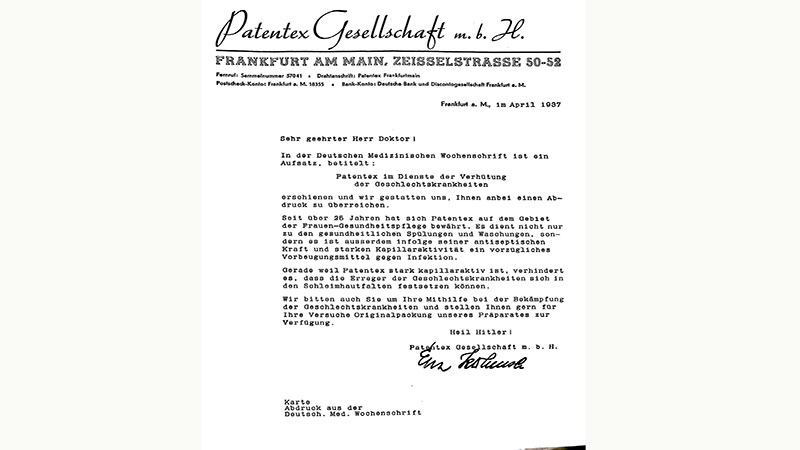


Among the most remarkable acquisitions to pass through my hands in recent years is an extraordinary archive documenting the behind-the-scenes development of one of the twentieth century's most original Orthodox treatments of Taharat HaMishpachah. Comprising correspondence written between 1937 and 1938, the collection preserves an intimate scholarly dialogue between Rabbi Avraham Dov-Ber Kahana Shapiro, the illustrious Av Beth Din of Kovno and author of the classic Devar Avraham, and the distinguished Berlin physician Dr. Jacob Levy.
The letters were written in the years following Rabbi Kahana's celebrated 1935 address to the Bais Yaakov movement on Taharat HaMishpachah, a work that attracted considerable attention for its thoughtful engagement with both halachic tradition and contemporary medical knowledge. Far from considering the project complete, Rabbi Kahana devoted himself to expanding and refining the material for publication before a broader audience. Among the most fascinating letters is one dated 11 Av 5698 (1938), in which he informs Dr. Levy that he has secured a translator for a German edition of the work and requests a typed copy of Dr. Levy's German essay. Explaining, with characteristic humility, that he found German handwriting difficult to decipher, Rabbi Kahana hoped to include the essay as an appendix to the forthcoming edition.
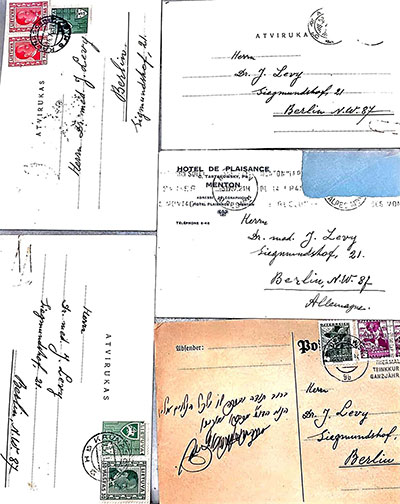
What unfolds throughout the correspondence is far more than a simple exchange of ideas. Rather, the letters reveal the extraordinary scholarly discipline with which Rabbi Kahana approached every aspect of the project. Time and again, he asks Dr. Levy to provide exact bibliographic references so that he might verify medical claims in their original scientific publications rather than relying on secondhand summaries. The correspondence ranges across an impressive spectrum of contemporary medical literature, discussing the writings of Drs. Jacob Smithline, Schiff, Röder, and numerous other physicians. Subjects include menstrual physiology (referred to in the letters as "Aras HaVeset"), gynecology, bacteriology, pharmacology, and the therapeutic applications of then-modern medicines.
The letters also offer unexpected glimpses into Rabbi Kahana's own research methods. Some were penned while he was staying in Vienna at the home of Dr. Rabbi Carlebach, while others document his direct correspondence with pharmacies and medical professionals as he investigated the scientific foundations of various treatments and physiological phenomena. The image that emerges is not merely that of a great posek, but of a meticulous investigator determined to understand the latest scientific research firsthand before incorporating it into his halachic writings.
Equally compelling is the historical setting in which this scholarly collaboration unfolded. The German-language letters bear unmistakable traces of life under the Third Reich. At least one concludes with the compulsory Nazi salutation, "Heil Hitler" – a chilling reminder of the regime's encroaching reach, even into correspondence devoted entirely to Torah scholarship, medicine, and Jewish religious life. Printed letterheads from pharmacies, medical offices, communal organizations, and professional institutions further illuminate the network of Orthodox physicians, academics, and communal leaders who continued their work under increasingly oppressive conditions. These seemingly incidental details transform the archive into a vivid testament to Jewish intellectual life persevering in the shadow of Nazi persecution.
Perhaps most striking is what these documents reveal about Rabbi Avraham Dov-Ber Kahana Shapiro himself. Revered throughout the Torah world as the author of Devar Avraham and one of Eastern Europe's foremost halachic authorities, he appears here as a scholar of uncommon intellectual curiosity. He borrows scientific works, follows current medical research, consults physicians and pharmacists, and carefully weighs the conclusions of contemporary science before citing them in support of his halachic analysis. At a time when such sustained engagement with modern scientific literature was exceedingly rare among leading rabbinic authorities, these letters provide remarkable evidence of a methodological rigor that was decades ahead of its time.
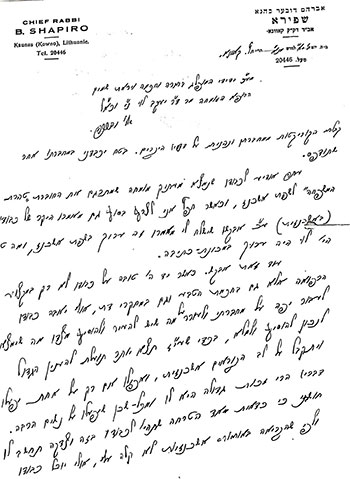
Taken together, the correspondence offers a rare window into the intellectual workshop behind one of the most innovative Orthodox discussions of Taharat HaMishpacha produced in the twentieth century. It documents not only Rabbi Kahana's collaboration with one of Germany's leading Orthodox physicians, but also his profound conviction that Torah and authentic scientific inquiry need not stand in opposition. Indeed, in one particularly revealing letter, Rabbi Kahana encourages Dr. Levy to broaden his contribution beyond medicine alone and address the relationship between the natural sciences and religion, adding that even if such an effort were to influence only a single reader, "it would already be of great value."