 September 25, 2026
 Categories: Headline / Perspectives
The Palestinian Authority’s Illegal Army


Given the alarming decline in public – and Congressional – support, Israel in the coming years is likely to face mounting pressure from Washington to recommit to the so-called two-state solution and to reopen negotiations with the Palestinian Authority.
This is true regardless of who wins the 2028 presidential election. It becomes a practical certainty if the winner is a Democrat, or if JD Vance is the Republican nominee and prevails; it is somewhat less likely under a President Rubio.
In any event, Israel should prepare for the worst and assume that sooner or later, the demand will come.
And when it comes, one principle will be paramount. Every serious version of a two-state framework, going back decades, has rested on a single, non-negotiable security requirement – that any future Palestinian state must never be militarized. Such an entity might field national and local police agencies to keep public order; it may not field an army. That was the premise of the Oslo Accords, and it has been the premise of every American peace plan since.
The Palestinian Authority has already broken that principle – and it did so, unfortunately, with Israel’s tacit approval, and at times its active cooperation.
That is the disturbing conclusion of an important new report by Lt.-Col. (res.) Maurice Hirsch for the Jerusalem Center for Security and Foreign Affairs, bluntly titled “The PA’s Massive Army Threatens Millions of Israelis Within Just 22 Kilometers.”
The report’s findings deserve serious attention. Start with the raw figures. The Oslo Accords permitted the PA a civilian police force, capped, in Judea and Samaria, at roughly 12,000 men, equipped with a defined and relatively modest inventory of arms: 4,000 rifles, 4,000 pistols, 120 machine guns, and just 15 armored vehicles. These were the tools of policing – enough weapons to arrest criminals and keep public order, not to wage war.
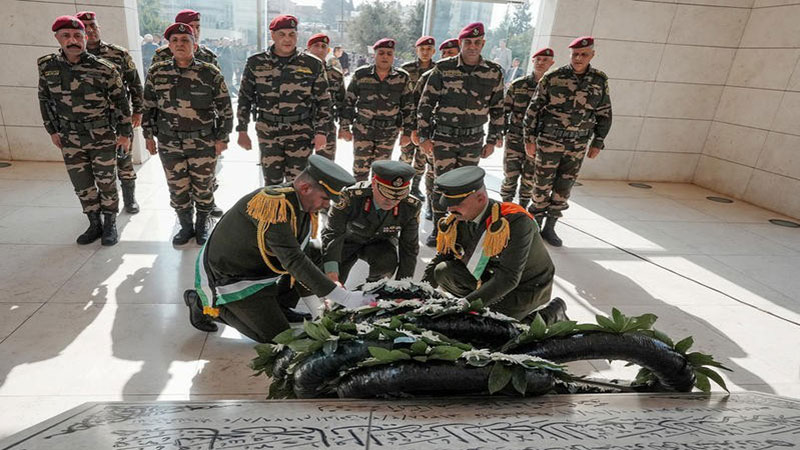
Today, Hirsch documents, the PA fields approximately 70,000 security personnel, including more than 50,000 in Judea and Samaria – more than four times the 12,000 allowed there under Oslo. The PA’s arsenal is no longer measured in a few thousand light weapons but in tens of thousands of assault rifles and pistols, supplemented by heavy machine guns, RPGs, shoulder-fired missiles, and dozens of armored vehicles.
This is an army – and Israel, shockingly, helped build it. The report traces a series of Israeli-approved weapons transfers in 2007, 2008, 2016, and 2019, as well as a disputed September 2023 shipment reportedly containing 1,500 weapons and eight armored vehicles. Other arms arrived through smuggling and local manufacture that Israel proved unable or unwilling to stop.
Washington underwrote much of the rest, providing $392 million for PA security purposes in 2007 and May 2010 alone for training and equipment, while the European Union poured tens of millions of euros into the PA’s forces over two decades.
In short, while the PA does not control a state, the areas under its control – Area A, which covers about 18% of the West Bank, where the PA has full civil and security control, and Area B, which covers about 22%, where the PA shares security control with Israel – have apparently already been completely or partially militarized.
Why does the “22 kilometers” of the report’s title matter? Because 22 kilometers (about 13½ miles) is roughly the depth that Hamas terrorists penetrated into Israel on October 7, 2023. Hirsch asks a simple and chilling question: What lies within that same distance of the PA’s existing bases in Judea and Samaria? The answer is much of the country.
A 22-kilometer arc from the northern West Bank reaches Afula, Yokne’am, and their surrounding communities – several hundred thousand Israelis. Move west from Tulkarm and Qalqilya, across the Green Line and Israel’s narrow waist, and the number climbs into the millions – the coastal plain, Highway 6, and the approaches to the heart of the country.
By the report’s reckoning, well over two million Israelis live within a single October 7 radius of a military force that isn’t supposed to exist.
And that is only the threat on which the report focuses. Hirsch is careful to note that his scenario deliberately leaves out potential PA military operations directed inward, within Judea and Samaria – attacks that would put hundreds of thousands more in the line of fire, including the Israelis who live in the Jewish communities of the territories, and the many thousands who travel the local roads every day. They wouldn’t be 22 kilometers from the danger. They would be surrounded by it.
While numbers alone do not prove intent, training does. A police force trains to make arrests, direct traffic, and gather evidence. It does not train for armored warfare, artillery, sniping, and parachuting. Yet those are the skills on the PA syllabus. In January 2025, Hirsch notes, 49 PA cadets were participating in such training at a Pakistani military academy. Organizations train men this way to fight conventional wars, not to police civilians.
Hirsch describes the culminating exercise of a PA officers’ course, which featured a drill in stopping a civilian vehicle and pulling out its occupants – a scene the report compares directly to the images of Israelis being dragged from their cars on October 7.
There is no lawful policing purpose for rehearsing the seizure of passengers from a vehicle. That is military or terrorist training, not law enforcement.
Nor is this a case of a few bad actors slipping through the vetting. The PA has made room for terrorists by design. Jibril Rajoub, a senior PA and PLO figure, has boasted that no fewer than 12 percent of the Palestinian terrorists held in Israeli prisons came from the ranks of the PA’s own security forces.
In 2020, the PA’s President Mahmoud Abbas formally approved embedding released terrorists directly into those forces, an arrangement Hirsch says was intended to conceal continuation of payment to terrorists.
An institution that recruits, pays, and promotes such men isn’t helping Israel to prevent the next October 7. It is staffing for it.
Defenders of the arrangement say the PA’s forces coordinate closely with the IDF, share intelligence, and have helped foil Hamas plots in Judea and Samaria. That is true, as far as it goes; but security coordination can be expected to endure only so long as it serves the PA’s interests. Military capabilities, once built, often outlast the political intentions that justified them.
There is a historical parallel that is hard to ignore. In the 1930s, Germany rearmed in open violation of the Treaty of Versailles. Germany’s intended victims, Britain and France, didn’t assist that rearmament. The Soviet Union secretly did, and it paid for the miscalculation in oceans of its own blood.
In the case of the PA, the most probable intended victim has been an active participant. Israel has permitted, and partly financed, the PA’s buildup on the theory that a strong PA is a useful counterweight, a force able to combat and deter Hamas.
That theory could tragically prove to be another conceptzia – another strategic conception that shatters on contact with reality, just as the belief that Hamas was deterred and content to rule Gaza while enriching itself shattered on October 7. The price of being wrong a second time – this time along the country’s most densely populated frontier – could inflict casualties on a scale almost too horrific to contemplate.
Nor would the PA necessarily fight alone. Iran and Hezbollah would almost certainly intervene in such a conflict, assuming they retained the capability to do so.
And Israel should consider another danger as well – the possibility that political upheaval in neighboring Jordan could someday produce a hostile regime. With a population that is majority Palestinian by most estimates, it’s not hard to imagine a radicalized Jordan militarily backing a Palestinian state – or uniting with it ahead of a conflict with Israel. In that event, a heavily armed PA on the West Bank of the Jordan River would constitute a forward military base on Israel’s eastern frontier.
(Recall that from the renamed Roman province Syria Palaestina – formerly known as Judea – through the Byzantine Empire’s Palaestina Secunda and the Umayyad and Abbasid Caliphates’ Jund Filastin district, and according to 19th-century European geography and the initial post-WWI Mandate boundaries, “Palestine” included substantial land east of the Jordan River. The idea that Palestine was ever confined strictly to the land west of the Jordan is a product of the 1921–1922 British administrative decision to exclude the eastern 78 percent of the territory from the provisions of the Balfour Declaration regarding the establishment of a Jewish national home.)
What should Israel do? It should stop playing defense on the diplomatic field and go on the offensive. Instead of waiting to be lectured yet again about a two-state solution, Israel should reframe the entire debate around the core commitment the Palestinians have already broken.
The demand should be simple. The PA must return to what Oslo actually permitted. That means a genuine, verifiable rollback – the force cut to a policing body of the agreed size, the heavy weapons and armored vehicles surrendered, the offensive training programs ended, the foreign military academies closed to PA cadets.
If the Palestinian Authority is truly committed to peace, it has no need for RPGs, armored columns, and cadets schooled in artillery and parachuting.
So, the debate over Palestinian statehood shouldn’t begin with borders or settlements. It should begin with a simple question: Why does an authority that claims to seek peace require an army?
Until that question is answered – and until that army is dismantled – there is nothing meaningful to negotiate.