 July 31, 2026
 Categories: Collecting / Arts
The Shomrim Society, Max Finkelstein, And Margin For Error


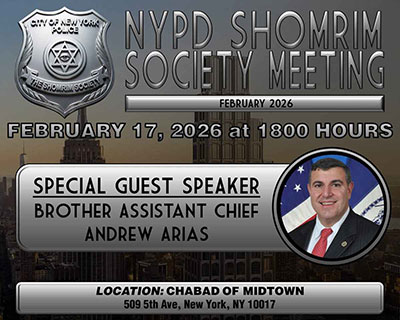
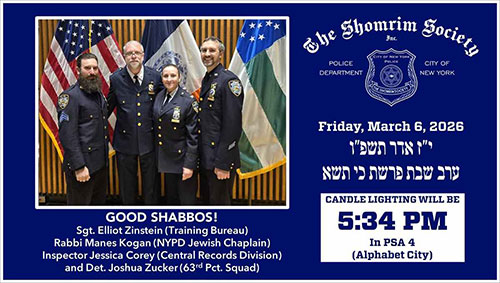
The Shomrim Society is the fraternal organization of Jewish members of the New York City Police Department (NYPD). (It does not refer to civilian neighborhood watch patrols, also known as “Shomrim,” that operate in Brooklyn and other localities; those are separate, volunteer community safety groups and not formally affiliated with the NYPD Shomrim Society discussed here.) The Society was first established in 1924 as a fraternal and charitable organization for Jewish officers of the New York City Police Department. Formed with the approval of then‑Police Commissioner Richard Enright, its creation paralleled similar ethnically or religiously oriented fraternal groups within the department, such as the Knights of Columbus (for Catholic members) and Masonic societies.
At the initial meeting held at Liberty Hall on Houston and Norfolk Streets, approximately 240 Jewish policemen joined the newly formed society out of an NYPD force that at the time included roughly 700 Jewish members, representing only about one percent of total personnel. Lieutenant Jacob Kaminsky was elected the first president, with Sergeant Morris Greenberg as first vice‑president, Patrolman Harry Schreiber as second vice‑president, and Detective Morris Borkim as recording secretary. The Jewish chaplain of the NYPD, Dr. Isidore Frank, announced the society’s formation to the public.
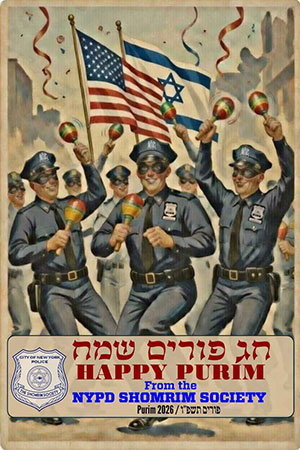
The impetus for the society’s creation reportedly stemmed from both a desire for camaraderie among Jewish officers and the need to foster religious solidarity and mutual support at a time when Jewish law enforcement personnel were a distinct minority in the department. One oft‑recounted anecdote from the group’s history describes how a younger Jewish officer on patrol was told that he “might feel more at home with a salami, rather than a nightstick, under his arm,” a remark that, whether apocryphal or literal, highlighted the social tensions and cultural dissonance some Jewish officers felt in early 20th‑century policing.
From its inception, the Shomrim Society aimed to operate similarly to other fraternal police organizations: promoting welfare, fellowship, and support among Jewish law enforcement officers while integrating them more fully into the broader civic fabric of New York. Its chartered purposes included strengthening religious spirit among Jewish officers, providing a network of mutual assistance, and fostering goodwill both within the NYPD and in the wider community. Early annual reports and society letterhead reportedly bore a mission statement along the lines of “so that Law Enforcement Officers of the Jewish faith may join together for the welfare of all.”
The historical context of its founding is important. In the 1920s, American Jewish communities, particularly immigrant families from Eastern Europe, were achieving increasing presence in public institutions, including law enforcement, but still faced social prejudice and cultural challenges. Within this milieu, a distinct society for Jewish officers provided a forum for professional solidarity and a space to honor religious observances, support one another in times of need, and engage with Jewish communal life more broadly.
During the Great Depression era and into the late 1930s, the Society grew significantly as thousands of Jewish applicants entered the civil service lists to take police exams in pursuit of stable employment. Civil service lists from 1935 to 1937 added approximately 400 new Shomrim members as applicants passed tests and joined the department; around 1939, of the 33,000 applicants who sat for the NYPD entrance exam, about 1,440 passed and roughly one‑third of those were Jewish, numbers that reflect a remarkable increase of Jewish participation in the police force relative to earlier decades. A generation of Jewish officers from that period rose through the ranks, with some achieving senior leadership positions including Chief Inspector, Chief of Detectives, and high command roles in Narcotics and Organized Crime bureaus by the 1960s.
One of the Shomrim Society’s early presidents who gained broader public attention was Max Finkelstein, a longtime captain in the NYPD. In 1938, Mayor Fiorello H. La Guardia selected Finkelstein to lead a special squad tasked with guarding visiting officials from Nazi Germany and the German consulate in New York, at a time of rising global tensions and antisemitic provocations; this appointment underscored not only the competence of Jewish officers but also the growing civic trust placed in them.
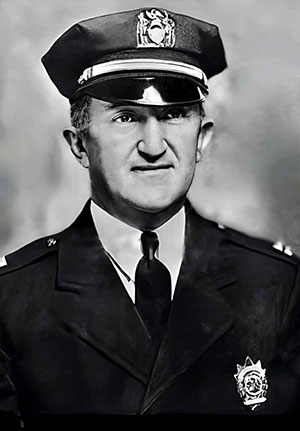
Max Finkelstein (1884-1940) was born in the Russian Empire and emigrated to the United States, where he entered the New York City Police Department on May 29, 1911, beginning what would become a nearly three‑decade career. He rose to the rank of Captain and served with distinction, eventually becoming president of the Shomrim Society, his tenure coinciding with a turbulent era in global and American history, marked by the rise of Nazism in Europe, increasing antisemitism, and profound anxieties within the Jewish community about events abroad and attitudes at home.
Finkelstein became nationally known in 1938 when New York City Mayor Fiorello H. La Guardia appointed him to lead a special NYPD detail charged with safeguarding officials from Nazi Germany who were visiting New York, and with protecting the German consulate and embassy premises. La Guardia’s decision was reported in contemporary news accounts, including The New York Times, which noted that the police detail guarding German officials was composed solely of Jewish officers, a remarkable and provocative arrangement given the regime those officials represented. La Guardia’s motivation for this appointment must be understood in light of his well‑documented opposition to Nazism and antisemitism; he frequently spoke out against Nazi policies, protested violence against Jews in Germany, and worked to broaden diversity in municipal appointments and civil service. In 1937 and 1938, he publicly denounced Nazism, promoted anti‑Nazi events, and supported expanded civil rights in New York more broadly, including for Jewish residents who were alarmed by the rise of fascism abroad.
The reaction to the assignment was polarized. The Nazi press in Germany was incensed; Der Angriff, a Nazi newspaper, published Captain Finkelstein’s photograph on its front page and denounced his appointment as a “provocation,” explicitly framing the decision in deeply antisemitic terms and questioning how Americans would react if Jewish Americans in Germany were to be guarded by black policemen. This outcry reflected the Nazi regime’s broader ideological fixation on racial hierarchy and antisemitic nationalism, and the disproportionate publicity given to the assignment underscored how politically charged the situation was on both sides of the Atlantic.
Within the Jewish community in New York and the United States, La Guardia’s choice was received almost universally as an affirmation of Jewish dignity and a rebuke to the Nazis. Jewish newspapers and communal leaders celebrated the appointment as symbolic resistance to antisemitism; indeed, many saw it as a dramatic repudiation of Nazi ideology on American soil. This broader public reaction should be understood against the backdrop of American Jewish activism against Nazism in the 1930s, which included boycotts of German goods, mass demonstrations, and vocal pressure on political leaders to oppose pro‑Nazi sentiments.
For the general American public, the reaction was more mixed but largely leaned toward admiration for La Guardia’s firmness against antisemitism and far right extremism. Newspapers beyond the Jewish press covered the story in ways that underscored its symbolic significance, with The New York Times reporting the formation of an all-Jewish guard detail for German officials and newspapers across the country following both the initial shock and the sustained commentary. Historians note that such publicity helped discredit pro‑Nazi and antisemitic movements in the U.S., which were active in the late 1930s through organizations like the German‑American Bund, and helped cement New York City’s reputation as a bastion of diverse civic values. (It is difficult not to imagine what the antisemitic Mayor Mandani would have done under similar circumstances.)
Finkelstein’s life after this period took a tragic turn. In 1940, after nearly three decades of “spotless” service with the NYPD, he requested retirement, but was informed that he would be required to face charges related to irregular bail bonds. Before the matter could be resolved, he died by suicide on May 3, 1940 and his funeral was attended by a crowd estimated at 10,000 people, a testament to the deep respect in which he was held in the New York policing community and beyond.
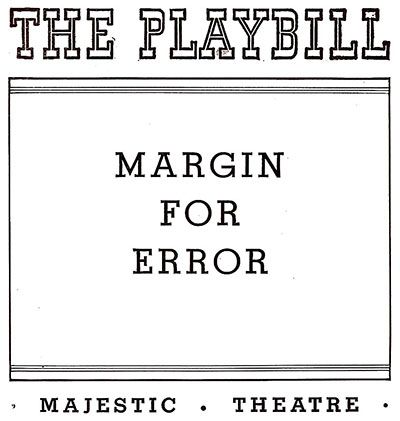
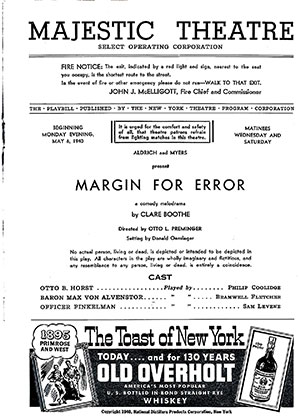
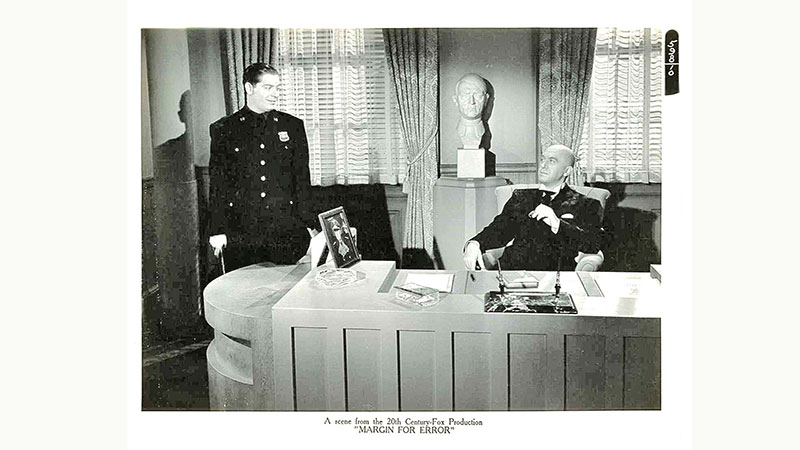
Finkelstein’s experience guarding Nazi officials later inspired a fictionalized character in the 1939 Broadway play Margin for Error and the 1943 film adaptation, where his unique role during a fraught period served as dramatic subject matter. The play was written by Clare Boothe Luce, a prominent American playwright, journalist and later diplomat who was already well known for her 1936 comedy The Women, which had become a major theatrical success. She turned her talents in Margin for Error toward satire and sharp critique of Nazism at a moment when World War II had already begun in Europe and America was debating its own stance toward fascism abroad.
The Broadway production opened on November 3, 1939 at the Plymouth Theatre in New York, where it ultimately ran for 264 performances, a solid commercial run by the standards of the time. Otto Preminger, then a stage actor and director who had recently emigrated from Austria to the United States, directed the production and starred in it as Karl Baumer, the Nazi consul at the center of the story. Following its Broadway success, Preminger also took the play on a national tour in 1940.
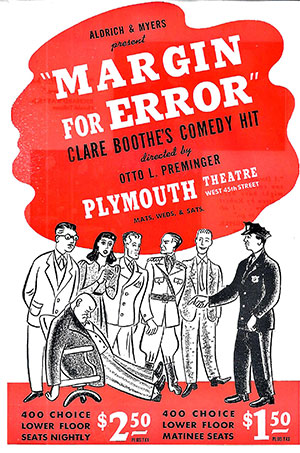
As a Broadway play, Margin for Error was a mystery satire with a definite political edge. The plot centers on a German consul in an unnamed American city, Karl Baumer, whose dubious character – he lies, steals, manipulates and maligns everyone around him – makes him widely disliked. When Baumer is found dead, virtually every person present at the consulate has a motive for murder. Posing as both comic relief and social commentary is Officer Finkelstein, a Jewish policeman assigned by a prankish mayor modeled on real‑life Fiorello La Guardia to guard the consul despite his personal distaste for Nazism. As Finkelstein investigates, each suspect’s motive unfolds, from betrayal of comrades to personal grudges, and the mystery resolves in a twist: the consul’s death turns out to be accidental because he drank poison he had intended for someone else. Along the way, the play skewers Nazi ideology and diplomatic hypocrisy while weaving a detective story that keeps its audience guessing.
Contemporary coverage confirmed that the play’s blend of comedy and political critique was unusual for its time. In Time magazine’s 1939 review, even though Margin for Error included sharp laughs and lively dialogue, it was recognized as one of the first successful anti‑Nazi dramas of that season, breaking a streak of earlier flops in the genre. Reviewers noted that its satirical approach, presenting Hitlerism in an American setting and poking fun at German officials, managed to entertain while carrying an underlying message about democracy versus fascism. Indeed, when the play was still in pre‑Broadway tryouts, the German Embassy in Washington protested to the U.S. State Department that the play was “derogatory” to the Reich, inadvertently giving it free publicity and underscoring the charged political climate in which it premiered.
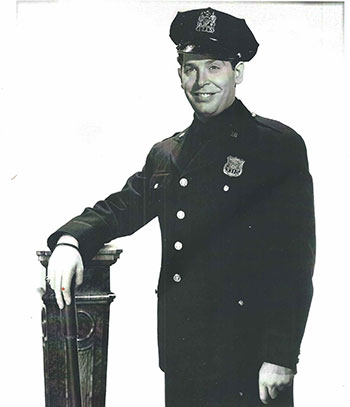
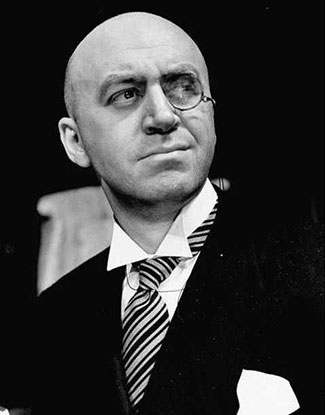
The film adaptation was released in 1943, directed by Preminger, with a screenplay credited to Lillie Hayward and revised by Samuel Fuller (uncredited). It was produced by Ralph Dietrich for 20th Century‑Fox with Preminger also reprising his stage role as Karl Baumer. Comedian Milton Berle starred as Officer “Moe” Finkelstein, and Joan Bennett played Sophie Baumer, the consul’s conflicted wife. Other notable cast members included Carl Esmond as Baron Max von Alvenstor and Howard Freeman as Otto Horst, among an ensemble that supported the film’s blend of mystery, comedy, and wartime messaging.
Where the play functioned primarily as satire and a political whodunit closely reflecting the real‑world tensions of its moment, the film underwent notable changes. Studios purchased the screen rights in 1941, but initially shelved the project; by the time production commenced, the United States had entered World War II and the anti‑Nazi message that was radical in 1939 was by 1942 essentially mainstream wartime propaganda. As a result, the screenplay was updated in tone and structure: the studio removed some of the more overt political scenes (for example, a subplot about rescuing a concentration camp prisoner that appeared in the stage version) and eliminated the character of a Nazi Bund leader present in the play. In the film, the story is recast as a flashback told by Finkelstein (Berle) while he serves as a U.S. soldier, allowing the narrative to serve both as mystery comedy and morale‑boosting wartime entertainment. Preminger and Fuller worked to adapt Luce’s original political statement into a story that would bolster American resolve and reflect ongoing war aims rather than critique fascism from the outside as the play had done.
The plot of the film shares its basic skeleton with the play – Finkelstein is reluctantly assigned to protect a Nazi consul, comes to observe the villainy around him, and discovers multiple suspects with motives for murder – but it introduces additional intrigue and action characteristic of Hollywood storytelling. In the film, Consul Baumer is in trouble with Berlin for embezzling saboteur funds, his wife despises him, his secretary Max is disenchanted with his orders, and a group of German saboteurs are poised to strike an American port. The plot layers murder mystery with espionage, culminating in the sabotage plot’s foiling and the revelation that Baumer died by poisoning intended for another, consistent with the play’s twist but amplified with action elements.
Critical reception of the Broadway production was generally positive. Its 264‑performance run attested to its commercial viability, and reviewers of the time noted its clever dialogue and timely themes, while audiences responded to its combination of entertainment and political urgency. In contrast, the film’s reception was more mixed; contemporary critics such as The New York Times’s Theodore Strauss described it as “painfully dated” by 1943, with much of its anti‑Nazi content feeling like cliché by then because Hollywood had already produced many explicit wartime propaganda films. The Times review suggested that while the Nazis remained villainous, the film’s conventions and characterizations had grown familiar, diluting its impact compared to the stage version’s fresh take years earlier.
Modern reviewers often view Margin for Error as a historical curiosity rather than a cinematic classic. Some appreciate it for its craftsmanship, period value, and especially for Otto Preminger’s early directorial work, which paved the way for his later career as a major Hollywood director. Others criticize the film’s uneven tone, the juxtaposition of comedic elements with serious political themes, and note that it lacks the sharper satirical edge of the original play. As one retrospective review put it, the film’s narrative and comedic choices feel dated and uneven to contemporary audiences, though its historical context as one of the early anti‑Nazi entries in Hollywood’s wartime output gives it specialized interest.
In theatrical history, Margin for Error is often discussed alongside other politically engaged works of the late 1930s and early 1940s, as an example of how Broadway responded to rising global fascism before America’s direct involvement in World War II. While it is not performed nearly as often today as the playwright’s The Women, it remains a subject of study for scholars of American drama and cultural responses to Nazism in the United States. In film history, it is similarly referenced in discussions of early wartime cinema and the evolving role of Hollywood in mobilizing audience sentiment through genre blending, combining comedy, mystery, and political messaging.
Together, the Margin for Error play and film exemplify how a single dramatic premise can be adapted across media to suit shifting cultural moments: the play as pointed stage satire in 1939, and the film as wartime cinematic entertainment and propaganda in 1943. Both versions reflect their eras’ concerns and audiences’ expectations, and their combined legacy offers insight into American cultural production on the eve and in the midst of global conflict.
* * * * *
The Shomrim Society’s acceptance by NYPD authorities and the city government over time was generally positive, reflecting both changing demographics and shifting attitudes within municipal institutions, and the very fact that Commissioner Enright approved its founding and that the Society persisted through decades suggests institutional support. As Jewish officers became more common within the NYPD and advanced in rank, the Society’s profile naturally rose. It did not operate as a political or union group in the modern sense, but rather as a professional and fraternal association, providing networking, mutual aid, and cultural affirmation, and its relationship with department leadership appears to have been cordial overall, even when its members raised concerns about antisemitism or other issues affecting Jewish personnel.
That said, the Society was not immune to controversy. Both in Finkelstein’s era and in later decades, it has on multiple occasions responded to what its members cited as religious discrimination or bias within the NYPD. One well‑documented example comes from 1998, when the Society publicly asserted that antisemitic incidents within the department had been insufficiently addressed by NYPD leadership. That year, Shomrim, then estimated to represent about 2,800 members including active, retired, and civilian personnel, took a more assertive stance in seeking accountability for alleged bias. The catalyst was an investigation involving an NYPD officer named Thomas Pappas, who reportedly admitted to returning solicitation cards with racist and antisemitic messages. Shomrim leaders demanded that Pappas be fired for conduct they considered “unforgivable” for a sworn law enforcement officer, and they further accused the department of proposing to allow him to “retire with benefits” despite the seriousness of the allegations.
Shomrim’s president at the time, Officer Stuart Portner, wrote to Police Commissioner Howard Safir – who was notably the first Jewish individual to serve as NYPD commissioner – expressing that the society was “saddened and angered by the total lack of justice this matter has engendered,” and pressed for “strongest attention” to the case. The NYPD’s deputy commissioner for public information responded that no final departmental action had been taken and that Safir “takes any sort of allegation of discrimination very seriously.” The letter reportedly went unacknowledged at the time, prompting Shomrim to go to the media to raise attention.
In addition to the Pappas case, Shomrim identified other incidents over the preceding years in which Jewish officers allegedly faced anti‑Jewish remarks, including cases where testimony about harassment was apparently not investigated and tensions arose over leave for religious observance days. Officers historically have occasionally requested Sabbath leave or time off for holidays such as Rosh Hashanah or Yom Kippur, and before the NYPD had formal provisions, such requests could be challenging for observant Jews. Rabbi Alvin Kass, the NYPD Shomrim Society’s longtime chaplain, later reported his efforts to ensure policies were implemented allowing officers to observe Saturdays and Jewish holidays without penalty, reflecting institutional change influenced by advocacy tied to the society’s presence.
Shomrim has generally balanced its advocacy with caution about “crying wolf,” as one retired executive secretary explained: new recruits are advised not to declare antisemitism prematurely or without evidence, because once the claim is made and disproven, future bona fide incidents may be harder to substantiate. This reflects a desire to maintain credibility while still pressing for recognition of discriminatory behavior when it genuinely occurs.
The Shomrim Society also engages in a range of benevolent and community activities beyond professional advocacy. According to its current organizational mission, it supports member families through scholarship funds, burial assistance, and various charitable programs. And annual events such as food drives, particularly a Passover distribution named for a former assistant spiritual director, and social gatherings, including family picnics and community outreach, emphasize its dual role as both a fraternal brotherhood and a community‑oriented nonprofit.
Religious and ceremonial life also play a role in the society today. The official website publishes a Shomrim prayer for the protection of law enforcement officers, soldiers of Israel and the United States, and all those who serve, affirming a connection between Jewish identity, service, and faith‑inspired concern for safety and peace. This prayer, while not formal liturgy in the denominational sense, reflects an integration of heritage and vocation that aligns with the Society’s origins.
Membership requirements reflect the organization’s foundational purpose: it is specifically limited to active, retired, auxiliary, and civilian members of the NYPD of the Jewish faith, which distinguishes the fraternal society from other groups with overlapping names or community safety missions. It is incorporated as a non‑profit organization and participates in the National Conference of Shomrim Societies, which connects Jewish law enforcement officers and public safety professionals across the United States. The National Conference, which was formed in 1958 to coordinate communication between local chapters and to support shared goals, now includes societies in roughly twenty cities nationwide, though the New York chapter remains among the most prominent and historically significant.
Quantifying exact membership numbers today is difficult because the NYPD does not officially track the religion of its officers, and data come from the Society’s own estimates rather than municipal statistics. In the late 1990s, the society estimated that Jewish officers made up about three percent of the department, which then had roughly 40,000 sworn personnel, a figure that suggests approximately 1,200 Jewish officers, though including civilian and retired members brought the Society’s total membership into the thousands. The current Society’s membership may include a broader spectrum of NYPD personnel and retirees, but precise contemporary numbers are typically maintained by the organization itself and are not publicly reported in independent sources.
In conclusion, the history of Captain Max Finkelstein’s public assignment in 1938 illustrates both the complexities of American Jewish life on the eve of World War II and the symbolic power of civic institutions to confront discrimination. The Shomrim Society’s ongoing work, whether advocating for fair treatment within the NYPD, supporting members’ religious observances, or engaging with Jewish cultural and charitable life, demonstrates how an enduring professional association can serve as both a voice for its members and a bridge between law enforcement and the communities they protect.