 October 16, 2026
 Categories: Arts
Encounter with an Icon: The One and Only Avraham Fried
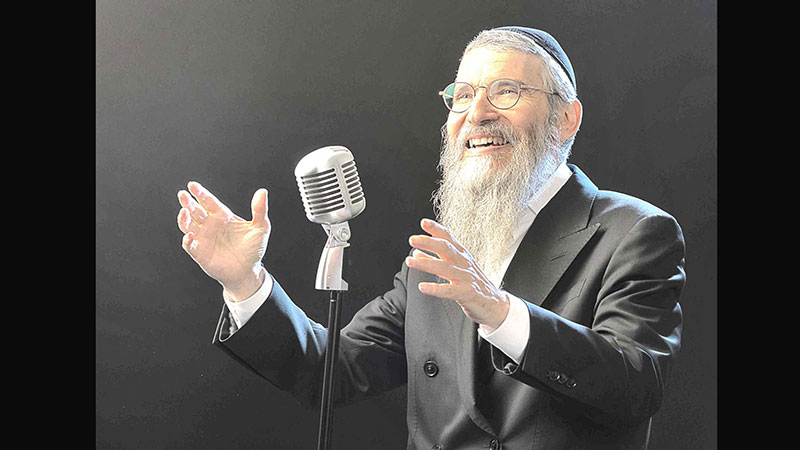


In my old backpack – the one I’ve kept since high school – there is still an old Sony Walkman in the front pocket that my dad bought us, probably from one of his trips to the U.S. And inside it, there’s still an old cassette of Avraham Fried’s album Aderaba, released in 1990.
Avraham Fried’s songs were part of my personal soundtrack – the music I grew up on as a teenager and beyond. Readers of this column already know that I’ve written about his songs in the past. So to be honest, I was both thrilled and a bit nervous when Fried replied to my email agreeing to an interview. I had questions I had been waiting to ask him for years.
And I wasn’t the only one excited. You should have seen the look on my oldest son’s face when I told him I was going to talk with Avraham Fried. He’s been listening to Fried’s music since he was very young, and whenever we drive together, I often put Fried’s albums on. So besides my own list, I also had questions from my son, as well as a Chabad rabbi I know who contributed two questions as well.
“When Melech HaMoshiach comes – very soon, b’ezrat Hashem – what song will accompany him?” I ask him first. “Baruch Haba” or “Anovim?”
“Baruch Haba!” Fried answers immediately, without hesitation. “You can’t sing ‘Ve’im ein atem ma’aminim’ (And if you don’t believe) in front of Moshiach – Moshiach is already here!”
“There are five brachot we will say when Moshiach comes,” Fried added. “And what song will we sing? ‘Baruch Haba’!”
Then, with a smile, he adds: “There’s no competition with Mordechai Ben David. We’re good friends.” He understands my question – “Anovim,” the iconic song composed by Yossi Green, is famously performed by MBD.
“What types of songs do you prefer to perform? Those in major scales (more upbeat and happy) or minor scales (quieter and more touching)?” I ask.
“Music is like colors,” Fried answers. “A single color gets a bit boring. The secret – the most important thing – is to bring out different colors. Don’t stick to just one.”
He notes that while there are happy, upbeat songs in major scales that he loves to perform, Yiddishkeit is deeply rooted in yearning, pleading, and prayer. Deep down, his heart leans more towards these soulful, longing melodies. Still, he emphasizes, there are times when you simply need happy songs.
“I noticed a pattern in your albums,” I mention to him. “In almost every album, at least among the earlier ones from the 90s, there are songs that sound more like chazzanut (cantorial) pieces. For example, ‘Shaavas Einayim’ and ‘Emes’ from the album We Are Ready!; ‘Chavivi,’ ‘Ritzay,’ and ‘Zechor’ from Brocha V’hatzlocha; and ‘Udvorov,’ ‘Tiher,’ ‘Tekah,’ and ‘Adon’ from Chazak! – and more. These are pieces I personally love. Are you also a cantor, in addition to being a singer?”
Hashem gave him the gift, but Fried says he definitely doesn’t consider himself a cantor. He wouldn’t define himself as one because he never had formal cantorial training. Still, he deeply loves chazzanut. “Chazzanut is davening,” he says. “It’s yearning. Take your time. Daven.”
Since he loves chazzanut, his vocal coach suggested including some cantorial elements in his songs. He fell in love with these pieces; as he puts it, they add “another color” to his singing.
Hersh Einhorn helped Fried tremendously with vocal training. When he first started his career, he had what he calls a “baby voice” – that of a young boy. With every new album he released, his voice grew deeper and richer and reached higher notes. He is glad he took that path.
On his very first record, he didn’t really know what singing was, let alone how to perform. He was just a yeshiva student. Today, he knows how to sing, how to structure a song and make it accessible, and how to perform and command a stage.
When he mentions his first album, I tell him about a question I had initially planned to skip, but decided to ask anyway: “You mentioned in an interview in the past that you feel somewhat embarrassed by your early albums, which I could never understand. I have many of your 90s albums on my music player, and they’re fantastic!”
He laughs. “I didn’t mean those albums. I meant my debut album, No Jew Will Be Left Behind.”
To be honest, I wasn’t as familiar with that specific album. I promised Fried I’d give it a listen and let him know what I thought. So I listened.
So to one specific reader, Avraham Fried: That album is great too! Yes, your voice sounds a bit younger and less mature, but not only is it a wonderful album, it turns out I was already familiar with several of the tracks – like “Keil,” “V’koraiv,” and “Ani Maamin.” These songs are absolute cornerstones of Jewish music – classics we all grew up on.
Another question I had been curious about for a long time was regarding the song “Didoh Bei” from the album Chazak!, released in 1997.
Over the years, every time I listened to that album – especially the percussion intro – I’d ask myself: Where did this beat come from? It sounded like a cross between South American Samba rhythms and Mizrahi-style music. Even the guitar solos sounded different, much more powerful. The whole vibe was a clear departure from classical chassidic arrangements. In fact, it sounded more like a track from Fried’s later album, Bring the House Down (released in 2016), which features modern beats rather than just “standard” arrangements.
“Yossi Green composed the song,” Fried explains. “He was doing something new back then – taking lyrics not just from the davening or Tehillim, but directly from the Talmud and Midrash. Songs like ‘Aderaba’ and ‘Tanya’ were part of that movement. Composing words from the Gemara and Midrash was revolutionary at the time, and with ‘Didoh Bei,’ we wanted to bring a fresh vibe that young people could connect with.”
He adds that he approached Bring the House Down with the same mindset years later: a desire to introduce sounds that would resonate with the younger generation.
I then mention my conversation with Yitzy Waldner, whom I had interviewed a few weeks earlier. Yitzy told me how the title track for Bring the House Down came to life, recalling that Fried had told him at the time: “I want the Beit HaMikdash to come down – now! I want the Beit HaMikdash! Let’s bring the House down!”
“Yes,” Fried confirms. “When I finished davening ‘She’yibaneh Beit HaMikdash,’ I thought to myself: We need to bring the Beit HaMikdash down! I sat with Yitzy at his keyboard, exploring different sounds. We started hitting the keys, and suddenly we stumbled upon a sound we both loved. We immediately said: ‘This is it! This will be the sound of the intro!’”
“And now for my favorite question,” I say. “Are the classical arrangements from your classic albums – and those of other giants like MBD – still relevant today amidst all the dance and trance beats? The brass intros, the heavy use of strings and piano throughout, the iconic rock-freilach beats... Is that what defines chassidic music? What is chassidic music at its core? Is it that classic orchestration?”
“I love the freilach beats very much,” Fried replies. “Using modern dance beats stops the simcha. When I create music, I try to keep the flame alive so it sounds genuinely chassidic. But sometimes you have to throw in a bit of a Yetzer Hara (a taste of dance beats, etc.) – just in moderation, though!”
And yes, Fried confirms, those classic freilach beats are chassidic music. “When disco beats first entered chassidic music many years ago, there was some initial criticism, but it was still executed in a distinctly Jewish style. Rhythm itself is part of what defines chassidic music – it needs to maintain the proper tempo and feel of chassidic music. There are boundaries that are better left uncrossed.” He adds that he has no desire or ambition to imitate non-Jewish styles. “When singing words from sacred sources, pairing them with heavy dance and trance beats is an absolute contradiction in terms.”
So what does he think about the recent trend of blending dance and trance beats into chassidic music? “It’s not defined music,” he notes.
(A personal note: I couldn’t have been happier to hear from Avraham Fried himself that he fully agrees with me on this topic.)
“One of the things I love most about your music is when I play it in the car, my older kid will suddenly ask a question about a song,” I tell him. “I can pause the track, discuss the lyrics with him – whether it’s ‘Yochid V’rabim,’ ‘Tiher,’ ‘Shtar Hatno’im,’ or ‘Tania’ – give him a Dvar Torah based on the text, and then resume playing it.”
“Is that part of your consideration when picking words for a song, or do you just happen to like the text? In other words, do you actively intend to educate through your music?”
“It is entirely intentional,” Fried answers. “That’s the main purpose.”
And then he gave me a bit of an exclusive scoop: He is currently working on a new album.
“In the new album I’m currently working on,” Fried shares, “there’s a song with a very powerful message – that at the end of the day, we are mere flesh and blood – the smallest of the small. Yet, we have the unique power to bring immense satisfaction to Hashem – the Greatest of the Great – through Torah and mitzvot.”
He is always searching for messages that will make his listeners think and spark an awakening – songs where people say, “What a powerful message!” much like “Aderaba” or “Tania.”
As he puts it, he is constantly looking for “shir im shiur” (a song with a lesson) – a phrase that carries a poetic ring in its original Hebrew.
In recent years, Fried has embraced a distinct Israeli chapter in his career – spanning the classic hit “She’Hashemesh Ta’avor Alai,” The Israeli Album, and an unexpected, high-profile collaboration with Israeli rock artist Aviv Gefen.
“How did that whole direction open up?” I ask him.
“Pure Hashgacha Pratit – Divine Providence,” Fried responds simply. “I don’t even know how to explain it.”
He pauses to reflect on his deep, ongoing connection with the Israeli audience. While he resides in Brooklyn, his career is largely centered in the Holy Land. “Surprisingly, most of my performances over the years are in Eretz Yisrael. I spend a tremendous amount of time there.”
The turning point came after the massive success of “Aleh Katan,” composed by Ishay Lapidot. “After that song took off, people kept coming up to me saying: ‘Why not do more Israeli songs? Most of your listeners are in Israel anyway.’” That momentum led his musical director, Yuval Stupel, to orchestrate the legendary shidduch with Aviv Gefen, alongside other Israeli artists.
For Fried, the unexpected pairing with Gefen wasn’t just a musical experiment. “People, especially secular Israelis, often tell me that duet created a genuine Kiddush Hashem,” he says. “It added another color to my palette. But make no mistake: I never forget for a moment that I am a chassidic singer, not an Israeli pop star. If someone wants Israeli, chassidic, Yiddish, or Chabad – it’s all there. The entire spectrum.”
That spectrum extends to one of his most deeply personal projects: the double album Otzrot Yehudim (Yiddish Gems 1 and Hebrew Gems 2), featuring the narrative-driven compositions of the legendary Rabbi Yom-Tov Ehrlich.
Fried shares that he frequently encounters people who have drifted from a religious lifestyle, yet admit that these songs remain their last tether to Judaism – most notably Ehrlich’s masterpiece, “Kol Nidrei,” the moving narrative about the chazzan from Odessa.
Then Fried shares a striking story. A few years ago in California, he met a man who opened up about his past: He had been deeply involved with a non-Jewish woman and was on the verge of marrying her. Someone played him Fried’s rendition of Ehrlich’s famous song “Yaakov,” which tells the agonizing story of mesirat nefesh and the struggle to preserve Jewish identity against assimilation.
The song struck a nerve. Deeply shaken by its message, the man broke off the relationship. Years later, he was fully observant, married to a Jewish woman, and raising Jewish children.
How He Started: Early Influences & Inspiration
I then ask Fried to take me back to where it all began.
“I started singing as a child,” Fried shares. “I had a very strong, high-pitched voice.” As a young student at the Oholei Torah yeshiva, he served as a soloist in a kids’ choir directed by Eli Lipsker until the age of 13. They toured across the United States, from Minnesota to Florida to California, singing Chabad niggunim.
“Then, around age 13, my voice changed to an adult’s, and I stopped singing altogether. I spent my years in yeshiva with no real plans to become a professional singer.”
It wasn’t until he turned 20 that the desire to sing resurfaced. “At that time, I was deeply influenced by the teachings of the Lubavitcher Rebbe about what a Jew is, and what a soul is. I decided to incorporate those messages into singing,” he explains.
The core message that resonated most with him was one the Rebbe reiterated frequently: No Jew should be left behind.
“That concept inspired my very first album, No Jew Will Be Left Behind,” Fried reflects. “How can there be a complete Redemption if even a single Jew is missing? It’s like a puzzle – it remains incomplete if a single piece is missing.” The theme of Moshiach became a central pillar in his career precisely because of the Rebbe’s constant emphasis on anticipating his arrival. It was the Rebbe’s profound influence that ultimately inspired him to sing so extensively about Moshiach.
As a boy, Fried loved the Yiddish compositions of Rabbi Yom-Tov Ehrlich – songs he would eventually record himself decades later in both Yiddish and Hebrew. As he grew older, he began listening to this one singer – a guy named Mordechai Ben David – who left a profound mark on his style. But as a teenager, his absolute favorite albums were those of David Werdyger (father of MBD).
“I learned many of the classic court melodies – from Bobov, Nadvorna, and Skulener – from David Werdyger’s records,” Fried recalls. He also listened to Ben Zion Shenker and Rabbi Shlomo Carlebach, as well as the legendary Sephardic vocalist Joe Amar, admiring his vocal agility and traditional ornamentation (sulsulim). In New York, he tuned into Art Raymond’s daily Jewish radio show, discovering artists like Yehoram Gaon, Ran Eliran, and famous chazzanim.
The pivotal turning point in Fried’s career arrived when Divine Providence had him cross paths with Sheya Mendlowitz, a”h,a legendary visionary in the Orthodox music industry.
“Sheya was well ahead of his time,” Fried says warmly. “He elevated chassidic music from the ground up to the sky. He was the one who pioneered the monumental HASC concerts, bringing chassidic music to elite venues in Manhattan.”
When 20-year-old Fried decided to dip his toes back into music, he sent demo recordings to several producers. Mendlowitz listened and immediately recognized something special. “I hear something in your voice,” he told young Fried. “Let’s work together.”
That partnership would span over ten albums. It was Mendlowitz who introduced Fried to composer Yossi Green – initiating a career-long collaboration – and later to master arranger Moshe Laufer.
“Looking back at timeless hits like “Keitzad” (from Aderaba, 1998) or “Ein Od Milvado” (from Avinu Malkeinu, 2002) – what is the formula for a song that continues to be played at weddings 20-plus years later?” I ask.
(Side note to readers: Ever wondered what the rapid intro spoken at the very beginning of “Ein Od Milvado” is? It’s Yiddish: “S’is doch alles hevel havalim” – It’s all ultimately vanity of vanities!)
“I only record a song if it speaks to me directly,” Fried explains. “If it touches me, I feel I can perform it well, and hopefully the audience will connect with it too. Baruch Hashem, Hashem gives me Siyata d’Shmaya that many tracks have stayed alive for over 30 years.”
Yet predicting hits is an imprecise science. “There were songs I was convinced would be huge hits that didn’t take off as expected – like ‘Otzar Shel Yirat Shamayim,’” Fried admits. “On the flip side, I never anticipated that ‘Abba’ would become such an extraordinary, historic hit worldwide – even attracting attention from non-Jewish listeners on YouTube! Nor did I expect the live orchestral version of ‘Shalom Aleichem’ with the [Israel] Symphony Orchestra to resonate so deeply.”
Two years ago, Fried released a songbook for children titled Avraham Fried: I Sing (Ani Shar), re-recording classic children’s melodies. “The reaction from kids has been phenomenal – it became a total sensation.”
Before wrapping up our interview, I posed a few questions to Fried submitted by my friends and family.
Question from my eldest son, Dan:
“How did you become famous? When you first started, did you know you’d become this famous?”
“If you have good material, word of mouth takes over,” Fried answers. “One person asks another, ‘Did you hear Fried’s new song? It’s good!’ and it spreads from there.”
“As for my own career, I never imagined I’d become famous,” he reflects candidly. “My dream was simply to stand on a stage and perform for an audience – and even that felt almost unimaginable. I was always very shy. Shy, but perform in front of thousands. To this day, I still find it hard to believe I do this! I honestly don’t know where I find the courage to perform in front of thousands, hundreds, or even a minyan. It’s never something I take for granted.”
Question from a local Chabad rabbi: “What was your most inspiring moment?”
“I am occasionally privileged to visit young children and youths in hospitals who are in dire need of Heavenly mercy and healing,” Fried shares quietly. “There have been times when, Baruch Hashem, those children recovered, and years later, I was privileged to sing at their weddings. To see someone who was gravely ill as a child now healthy, standing under the chuppah, and to sing for them... those are truly the most inspiring moments.”
And a follow-up from the rabbi: “What specific guidance did you receive from the [Lubavitcher] Rebbe regarding your career?”
“There was no explicit instruction specifically about the mechanics of singing,” Fried says. “Instead, there were guidelines like giving tzedakah before and after a concert, and printing a notice on album covers stating that the recordings should not be played on Shabbat or Yom Tov.”
To this day, Fried brings a tzedakah pushka to every performance. “Sometimes, if I accidentally leave the pushka in the dressing room during a show, people actually ask me where it is!” he smiles. “The Rebbe taught me to say a prayer before stepping onto the stage, and to offer thanks to Hashem the moment I step off.”
As we begin wrapping up our WhatsApp video call, I can’t help but reflect on my own journey – from a teenage boy listening to a worn-out cassette of “Aderaba” on a Walkman to talking face-to-face through a phone screen with the icon himself.
Through four decades of evolving trends, shifting beats, and massive musical transformations, Avraham Fried remains anchored to his core purpose: bringing a message, sparking an awakening, and ensuring that no Jew is left behind.