 October 23, 2026
 Categories: Arts
In the Mood for Chazzanut: Cantor Yaakov Motzen


It’s that time of year again. You start to feel the kedusha in the air. The days are getting shorter, summer is almost over, and the upcoming Yomim Noraim are right around the corner. You can already sense it through the smells, the special foods, and, of course, the soulful melodies of the tefillot.
It’s Elul. As the new month begins, it serves as a gentle reminder of the High Holidays ahead. And just like last year, we are excited to launch our annual chazzanut series.
To open this year’s series, I had the privilege of speaking with one of the greatest cantors in the field – someone with a career spanning more than 50 years. I remember hearing his name when I was younger, so interviewing Cantor Yaakov Motzen was truly a special experience.
Cantor Motzen’s father was himself a devout baal tefillah. When Motzen began his career as a chazzan at just 17 years old, his father gave him a piece of advice that stayed with him forever: “If you aren’t a baal tefillah first, you won’t be a cantor either.” To this day, Motzen continues to pass this foundational message on to young cantors: First, learn how to daven.
Hungarian cantors were known to be, above all, true baalei tefillah. The yesod tefillati, the authentic foundation of prayer, was deeply rooted in their tradition, making them among the finest in the Jewish world. Cantor Motzen comes from this rich heritage; his grandfather was a shochet and a renowned baal tefillah as well.
Motzen has performed alongside the greatest cantors of the past generation. In 1980, he even brought Cantor David Kusevitsky to daven with him in Montreal.
Today, he observes, not all cantors place the necessary emphasis on tefillah – many focus primarily on the bombastic, theatrical elements of chazzanut. He shared a fascinating personal habit: Back when he used to go listen to legendary cantors like Kusevitsky, he would first daven early at the Netz (hashkama) minyan, so he could really daven, and only then would he come to hear the chazzanut “concert.”
In his view, chazzanut consisting solely of cantorial pieces – without the tefillah – fails to fulfill the cantor’s duty to the tzibbur.
When I asked him why there are almost no permanent cantors in synagogues nowadays, he explained that it reflects a broader generational shift. The problem, Motzen says, is that today, people don’t have the patience to sit through a service for a few hours.
Those who heard chazzanut 20 years ago were still hearing the tail end of the previous generation, he noted. The current generation simply lacks patience – and it has nothing to do with the music itself. Life moves at a relentless pace today. “How many young people today listen to classical music?” he challenged.
Roughly 65 years ago, Tel Aviv alone boasted 16 permanent cantors, including icons like Cantors Benjamin Ungar, Yitzhak Eshel, Moshe Taube, and Kurzweil. Today, there are virtually none. Some synagogues, Motzen laments, have turned into social clubs where people come mostly to chat.
His own love for music began at home. From his mother, he gained an appreciation for classical music as well as chazzanut. In fact, she knew her husband’s nusach tefillah completely by heart.
Motzen grew up in a dati-leumi (Modern Orthodox) home but attended haredi yeshivas. His musical journey started early: By third grade, he was already singing in the school choir, and by age nine or ten, he was performing alongside his father during the High Holidays, when his father would step before the amud. As a child, he also learned to play the accordion and read notes.
Around age ten, he became close to the Modzitzer Rebbe, the Imrei Aish, zt”l. By 16, he was traveling to daven for the High Holidays with the Rebbe, who was himself an extraordinary baal tefillah. There, Motzen learned the hasidic nusach and essentially became a Modzitzer chassid. At 17, he went to learn at the prestigious Ponevezh Yeshiva and simultaneously began studying under Cantor Yitzhak Eshel. For seven years, he would travel an hour each way every week from Ponevezh just to take lessons with him.
At 18, Motzen got his first job as second cantor at the Great Synagogue Ein Yaakov in Givatayim. At that time, he used to daven at Shikun Vatikim in Ramat Gan, a place frequented by prominent politicians from the Herut party, as well as the famous poet Uri Zvi Greenberg. Years later, Motzen was invited to be the cantor at the wedding of Uri Zvi Greenberg’s daughter.
After getting married at 23, he became the chief cantor of Givatayim, leading the services for the High Holidays as well. In 1976, he was appointed chief cantor of the Great Synagogue of Ramat Gan. Two years later, in 1978, his international career took off when he moved to Montreal to serve at Congregation Shomrim Laboker, and later at Adath Israel.
In 1996, Motzen moved from Montreal to Toronto to serve at the Shaarei Shomayim Congregation. A decade later, in 2006, he relocated to Miami to become the cantor at The Shul of Bal Harbour, where he served for 14 years (succeeding Cantor Yitzhak Meir Helfgot).
There is a wonderful story behind his appointment in Miami. Four years before taking the job, Motzen had come to Bal Harbour for an interview. At the time, he wore a styled French beard. The rabbi of The Shul, Rabbi Sholom Lipskar, gently informed him that since it was a Chabad synagogue, he would need a full beard to get the position. Motzen dryly replied: “Is the Rabbi looking for a chazzan or a zakan (a beard)?”
When he returned to Bal Harbour four years later, Motzen went to consult with the Modzitzer Rebbe beforehand on whether to accept the position. Rabbi Lipskar urged him, “Can you also ask the Rebbe about the beard?” The Rebbe instructed him simply to fill in the French beard and it would resolve the problem. Motzen lived by a strict personal rule: If he asked the Rebbe for guidance, he was fully committed to following that advice unconditionally. The Rebbe said to fill the beard – and to this day, Motzen still has a beard, as he continues to daven for congregations during the High Holidays as a freelance cantor.
When setting new melodies to various parts of the High Holiday service, Motzen always ensures a deep thematic connection to the words. For instance, during the poignant text of Ezkera Elokim V’ehemaya, he intentionally incorporates the melody of “Im Eshkachech.”
The vast majority of his nusach was passed down from his father and grandfather. In fact, his father recorded the entire High Holiday nusach – a legacy Motzen studied meticulously alongside his formal training under Cantor Yitzhak Eshel.
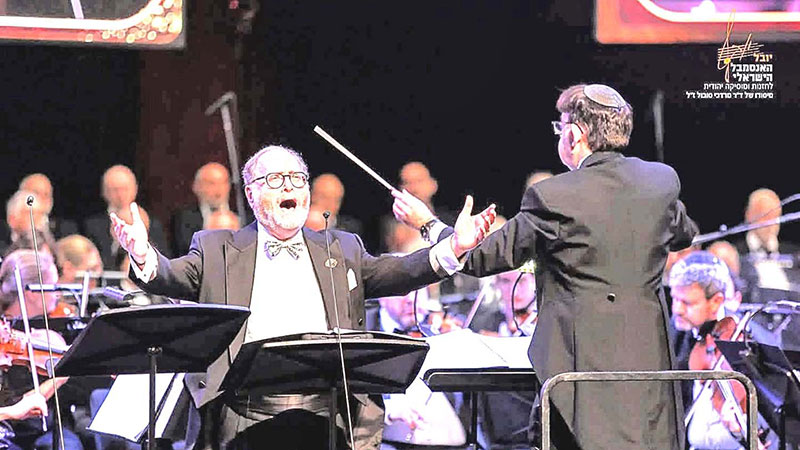
Motzen began performing in concerts at a remarkably young age, around 17 or 18. About 40 years ago, he joined the prestigious Yuval Ensemble for cantorial and Jewish music, founded by the late Dr. Mordechai Sobol. Even now, he continues to perform under the baton of Dr. Sobol’s son, Ofir Sobol, marking four decades of collaboration with the Yuval Ensemble.
Over the years, he has performed in concerts in Israel, the U.S., and Europe. Notably, he was among the pioneers who participated in the historic first cantorial tour behind the Iron Curtain in 1987-88, organized by the late Chaim Wiener, z”l (father-in-law of Cantor Netanel Hershtik), which traveled through Romania and the Soviet Union.
Beginning in the 1970s, Motzen also performed in several concerts in Israel alongside hasidic music legend Mordechai Ben David (MBD). He even had the unique privilege of performing with MBD’s father, the iconic Cantor David Werdyger, z”l, during one of his visits to Israel.
Tragic loss has also shaped his art. When his brother fell in the First Lebanon War, Motzen composed the moving piece “Harninu Goyim Amo” during the shiva. A few years later, during a live performance, he improvised and composed the intricate cantorial section of the piece on the spot.
When asked how he prepares for the High Holidays, Motzen is uncompromising: There is no such thing as stepping up to the amud without reviewing the nusach from start to finish every single year – even after nearly 58 years of leading services. Reviewing the text means delving into the meaning of the words, not just rehearsing the music.
This was the standard set by his father. Before Motzen stood before the amud for the very first time at age 18, he had reviewed the service 500 to 600 times. He made good use of his time, practicing during his 90-minute commute to his lessons with Cantor Eshel.
How do we get the younger generation to connect to chazzanut? I asked him.
For Motzen, the answer lies in his personal example. He fell in love with chazzanut because his father took him to hear cantors from an early age. Whenever a great cantor came to Tel Aviv, his father made sure they went to listen, regardless of the ticket cost. He heard legends like Yaakov Barkin, Sholem Katz, and Samuel Ganshof.
Later in life, Motzen actually performed alongside Ganshof at his synagogue in Montreal. Ganshof had first heard the 18-year-old Motzen sing his own composition, “Ata Nigleita,” during a visit to Israel, and was deeply impressed. On another occasion, when Ganshof traveled to Haifa to daven, he invited young Motzen to join him as his assistant.
From Ganshof and his father, Motzen learned a vital lesson: Don’t be a “record-player cantor.” Be a true baal tefillah. There is a stark difference between a concert performance and a prayer service. A baal tefillah takes true ownership of the prayer. While a studio recording sounds like a polished album, prayer in a synagogue needs to sound like tefillah.
Ultimately, Motzen believes that connecting youth to chazzanut comes down to the home. The father must set the example by not talking during tefillah and making sure to go to synagogues where people do not talk during davening. If a parent truly loves chazzanut, his children will absorb that love naturally. If, at home, parents listen to chazzanut, the children may also come to love it.
Today, Cantor Motzen stands as a unique treasure in the cantorial world – a bridge between a bygone golden era and the present day. Motzen notes that the kind of old school cantor he styles himself as is rapidly vanishing in today’s world. There are better ones, and there are lesser ones – but none quite like him.