October 2, 2026
 Categories: Halacha & Hashkafa / Torah
From the Mundane to the Sacred (Part IV)


In the previous articles, we followed animal hide as it began its transformation into klaf. We saw that halacha governs not only what species the hide may come from and how it is processed, but even the intention with which that processing is performed. By the time the parchment reaches the sofer, a great deal has already happened.
But anyone who spends time around sofrim quickly discovers another fact: not all klaf is the same.
Is Some Klaf Better than Others?
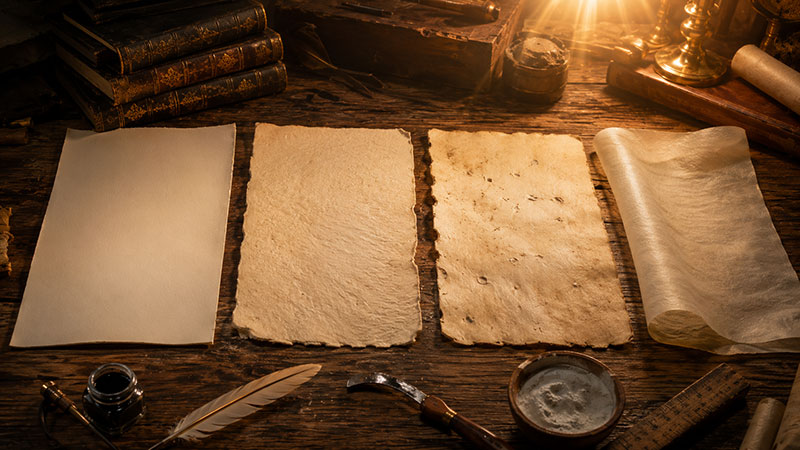
Two sheets may both be completely kosher and yet be very different to write upon. They can differ in thickness, smoothness, flexibility, uniformity, natural markings, and the number of imperfections in the hide. Some of these differences have direct halachic consequences. Others affect the beauty or durability of the finished writing. And some qualities are actually identified by later authorities as hiddurim.
The most basic requirement is that the klaf provide a proper surface for the letters. The Shulchan Aruch rules that the parchment should be whole, without a hole that causes the ink to break so that the letter appears divided. This is connected to the fundamental requirement that the letters of STaM have their proper form and be properly surrounded by parchment. A small natural imperfection is therefore not necessarily a problem, but the location and size of a defect can become extremely important when a letter is written over it (Shulchan Aruch, Orach Chaim 32:13).
Thickness is another example where “better” does not simply mean thicker or thinner. Different jobs require different parchment. The Shulchan Aruch records an intriguing practice among especially meticulous sofrim writing the four parshiyos of the tefillin shel rosh. Because the four passages contain different amounts of text, they would deliberately use parchment of different thicknesses: thicker klaf for the shorter Shema, somewhat thinner parchment for Vehayah im shamoa, and very thin parchment for the longer passages. The purpose was for the four compartments of the tefillin to be filled evenly, which the Shulchan Aruch calls “noi tefillin,” a beautification of the tefillin (Orach Chaim 32:14).
There is also a fascinating discussion about the animal from which the parchment originates. Fundamentally, STaM may be written on the hide of a kosher species even if that particular animal was a neveilah or treifah. Yet the Keset HaSofer records a hierarchy of preferable hides. Most strikingly, he writes that or shlil, hide from an unborn animal, is valid for Sifrei Torah, tefillin, and mezuzos and calls it “hamuvchar,” the preferred type. He then lists bird skin, wild-animal skin, ordinary domesticated-animal skin, and finally hide from an animal that died without shechitah (Keset HaSofer 2:1).
This preference for shlil is not merely a modern parchment manufacturer’s advertising claim. The Biur Halachah also records earlier sources that regard it as especially choice. Different explanations are offered for its advantage, including that the animal had not yet emerged into ordinary worldly life. Whatever the deeper explanation, the important point is that the language of muvchar regarding parchment has genuine halachic roots.
At the same time, we should be careful not to confuse a hiddur with basic kashrus. A beautifully smooth sheet of klaf is not automatically more kosher than a less attractive one. Likewise, white parchment is not inherently superior simply because it looks cleaner. The Keset HaSofer discusses the historical practice of coating parchment with a white substance to make it exceptionally smooth and bright. Some authorities permitted this, while others objected that the coating might form an intervening layer between the ink and the actual klaf. He therefore recommends being stringent (Keset HaSofer 2:12).
That case teaches an important lesson. Sometimes an attempt to make parchment look better can create a halachic question. In STaM, aesthetics must operate within halacha, not replace it.
There is also the perspective of the sofer himself. A uniform, well-prepared writing surface gives the sofer greater control over his quill. The Shulchan Aruch tells the sofer to produce a kesivah tamah, complete and careful writing, and even recommends writing somewhat boldly so that the letters will not quickly fade. The better the surface responds to the hand of the sofer, the easier it is for him to consistently form beautiful, durable letters. (Orach Chaim 32:4)
So, when someone asks whether one klaf is “better” than another, the right answer is: better in what sense?
One parchment may have fewer defects. Another may be better suited to very small writing. Another may come from a type of hide identified by the poskim as muvchar. Still another may simply have a texture that allows a particular sofer to produce his finest work.
The klaf does not replace the skill or yiras Shamayim of the sofer. But neither is it merely a blank background.
The Torah's letters will spend decades, and sometimes centuries, sitting upon that surface.
It makes sense to care what lies beneath them.