 November 6, 2026
Categories: Arts
The SHIR’s Letter of Recommendation for a Budding Talmid Chacham
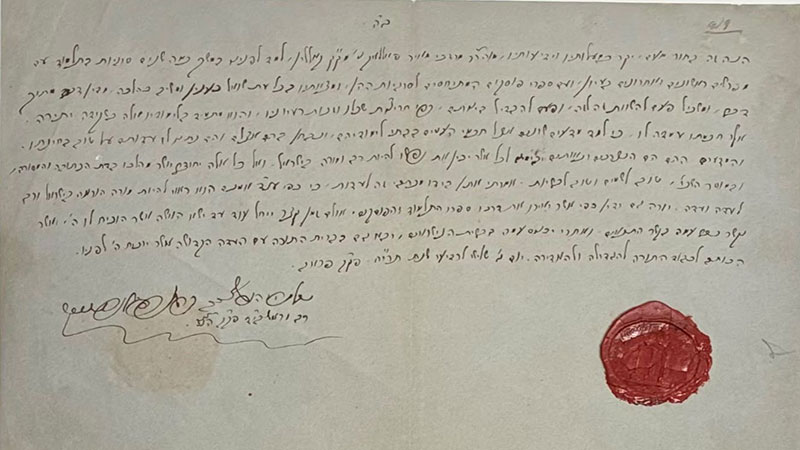


An extraordinary handwritten rabbinic credential signed by Rabbi Shlomo Yehudah Rapoport, best known as SHIR, that I acquired recently offers a rare glimpse into the qualities that one of nineteenth-century Europe's most distinguished rabbis believed were essential for the next generation of Jewish leadership.
In the middle of the nineteenth century, European Jewry was undergoing profound change. The old Jewish world remained firmly rooted in Torah and tradition, but a new age had arrived. Universities were opening their doors to Jews, secular education was becoming increasingly accessible, and Jewish communities were confronting new professions, new political institutions and new intellectual currents. The rabbi of the future therefore faced a delicate challenge: How could he engage with the changing world without surrendering the Torah values and traditions that had sustained Jewish life for generations? This letter provides a remarkably intimate answer. It is an autograph letter of Rabbi Shlomo Yehudah Rapoport (1790-1867), better known by his acronym SHIR, Chief Rabbi of Prague and one of the outstanding rabbinic scholars of nineteenth-century Europe. Written in 1857-58, the document constitutes a recommendation and semichah for a young scholar named Rabbi Mordechai Meir Pollak. SHIR's words reveal precisely what he was looking for in a rabbi who would serve Jewish communities in a rapidly changing Europe.

SHIR praises the young Mordechai Meir Pollak for his accomplishments in Torah study and, significantly, for his ability to render halachic decisions. He specifically calls attention to Pollak's secular education. The young scholar had studied the sciences, had been formally examined in those subjects and had received favorable certification. SHIR considered this education valuable for someone preparing himself to become “a rabbi and teacher in Israel.” That qualification is striking. Here was one of the leading rabbis of his generation explicitly recognizing the usefulness of secular knowledge. But SHIR's letter also makes clear that such knowledge could never replace the foundation upon which rabbinic leadership rested. What mattered most was Pollak's character and his unwavering adherence to both the written and transmitted Torah; the combination was essential. The ideal rabbi, as portrayed by SHIR, was not someone who chose between Torah and the wider intellectual world. He was a Torah scholar first and foremost, thoroughly competent in halacha and hora'ah, but also capable of understanding the intellectual environment in which his community lived. For a Jewish community entering modern Europe, this was a powerful model of leadership.
The letter becomes even more poignant toward its conclusion. Pollak was preparing to marry, and SHIR refers to the impending wedding. He expresses the hope that after entering the covenant of marriage, Pollak would also enter “the covenant of Torah” with the holy community that Heaven would designate for him. The words were more than a formal rabbinic blessing, for they proved remarkably prescient. Pollak did indeed marry shortly afterward, during the winter of 5619, and began his rabbinic career in Weisskirchen (Hranice). He would subsequently serve as rabbi of Holešov and ultimately as a dayan in Vienna. The young man whose future was still being imagined in SHIR's letter would go on to build precisely the kind of rabbinic career that the great Prague scholar envisioned. What had been written as a hopeful blessing became, in retrospect, an extraordinary prediction of the path Pollak would follow.
The man signing the document was himself uniquely positioned to understand the challenges facing Jewish leadership. Rabbi Shlomo Yehudah Rapoport was born in 1790 and became one of the most prominent rabbinic scholars of his era. He eventually served as Chief Rabbi of Prague, but his intellectual interests extended far beyond the traditional boundaries of rabbinic scholarship. He was an important figure in Wissenschaft des Judentums, the nineteenth-century scholarly study of Jewish history, literature and civilization. SHIR's own career therefore embodied, in a sense, the synthesis reflected in this letter: deep commitment to Torah alongside engagement with the broader world of scholarship. That makes his recommendation of Pollak particularly meaningful. This was not simply an older rabbi praising a promising student. It was a major rabbinic authority articulating a philosophy of leadership at a moment when European Jewish society was changing at extraordinary speed. The rabbi, in SHIR's conception, needed to be sufficiently learned to lead according to halacha, sufficiently educated to understand the world in which his congregants lived, and sufficiently anchored in tradition that the winds of intellectual change would not carry him away from the Torah.
Adding another fascinating dimension to the document is a second certification written beneath SHIR's recommendation. It was signed by Rabbi Abraham Placzek (1799–1884), Rabbi of Boskowitz and Landesrabbiner (Chief Rabbi) of Moravia. Placzek identifies Pollak as an outstanding and educated young man and adds his own endorsement to SHIR's recommendation. Placzek was himself one of the leading rabbinic figures of Moravia. A government assessment from 1851 described him as a Talmudist “without equal in Moravia,” while under his leadership Boskowitz became an important center of Jewish learning. A contemporary observer went so far as to describe its yeshiva as “a yeshiva of the modern age,” essentially a rabbinical seminary in miniature. The document therefore brings together several important strands of nineteenth-century Moravian and Bohemian Jewish life: the established rabbinic authority of Prague, the distinguished Landesrabbiner of Moravia, and the young scholar whose career was about to begin. Their signatures transform what might otherwise have been a routine credential into a remarkable snapshot of rabbinic networks and Jewish leadership in Central Europe.