


 November 20, 2026
Categories: Headline / Front Page / News Briefs
Election Day Exclusive: The J.D. Vance Dilemma
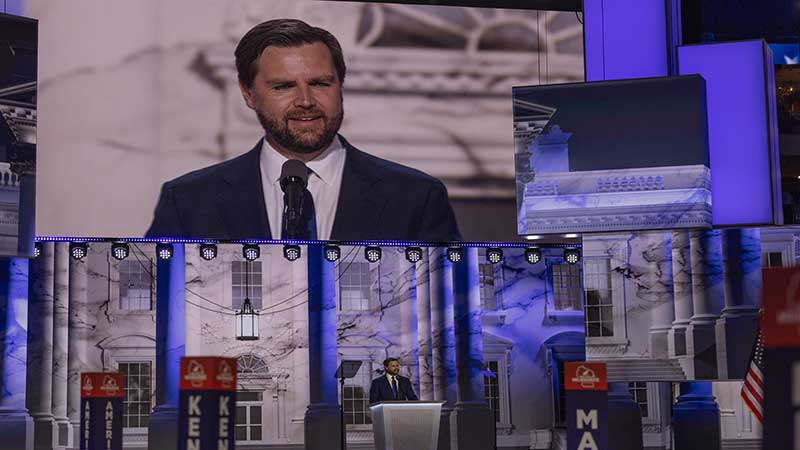


Editor’s note: This article was written prior to Tuesday’s elections.
It is no secret that conservative Jews in America have been feeling anxious about some of Vice President J.D. Vance’s recent statements about Israel and his questionable affiliations. His concerning comments include: (i) the assertion that members of Israel’s government have, “beyond a shadow of a doubt,” tried to derail U.S. negotiations with Iran; (ii) his statement that Israeli cabinet members should be careful not to attack the current American administration, considering that the U.S. is “the only powerful ally” that Israel has left in the world; and (iii) his claim that the Trump administration is the first to stand up to Israel in forty years.
Aside from the fact that these claims are demonstrably misleading – there is no evidence that any Israeli cabinet members tried to derail American-Iranian negotiations, America is certainly not Israel’s only powerful ally, and the Trump administration has been more aligned with Israel than any other U.S. administration since the founding of the modern State of Israel – these assertions also play into the dangerous and increasingly popular antisemitic trope coming from the alt-right that America is, or has been, controlled by Jews or Israel. The fact that Vance has also acknowledged being a close friend of Tucker Carlson, the spiritual patriarch of today’s alt-right and one of America’s most prominent antisemites, only deepens the concerns of American Jewish Republicans about the prospect of a Vance presidency.
However, as political thinker and national conservatism’s intellectual architect (and my former employer) Yoram Hazony has pointed out, the odds strongly favor J.D. Vance becoming the Republican nominee for president in 2028. While Trump has yet to officially endorse Vance, he has said that Vance will most likely succeed him, and has reportedly told donors privately that they need to get Vance elected. Even Marco Rubio, whom most Jewish Republicans would prefer as the nominee, has publicly stated that he will not run if Vance does.
Hazony adds that the nationalist-conservative camp, which Vance represents, is the most popular conservative brand in America today. Hazony estimates that NatCons represent around 65% of the Republican base, while neoconservatives represented by the likes of Ted Cruz and Nikki Haley comprise approximately 25%. Finally, the alt-right, in Hazony’s estimation, makes up about 10% of the Republican voter base.
Hazony’s point is simple: The immediate future of the Republican Party lies with national conservatism, and the politically expedient choice for conservative Jews in America is therefore to throw their support behind Vance.
Unfortunately, as Hazony and a number of political thinkers sympathetic to the Jewish cause have lamented, Jews have rarely demonstrated much political astuteness throughout history. Leo Strauss, Irving Kristol, and Ruth Wisse have all discussed how Enlightenment-era Jewry naively embraced the utopian promises of the secular state as a safe haven, while ignoring the enduring tribalistic nature of nations. This failure to recognize political realities ultimately left Jews vulnerable to the betrayal of the very nations in which they sought refuge. Wisse describes how Jews sought protection through private arrangements with political leaders, only to have those promises broken when they no longer served the interests of the governing power.
Both Kristol and Wisse have attributed Jewish political ineptitude to a history of exclusion from the political arena in the Diaspora. For Kristol, this helps explain the Jewish tendency to align with liberalism; as a persecuted people, Jews gravitated toward the promise of “tolerance” offered by liberalism.
While there is no question that the Jewish people have often behaved foolishly in politics, and much of this has to do with the trauma of a people that has rarely experienced political rights or power, it is not clear to me how American Jews’ decision to throw their support behind J.D. Vance would represent a break from these self-defeating tendencies. Rather, I see it as a continuation of them. To understand why, we first need to examine the psychological effects of Jewish persecution that underlie these poor political choices and behaviors.
Jewish political weakness is, at its essence, a reflection of poor self-image. A people that is constantly trampled upon – as the Jewish people have been throughout history – comes to develop little self-respect or national pride. Yes, Jews have traditionally voted liberal and identified with the left, in part because they believed that liberals would be more tolerant toward them. However, there is another factor, no less significant and one that transcends party or movement, which has also contributed to Jewish political ineptitude. Repeated persecutions and expulsions have instilled in the Jewish psyche a yearning to be loved and approved of, often leading Jews to go to extreme lengths of self-denigration to “earn” that love and affection.
It seems to me that endorsing the vice president while disregarding his deeply troubling statements and his close friendship with America’s most dangerous antisemite would reflect the very same low self-regard that Jews have so often exhibited in politics.
However, those in the pro-Vance camp will tell me that I am not seeing the whole picture.
For instance, Hazony has argued that it would have helped their own cause if Jewish Americans had made their case to the political right as to why they are convinced that Tucker Carlson is an antisemite and why he should not have a home in the Republican Party.
Should there be any doubt as to whether Carlson is an antisemite? Does this really need to be explained? Hazony himself has pointed out the fact that rarely does an episode of Carlson’s podcast go by without him – or his guests, while Carlson nods along – promoting antisemitic conspiracies. And if it should be obvious to any reasonable person that Carlson has been spewing antisemitic refuse on a daily basis, why haven’t all national conservatives condemned his rhetoric and labeled him an antisemite? Why is this the job of the Jews?
Seemingly, the answer would be that it is the Jews’ own well-being that is at stake, and so, it is in their interest to speak up. I will come back to this point shortly.
Another interesting argument in defense of Vance has been offered by Gita Hazani-Melchior, vice president of external relations at Hazony’s Herzl Institute, and my former colleague. She suggests that Vance’s distancing from Israel should be interpreted as a big-brotherly gesture intended to help guide Israel toward becoming more independent after decades of reliance on American military funding. She adds that Vance needs to keep his battle-weary base happy, as it is growing increasingly disillusioned with the Iran War.
It is completely reasonable for Vance to want to signal his intentions to disengage from an unpopular war, and it is not only reasonable but, I believe, advisable – both for Israel and America – for Israel to move toward independence from American military funding (something Netanyahu has vowed to do). However, I fail to see how accusing Israel of controlling American foreign policy is relevant to either argument, unless the goal is to demonize Israel and increase hostility among Americans toward Jews and Zionists – sentiments that are already reaching a fever pitch. On the contrary, if Hazani-Melchior is correct and Vance is trying to help wean Israel off American dependence, he should be asserting that it is time for America to stop controlling or babysitting Israel.
As such, the only possible explanations for Vance’s rhetoric, as I see them, are: (i) Vance senses that his national-conservative base – which, as Hazony estimates, comprises 65% of the Republican Party – does not hold a favorable view of Israel and, perhaps, of Jews in general, and he wants to appease them; or (ii) he himself does not hold a favorable view of Israel or Jews.
If the recent National Conservatism Conference in Jerusalem offers any indication of the political mood among young American conservatives, the former explanation appears to be a significant factor in Vance’s disturbing comments about Israel. A number of the speakers – including Matt Peterson, William Wolfe, Jonathan Keeperman, and Amanda Milius – conceded that young American conservatives are no longer sympathetic to Israel. They attribute this shift to a number of factors: (i) the Iran War, which they believe Israel has dragged America into, (ii) American Jews’ trigger-happy accusations that anyone who questions Israel is an antisemite, and (iii) American Jews’ demands that leaders like Vance disavow their antisemitic friends.
They argue that a generation of young white conservatives raised in a woke cultural climate – one in which they have been shamed for their whiteness, in which anyone who questioned the Covid vaccine was accused of being a murderer, and in which anyone who opposed mass-migration was branded racist – is unlikely to respond well to casual accusations of antisemitism. They also point out the fact that most Jewish Americans vote Democrat and have, therefore, only contributed to the problems associated with the woke left.
To be clear, I fully agree that it is unproductive, and even harmful, for American Jews to demand that J.D. Vance disassociate from Tucker Carlson. Such impositions are unlikely to be heeded and are yet another indication of Jewish insecurity and low self-regard that stem from a history of trauma and persecution. However, giving Vance a pass for his problematic statements about Israel and his friendship with America’s leading antisemite is no less an indication of Jewish political weakness and self-denigration. The message Vance will take from such blind acceptance is that the conservative Jewish vote can be taken for granted, that his behavior carries no consequences, and that he has little incentive to scale back his anti-Israel rhetoric or to reconsider his relationship with Carslon.
However, the most troubling aspect of the comments made by these leading national conservative thinkers is their implicit acknowledgement that the alt-right comprises far more than the 10% of the conservative base estimated by Hazony. Indeed, multiple surveys indicate that over half of conservatives under the age of 35 believe – as the likes of Tucker Carlson and Candace Owens have asserted – that Israel is committing genocide in Gaza. These are not, as Peterson argues, young conservatives merely “re-evaluating alliances.” Rather, this reflects a disturbing normalization of anti-Israel hostility and antisemitic narratives within conservative politics, fueled by figures such as Carlson and Owens and enabled by the intellectual leaders of national conservatism who appear perfectly willing to accommodate these vile antisemites within their movement.
The irony of this “re-evaluation” of the America-Israel alliance is that it comes as Israel is on the front lines of America’s battle against radical Islam, and with Israel serving as the model of the nation-state as envisioned by national conservatives. Its citizens are largely politically conservative, patriotic, and religious; its birthrate is among the highest in the Western world; and its citizens have demonstrated incredible heroism and valor in serving their country in battle against an evil and savage enemy. If there were ever a time for America to maintain a strong alliance with Israel, it is now.
I am not naïve. I understand that national conservatives have been focused on winning the midterm elections and gearing up for the 2028 presidential election, and they are not going to let some hostility toward a group comprising roughly 2% of the population – most of whom vote Democrat – jeopardize their political coalition. And it is particularly inconvenient for them when Jews on the right begin calling out that hostility.
And so American Jews have been put on notice. The patience of this new generation of conservatives is wearing thin. As Wolfe stated rather bluntly, conservative Jews need to “know their place” and “get on the Vance train.”
As has happened so often throughout history, a message of conditional acceptance is being directed at the Jews. They will continue to be tolerated so long as they fall in line and pledge allegiance to the cause. They are certainly in no position to make demands or voice complaints. Although not (yet) overtly, American Jews are subtly being reminded – once again – that they are foreigners, guests in a country that has been good to them but that will not tolerate their agitation and disruption indefinitely. J.D. Vance is the guy, and nationalists are not going to let a small but vocal minority ruin the party over what they regard as petty and selfish grievances.
The problem that nationalists in America fail to recognize is that by enabling antisemitism to permeate political discourse, they are endangering not so much the Jews as the conservative movement itself and America as a whole.
And herein lies the crux of the matter when determining the appropriate Jewish response to the J.D. Vance dilemma. Only when Jews develop the self-respect to recognize that America’s rejection of them poses a threat first and foremost to America can they adopt a healthy approach to the danger of antisemitism overwhelming the conservative movement.
Ironically, it is outside the Jewish world, among many of our Christian evangelical friends, that we find a model for such an approach. Christian Zionists such as Ted Cruz, Mike Huckabee, and Mike Pence ground their love and support for the Jewish people in G-d’s promise to Abraham in Genesis 12:3: “I will bless those who bless you, and those who curse you, I shall curse.” Those Christians understand that supporting the Jews is in their own interest.
However, William Wolfe made it very clear in his talk that this next generation of conservatives does not put much stock in Biblical pronouncements against those who turn on the Jews. That is unfortunate. But Jews themselves have done little to persuade American conservatives otherwise. Only when we begin to internalize Genesis 12:3 and start to take pride in our election by G-d to be a spiritual and moral guide to the nations – instead of yearning for their love and acceptance – can we expect others to do the same.
The Democratic Party has been consumed by Jew-hatred and appears beyond repair. If the Republican Party does not rein in its growing antisemitic contingent, that will mark the beginning of the end of America. With both Democrats and Republicans against them, Jews, of course, will be forced to leave. Most would probably emigrate to Israel, where they will find protection under a Jewish government. But for America, as has happened so often in countries that have expelled their Jews, the blessings it enjoyed with the Jews will rapidly transform into curses without them.
This is not a threat but a plea to conservative Americans from someone who loves America and wants her to continue to thrive and prosper.
How, then, does this new approach translate into action?
Jewish conservative leaders should request a meeting with Vance and engage him in a frank conversation. They should make it very clear that America stands at a crossroads: It must choose whether to allow antisemitism to proliferate and ultimately overwhelm the entire country, to the detriment of its own future, or to make the moral choice to confront this evil and preserve the conditions for America to continue to prosper. This message should be conveyed with respect and genuine affection for the vice president. Finally, he should be told that the Jewish people will be praying for him and asking G-d to guide him toward the right moral decision at this crucial moment in American history.
Although it is impossible to predict how the vice president will respond, such a conversation would at least demonstrate that American Jewry is a people with self-respect, one that takes pride in its faith and its mission. It would also make clear that Jewish concerns about antisemitism do not stem from self-serving insecurity, but from a genuine concern for America and its future.
In conclusion, it is not the responsibility of American Jews to convince the Republican Party that Tucker Carlson is an antisemite. Nor would American Jews enhance their standing among conservatives by endorsing the likely Republican presidential nominee while ignoring his inflammatory rhetoric at a time when antisemitism is already on the steep rise in America. And, of course, issuing demands that Vance sever his friendship with Tucker Carlson will not help either. Our task is to encourage American leaders to make the right choice for their own sake. If they do not, the Jews may suffer, but they will survive.
America will not.