September 11, 2026
 Categories: In Print / Headline / Parsha
Orthodoxy, Hashem’s Promises to Noah, And Climate Change


More than one in four readers of this newspaper – about 25% of Modern Orthodox and 35% of charedi Jews – believe humanity can rely upon G-d’s promises to Noah in order to protect and stabilize Earth’s environment nowadays.
These figures are from “American Orthodox Jewry, Climate Change, and Other Environmental Issues: Religion, Science, and Politics,” a recent survey and report by two communal organizations, Nishma Research and Meisharim: Illuminating Ideas for Orthodox Communities – the latter, an organization which I founded.
The origin of those promises is, of course, in this week’s parsha and haftarah. After the flood, Noah offered sacrifices to Hashem. In response, “Hashem said … I will never again curse the Earth because of Man… nor will I ever again smite every living being… So long as the Earth endures – seedtime and harvest, cold and heat, summer and winter, day and night – [these] shall not cease” (Gen. 8:21-22).
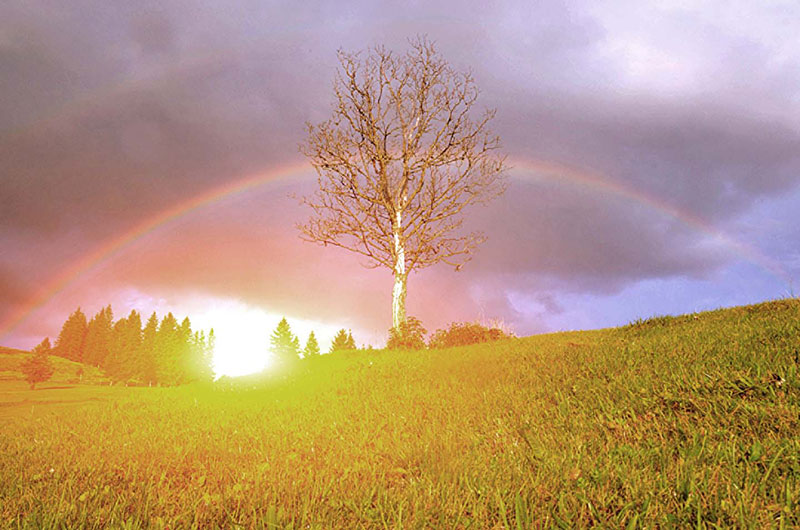
A few verses later (9:8-17), G-d tells Noah that He is establishing a covenant that “all flesh shall not again be cut off any more by the waters of the flood; neither shall there anymore be a flood to destroy the Earth.” (9:11). The sign of this covenant, the rainbow, “reminds” Him that “the waters shall no more become a flood to destroy all flesh” (9:15).
Finally, in this week’s haftarah, Isaiah (54:9) declares that “[Hashem] swore that the waters of Noah would never again flood the Earth.”
These verses, then, present five ideas: (1) Four earthly cycles that the Flood disrupted – relating to agriculture, temperature, seasons, and day/night – will never cease. (2) G-d will not again curse the Earth due to humanity’s actions. (3) Hashem will not again smite every living being. (4) Floodwaters will never again destroy the Earth. (Isaiah calls this a Divine oath.) (5) Floodwaters will never again destroy all flesh.
Note that the final three relate to the destruction of life on Earth, while the last two are part of a covenant G-d makes with humanity and all living things.
Taken as a whole, it’s easy to see why some people rely upon these verses to support their view that humanity can rely on Hashem to protect the environment. Indeed, Chazal also recognize that these verses can be understood in a sweeping manner.
Tosefta Ta’anit (2:11), for example, tells of a drought in Eretz Yisrael. People ask a certain chasid (pious man) to pray for rain, which comes. They then fear excess rain, and ask him to pray for the rain to stop. The chasid agrees to do so but, citing the pledge that floodwaters will never again destroy all flesh (idea #5 above) and G-d’s oath that floodwaters will never again destroy the Earth (idea #4), he reassures them that “we are betuchim [confident; lit. ‘have been promised’] that G-d will never again flood the world.” The chasid understands the biblical verses expansively, applying them not only globally as per their plain meaning, but even in a single locale – Eretz Yisrael.
However, the Tosefta continues by citing Tannaim who restrict the verses only to their most literal meanings. Rabbi Meir rules that the verses mean that G-d is restricting Himself only from destroying with floodwaters, allowing Him to destroy in other ways – e.g., by fire, as He did when destroying Sodom and Gemorrah (Gen. 18). Rabbi Yosi agrees, noting that in the messianic era, G-d may afflict idolatrous nations with pestilence (Zech. 11:10-11). Similarly, Rabbi Yehuda rules that the verses mean that G-d is restricting Himself only from destroying all living things, allowing Him to use masses of water to destroy even a single individual, such as someone drowning at sea.
A second text, Bereishit Rabbah 39:6, presents Avraham Avinu as the paradigm of one who loves righteousness and hates evil. He is astonished that Hashem would consider destroying Sodom and Gemorrah with fire by deploying an “I only promised not to destroy via floodwaters” loophole to evade His own oath (i.e., idea #4, above). Midrashic Avraham agrees with the chasid’s expansive reading.
Of course, since the Torah reports that Hashem did destroy Sodom by fire, we see that He acts in accordance with Rabbi Meir’s restrictive understanding of His words, against the expansive reading of the chasid and midrashic Avraham.
A third text, Zevachim 116a, recounts a midrashic conversation between the evil gentile prophet, Bilaam, and the idolatrous kings of the world. The revelation at Sinai creates a fearsome sound heard around the world, but the kings cannot identify its source. They ask Bilaam whether it might be G-d, flooding the world. Bilaam rejects their idea since G-d “swore not to bring a flood to the world.” The kings accept this but then cite Isaiah 66:15-16, describing Hashem punishing with fire, to suggest that the sound is G-d destroying by fire. Bilaam replies that G-d “swore that He would not again destroy all flesh.” The kings presumably accept this since the conversation concludes with Bilaam and the kings agreeing that the sound is that of G-d giving the Torah. Evil Bilaam and the idolatrous kings thus agree with an expansive reading of the texts that does not allow G-d to destroy the world by fire, despite a proof text (Isa. 66) supporting a restrictive reading to the contrary.
However, a fourth and final text, Sotah 11a (with parallels in Shemot Rabbah 22:1 and elsewhere), rejects the expansive approach of Bilaam and the kings. It presents a midrashic discussion between evil Pharaoh and evil Bilaam (again!) to determine how, precisely, Egypt can kill the Israelite baby boys at the beginning of their servitude (Exod. 1) without being subject to Hashem’s measure-for-measure punishment for doing so. They cite and accept Isaiah 66:15-16 to show that G-d punishes nations by fire as well as by sword, so they reject those methods. (This accords with a restrictive reading of the verses relating to Noah.) They therefore settle upon killing the babies by water (i.e., by drowning them in the Nile) because they understand G-d’s oath (idea #4) expansively (“G-d swore that He won’t bring a flood to the world”), thinking that it prevents Him from punishing them by water.
The Talmud explicitly rejects their expansive reading, stating that Pharaoh and his advisors “didn’t know” the proper, restrictive understanding of His oath: i.e., “although He will not flood the entire world, He does flood individual nations,” such as Egypt. The Talmud then presents a second restrictive reading of the oath: that it prevents G-d from bringing the floodwaters to those He wants to punish, but permits Him to bring them to the waters in which they will drown – as happened at the Red Sea. (This is a variation of Rabbi Yehuda’s view in the Tosefta which permitted G-d to punish individuals by drowning at sea.)
In short, these texts repeatedly present expansive readings of G-d’s words that could forbid Him from flooding Eretz Yisrael, destroying Egypt by water, or destroying Sodom or even the world by fire. This view is sometimes stated quite forcefully (as by midrashic Avraham). It is sometimes attributed to “good guys” (a chasid; Avraham) but also often to “bad guys” (idolatrous kings; Pharaoh trying to kill Israelite babies; Bilaam, twice).
Overall, however, these views are consistently countered by restrictive readings or texts that, by contrast, permit G-d to punish by bringing people to floodwaters; by drowning individual people, nations, or locales (Egypt, Eretz Yisrael); and by destroying by the sword, or by a “flood” of fire or pestilence. These views are supported by verses from Isaiah and G-d’s own actions (in Sodom; at the Red Sea), and held by prominent Tannaim (Rabbis Meir, Yosi, and Yehuda), and the anonymous voice of the Talmud (Sotah). Only “good guys,” and no “bad guys,” hold this restrictive view.
The takeaway is clear: Chazal read G-d’s words to Noah narrowly, allowing Him to punish and destroy entire nations and locales using a wide variety of natural means (water, fire, disease, etc.) They confine His words only to the extreme case of (a) Hashem (b) directly (c) destroying all of humanity or the entire world (d) by floodwaters. Chazal’s approach makes these texts inapplicable to the diverse dangers of contemporary environmental challenges which, by contrast, are caused by (a) humanity (b) largely indirectly, (c) destroying or endangering various populations and areas (d) by means other than a worldwide flood.
Speaking about G-d’s covenant with Noah, Rabbi Jonathan Sacks concisely summarized point (a): “G-d says: Never again will I destroy the world. But I cannot promise that you will never destroy the world – because I have given you free will.”
Moreover, the minority (around 30%) of Orthodox Jews who think humanity can rely on G-d’s promises to Noah face challenges beyond Chazal’s understanding of these promises and the challenge of human free will mentioned by R. Sacks. Since most Orthodox Jews (around 70%) do not agree with their view, this is hardly surprising.
A third challenge is the common-sense point made more than a half-century ago by Rabbi Norman Lamm: “Man is clever enough to conquer nature – and stupid enough to wreck it and thereby destroy himself.”
To elaborate on the points of R. Lamm and Sacks: Recognizing Hashem's omnipotence does not – and if we are honest, must not – preclude recognizing humanity’s enormous power to exercise the free will He grants us, to our benefit as well as to our detriment. Similarly, recognition of G-d’s hashgacha (Providence) can – and if we are honest, must – include recognition that G-d’s world typically operates through the natural laws He created. Finally, recognizing the power of mitzvah observance does not – and if we are honest, must not – preclude recognizing the enormous power of humanity’s ordinary, non-mitzvah actions.
A fourth challenge is the normative halachic principle of ein somchin al ha’neis – that we are prohibited from relying upon Divine miracles and intervention. We recite Refa’einu – and go to doctors. We recite Tefillat haDerech – and inspect our cars and drive safely. We recite Bareich Aleinu – and earn a living, invest, and buy insurance. We board airplanes – and, when required by halacha, recite Birkat haGomel after landing.
Scientifically, human activity is the unequivocal cause of climate change. It has already caused widespread losses and damages to nature and people. (See the Intergovernmental Panel on Climate Change; Climate Change 2023 Synthesis Report, Summary for Policymakers; Statements A.1 and A.2.) Yet the Nishma/Meisharim report shows that only 20% of Orthodox Jewry (12% of Haredim; 35% of Modern Orthodox) think humanity is the primary cause of climate change, a significant point I hope to discuss in a future article.
Relying heavily on G-d’s promises to Noah to protect humanity from these realities is, simply put, relying on miracles. As one survey respondent put it, “Climate change is no different from anything else. Hashem gave us free will. If we don't take care of each other and the planet, there will be consequences. We don’t cross the street blindfolded and expect Hashem to save us.”
Contesting sincerely held religious beliefs, such as reliance on G-d’s promises to Noah, can be touchy. For the above four reasons, however, it is past time to retire this one.