 November 6, 2026
A Broken Heart


“And Yitzchak prayed to Hashem opposite his wife because she was barren …” (Bereishis 25:21)
The Rambam translates the words in the pasuk as “Yitzchak prayed for his wife.”
R’ Meir Simcha of Dvinsk, the Meshech Chachmah, explains that Yitzchak was certain that he would have children because Hashem had already promised Avraham Avinu (Bereishis 17:19),“…and I will establish My covenant with him.” However, there was the apprehension that his child would be with a different woman. Therefore, Yitzchak prayed that the children Hashem gives him should be with this righteous woman. Sforno says similarly that Yitzchak prayed that this righteous woman standing opposite him, in his presence, should be the one who bears his children.
Our Sages tell us that our forefathers were childless initially, because Hashem desires to hear the prayers of the tzaddikim. The Zohar notes the prayers of the poor people are likewise beloved to Hashem, as it says (Tehillim 102:1),“A prayer for a poor man… when he pours out his prayers before Hashem.”
The Zohar says (Parshas Balak)that prayer is specifically ascribed to three people: Moshe, as it says (Tehillim 90:1),“tefillah l’Moshe”;Dovid HaMelech, as it says (Tehillim 86:1);and the poor person, as it says (Tehillim 102:1), “tefillah l’ani …”The Zohar says further that of these three, the prayer of the poor person is the most important, because a poor person is brokenhearted and humbled, as it says (Tehillim 34:19),“Hashem is close to those who are of a broken heart.” When the poor man says his prayer, Hashem opens all the windows of Heaven.
Why does the prayer of the poor man take precedence even over the prayers of the tzaddikim? We derive from the words of our Sages that two conditions must be met in order for our prayers to be heard by Hashem. One, the prayer must emanate from a broken heart, as it says (Tehillim 147:3),“Who heals the brokenhearted and binds his wounds,” and (Yeshayah 66:2), “... to this one I will look, to one poor and of crushed spirit.” Secondly, the prayer must convey one’s feeling of total and exclusive reliance on Hashem, to the exclusion of anyone else.
When any Jew, even the simplest Jew who is not anywhere close to the level of a tzaddik, prays from a broken heart, his prayers will be more noteworthy than the prayer of a tzaddik.
Be that as it may, Hashem listens to everyone’s prayers. The Torah tells us that Hagar raised her voice and wept after the water ran out (Bereishis 21:16).Hagar was the daughter of the king of Egypt and she chose to be a maid in the home of Avraham Avinu rather than a noblewoman in the palace of the king. However, Targum Yonasan says that when Sarah expelled Hagar from the house, Hagar was disappointed that it was not a “house of chesed,”and she resumed her worship of idols. Yet, when she prayed, she merited that five Heavenly angels were revealed to her, and Hashem listened to her prayers.
Yitzchak and Rivka did not have a child for fourteen years until they prayed, because Hashem wants to hear the prayers of tzaddikim. The Zohar comments that at the time when a tzaddik prays for whatever he needs, it simultaneously opens the channels in the upper Heavens to bring kedusha and beracha into the world. Whoever needs salvation, even if he is not worthy of deliverance, can be helped by these special prayers of the tzaddik.
Every Jew must know that even if he has fallen spiritually, and he finds himself in the most difficult situation, he should never give up. Hashem listens to our prayers.
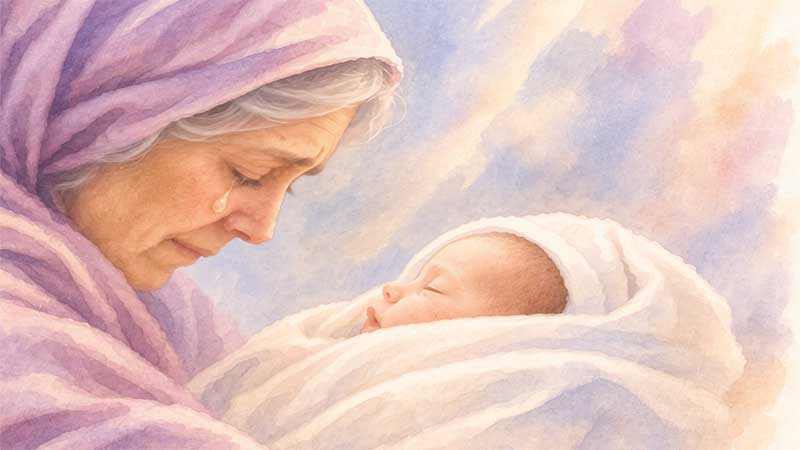
The well-known mohel,R’ Shmuel Yudelevitz, related that he was once invited to perform a bris on a baby born to a young Russian couple who had emigrated to Eretz Yisrael from Russia. When he entered the home, he saw the grandmothersobbing heavily.
R’ Yudelevitz asked why she was crying. She pointed to her son-in-law and her sobbing gave way to wails, as she cried that the baby’s father was not Jewish. “In Russia,” she said, “I prayed that my daughter should be Sabbath observant. And she was. But before she left Russia, she married this person, and this is their baby. I am crying and praying to Hashem that only good should happen.”
R’ Yudelevitz assured the grandmother that the baby was a complete Jew, and he would enter into the bris of Avraham Avinu like every other Jewish child. “However,” said R’ Yudelevitz, “continue to cry, because Eliyahu the angel of the bris is present now, and only good can come from your tears.”
Five years later, recounted R’ Yudelevitz, he was once again invited to the home of the same couple. This time, though, he was the mohel for the father of the baby who had gone through geirus k’halacha (Jewish conversion according to halacha) and had accepted to observe all the mitzvos of the Torah. He became a very special ben Torah.
R’ Yudelevitz told the grandmother that this had come about from the power of her tears. Usually, it’s the father who brings his son into the bris; in this case it was the son who brought his father into the covenant of Avraham Avinu.
I have been giving a daily shiur delving into the secrets of the Zera Shimshon. I invite all our Jewish Press readers to join this powerful learning experience. A live five-minute recording is sent out daily, Monday through Thursday, to our WhatsApp group. To join, you can text to 917-806-8831 to be added to the group.