יום שני, 13 יולי 2026Monday, July 13, 2026
Follow Us
יום שני, כ״ח תמוז תשפ״וMonday, July 13, 2026
Follow Us

Sections

Categories:

A Customer Service Approach to Politics
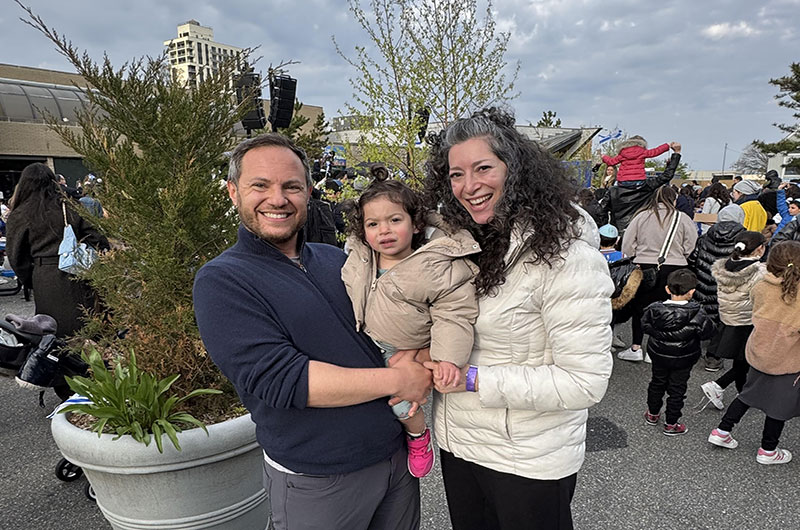
By Ita Yankovich

|

June 11, 2026, 8 AM ET


Entrepreneur Michael Goldfarb Is Running for Congress to Fix What's Broken

  Michael Goldfarb is a Democrat running for election to the U.S. House of Representatives to represent New York’s 9th Congressional District, which includes Brownsville, Crown Heights, East Flatbush, Flatbush, Kensington, Midwood, Sheepshead Bay, Marine Park, Gerritsen Beach, and Prospect Lefferts Gardens. He faces a tough battle against longtime incumbent Yvette Clarke in the June 23rd primary. The Jewish Press recently spoke with Goldfarb to learn more about him and what he stands for.   Your background is in small business, not politics. Why does that experience make you qualified to represent NY-9 in Congress? My very first job was working at my parents’ toy store when I was thirteen years old. As any small business owner knows, you have to meet your customers’ expectations each and every day, or they’ll take their business elsewhere. Too often I hear from people that politicians only come by once every two or four years to ask for a vote, and then they disappear. Here in NY-9 in particular, I frequently get messages from constituents who have been unable to get help from Rep. Clarke or her office and are looking for guidance. After I graduated from Harvard and worked in finance, I went on to build my own companies, helping people and businesses send money around the world. Today millions of immigrants every month use one of my platforms to send money home for free or almost free; governments, banks, nonprofits, and others use another platform of mine to send tens of billions of dollars every year. In the private sector, the stakeholders I was responsible to – my investors, my employees, and my customers – judged me exclusively on the results that I delivered.   One of your campaign’s top priorities is increasing investment and economic opportunity in NY-9. What specific policies or initiatives would you pursue to achieve that? The reality is that NY-9 gets less federal funding than almost every neighboring district. That’s less investment in community schools, neighborhood healthcare, public safety, infrastructure, you name it. And it’s a testament to having a representative [who] is simply ineffective and irrelevant in D.C. We should be investing significantly more here in NY-9 in ensuring safe subways and streets. I’d vigorously advocate for federal grant funds for sanitation projects to keep our communities clean as well. We also need to invest in our local businesses. We should be cutting the red tape that is strangling struggling businesses today, while at the same time contributing federal funds to uplift current and future entrepreneurs.   Rep. Clarke has represented the district for nearly two decades and remains a well-known incumbent. As a first-time candidate, what is your path to victory, and why do you believe voters are ready for change? On the campaign trail, I run into people from every background imaginable; what I never run into is a person who believes the government is working well… What voters have realized is that after almost two decades in office, Rep. Clarke is either part of the problem or, at the very least, is incapable of solving what is broken in D.C. Rep. Clarke is not invincible. The key here is going to be turnout. That 2018 midterm primary had just over 30,000 voters participating. In the second most Jewish congressional district in the United States, with an estimated 172,000 Jewish residents, the Jewish vote in particular will be critical.   What role does Judaism play in your daily life, values, and approach to public service? Much of my outlook has been guided by my grandparents, all of whom were Holocaust survivors. They deeply ingrained in us the importance of supporting the Jewish community and aggressively combating antisemitism. I’m actually participating in a program called the Maimonides Jewish Leadership Institute which is designed to help participants be more thoughtful about the relationship between Judaism and their lives/careers. In conjunction with study that I’ve undertaken locally, including with the amazing Rabbi Yehuda Levin, it has really reshaped how I conceive of Judaism in my daily life.   You have occasionally been critical of President Trump. Given that many Jewish voters in the district strongly support him, do you worry those criticisms could hurt your campaign? Not at all. Voters expect their elected officials to do what’s best for their constituents, their community, and their country. That means being willing to support, or oppose, anyone who is acting against those interests – including standing up to the president when I disagree with him, but also openly opposing members of the Democratic Party when necessary… Elected officials are supposed to think critically about every question that comes before them and do the right thing.   Antisemitism and hate crimes have risen sharply in recent years, including online, on college campuses, and in public spaces. What concrete steps would you support at the federal level to improve security and combat antisemitism? I can’t tell you how distressing it was the first time my wife expressed discomfort taking our daughter to an explicitly Jewish space in our own neighborhood, for fear that they would be the victims of antisemitic violence. The scourge of antisemitism cannot be overstated, it cannot be ignored, and it absolutely cannot be tolerated. We have to continue to invest in protecting our communities. That means more federal funding for the Nonprofit Security Grant Program and expanding the program to allow it to cover a broader range of expenses, including hiring security staff. We also need to provide federal funds to support local police in protecting houses of worship. College campuses that receive federal assistance should have to work with the Department of Education to develop policies and processes for preventing and punishing antisemitism at their schools. The federal government also needs to take the lead on combating antisemitism online. That includes holding platforms that host antisemitic content accountable. [Fixing] the education problem [includes] more critically evaluating who is funding education in the United States, especially our universities. Rep. Clarke voted against an amendment that would require foreign entities that provide funding to institutions of higher education to disclose ties to designated foreign terrorist organizations. I think it’s important to note this whole topic is one where I’ve vehemently disagreed with Rep. Clarke. For example, [she] met behind closed doors with Louis Farrakhan…[She] voted against an amendment that would prohibit the use of [federal] funds for colleges and universities that support events promoting antisemitism on campus… [She] voted against a resolution expressing that the slogan, “From the River to the Sea, Palestine Will Be Free” was antisemitic and its use must be condemned. Worst of all, in the majority of the above cases, Rep. Clarke voted in the minority of Democrats. These weren’t cases of partisan politicking – this was the woman who represents the second most Jewish congressional district in the country going out of her way to not combat antisemitism in our communities.  
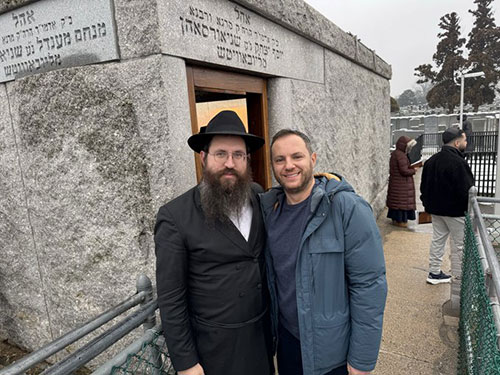
Visiting the Lubavitcher Rebbe’s Ohel in January with Rabbi Levin.
  Synagogues, Jewish schools, and community centers face growing security threats and often bear major financial burdens for guards, training, and infrastructure upgrades. How would you work to increase federal support for these institutions? First, I think it’s important to reiterate that in addition to the financial burden our community incurs, there is also the emotional burden that endures, especially in our children, knowing that for us constant vigilance is required. Second, the cost of security is only one of many ways the Jewish community faces unique economic challenges, and we need to comprehensively evaluate how we can make it more affordable to raise a Jewish family. Last, the federal government needs to be unambiguous: It is the responsibility of the government to provide all of the resources necessary to keep its citizens safe from violence or harassment. Expanding the Nonprofit Security Grant Program – both in size and scope – should be an easy means of providing the financial support to make that a reality in Jewish communities.   A strong cultural, religious, and political connection to Israel remains central to much of the Jewish community. How would you work in Congress to strengthen the U.S.-Israel relationship and address concerns important to pro-Israel voters? Israel is the only place of refuge for Jews around the world. [It] is a thriving democracy in a region of autocracies and theocracies. That doesn’t mean that everyone needs to agree with everything that the government of Israel does. But there is a massive difference between disliking a specific government figure or policy and calling for the elimination of a nation. My background in the payments space led me to work extensively between the U.S. and Israel on combating terrorist financing. Using my knowledge of how money moves legitimately around the world helped [reveal] how terrorists nefariously move money. Disrupting those flows would paralyze those organizations; without money, terrorists can’t buy weapons or pay fighters.   Many Jewish New Yorkers have expressed concern about NYC Mayor Zohran Mamdani’s policies and rhetoric regarding Israel, antisemitism, BDS, and taxation. Do you share these concerns? Would you publicly oppose these policies or advocate against them at the federal level? The reality is that since at least 2021, the number of anti-Jewish hate incidents in NYC has been unmistakably increasing – even as the number of hate incidents targeting non-Jews has been just as clearly decreasing. So, anyone who isn’t concerned about the safety and well-being of New York’s Jewish population is not paying attention. When it comes to Mayor Mamdani specifically, I would take the same approach as with any other elected official. When he does work that benefits the NY-9 community – for example, expanding free and low-cost childcare options in NYC – I’ll warmly support those efforts. When his statements or actions conflict with the best interests of my constituents, I’ll deploy every tool at my disposal to combat them.   Do you support school choice, including financial assistance for parents seeking private or religious school education for their children? Yes. I’m a proud graduate of the public education system. But I recognize that education is not “one size fits all.” We cannot and should not reduce the resources we provide to the public education system, which is responsible for teaching the vast majority of American children. But we should also accommodate alternative education venues and reduce the financial burden on families that wish to pursue that path. Here in NY-9, we have parents that seek traditional public schools, charter schools, parochial schools, yeshivas, and secular private schools. I trust my constituents to make an informed decision on their kids’ education and support them having the flexibility to do so.   What are the biggest differences between you and Rep. Clarke – in terms of leadership, accomplishments, and policy priorities? The most successful business I co-founded is a remittance company – people use it to send money to other countries. Others had done that for centuries; we thought we could do it better. Today millions of people use our platform, and it’s cheaper, faster, safer, and more convenient than what existed before. The company has also been a great financial success for its investors. When I look at what we need in government today, I see a lot of the same thing: Broken processes that haven’t been improved in generations. Constituents – government customers, essentially – who are looking for someone that will do whatever it takes to create a system that actually works for them. What does that look like? Today our families spend enormous sums of money on childcare; I have a detailed proposal for free universal childcare beginning at birth that’s actually less costly than today’s system. The same is true for education, where parents struggle to afford culturally appropriate schooling; my plan is grounded in a belief that the government should support all children’s learning. On public safety, we have research that shows that more data-driven, targeted law enforcement can drastically reduce rates of community violence while also spending fewer taxpayer dollars. We need to cut the red tape that makes it overly costly and time-consuming to build new housing (or just to fix up your house) or to open a new business. We need to provide training for young people who wish to enter careers that are well-paying and that our community needs more of. Rep. Clarke has been in Congress since 2007. She has introduced one piece of legislation that got passed into law as a standalone bill – to rename a post office in Crown Heights. Between October 2007 and April 2025, Rep. Clarke made $282,600 in rent payments to her mother’s organization, the Progressive Democratic Political Association. Tens of thousands of dollars more have been incurred as debt to her mother for using their shared home as a campaign office – a clear violation of ethics rules. Taxpayers lost $120,000 when Rep. Clarke hired staff members with a history of scandals and legal troubles who then went on to steal computer equipment from her office. She refused to take action or punish the perpetrators for fear of embarrassing her office. Rep. Clarke represents everything voters are frustrated with. An ineffective legislator who has used her office not to help constituents but to benefit herself and those around her. So yes, we desperately need creative, practical solutions to the issues that have plagued our nation for too long – and on my website voters can find detailed proposals on everything from health care to public transit and a federal privacy standard to protect our personal information. And yes, we desperately need a representative who views constituent services as the very core of an elected official’s responsibility. Any reader who wants to can always email me directly at mike@mikeforbrooklyn.org and see what it looks like to have a representative that’s always available and responsive.  

This interview has been edited and condensed. 
More Articles

NEWS

A Return to Berlin

By Chaim Saiman

NEWS

Getzlight – Chapter III

By Ruchama Feuerman

NEWS

Dance and Trance Revisited: Has It Gone Too Far?

By Mendi Glik

Serials

Getzlight – Chapter III

By Ruchama Feuerman

View all

Sponsored Posts

cross