 September 4, 2026
 Categories: Halacha & Hashkafa / Torah
The Borrowed-Back Bike
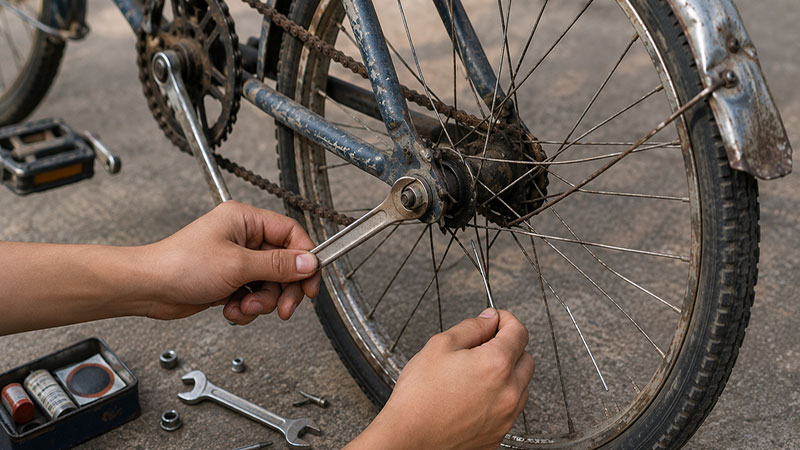


As Mr. Nathan walked home, he saw his neighbor’s son, Effy, fixing his bike. It was quite old and rusty and dented in many places. One of the spokes was even broken.
“Hello, how are you?” Mr. Nathan asked Effy. “It seems that almost every time I walk by, you’re fixing your bike.”
“Baruch Hashem, I’m fine,” replied Effy. “The bike, however, is in really poor condition.”
“Maybe it’s time to get a new bike?” asked Mr. Nathan.
“I’d love to,” said Effy, “but we just can’t afford it.”
Mr. Nathan walked home thoughtfully. He had a good bike that was almost never used; the last time he had ridden it was years ago. His grandchildren used to ride the bike when they visited, but they had moved to Israel the previous year.
“I saw Effy fixing his bike again,” Mr. Nathan said to his wife. “It’s in really poor condition, but Effy says they can’t afford a new one. Since I don’t use my bike anymore and the grandchildren have moved, I’m thinking of giving it to him.”
“That is very nice of you,” said his wife. “But what will we do if the grandchildren come to visit?”
“I can mention to Effy that if they should come, we’d like to borrow the bike back for the visit,” said Mr. Nathan. “I think that’s fair enough.”
“If he’ll do that, that would be a good use of the bike," agreed Mrs. Nathan. “Effy is such a nice boy.”
The following day, Mr. Nathan invited Effy over. “I have a bicycle that I don’t use anymore,” Mr. Nathan said to him. “Our grandchildren sometimes used it, but now that they’ve moved to Israel, I’d be happy to give it to you. The only thing is, if they should ever come to visit, I’d like to borrow it back while they’re here.”
“That’s very gracious of you,” said Effy. “Certainly, I’d be happy to lend it back if your grandchildren come.” He thanked Mr. Nathan and took the bike home.
The following summer, Mr. Nathan’s grandchildren flew in for a visit. “Zayde, where is your bike?” they asked. “We’d like to take a ride in the park.”
“I don’t use it anymore,” Mr. Nathan told them, “So I gave it to Effy, next door.”
“Oh! Then we can’t ride anymore?” they asked.
“Don’t worry,” replied Mr. Nathan. “I arranged to borrow the bike back when we needed it. I’ll give Effy a call.”
Mr. Nathan called Effy. “Hello, Effy,” he said. “Our grandchildren are in for a visit. Could we have the bike for the week?”
“Sure, with pleasure,” said Effy. “I’ll bring it over in a few minutes.”
The grandchildren rode the bike to the park and played ball. But when it was time to return home, the bike was missing. It had been stolen!
A week after the grandchildren left, Effy politely asked for the bike back. “I’m sorry,” said Mr. Nathan, “but the bike was stolen while the kids were in the park.”
“What do I do now?!” lamented Effy dejectedly. “I sold my other bike as scrap. Now your grandchildren lost my bike and I have none at all…”
Later that evening, Mr. Nathan met Rabbi Dayan and asked:
“Do I owe Effy anything for the bicycle, which I gave him in the first place?”
“Although you gave the bicycle to Effy, once you gave it, it became his property,” said Rabbi Dayan. “Therefore, borrowing the bicycle is no different than borrowing any other item from Effy, and you are liable for theft. (C.M. 340:1)
“Although when someone gives a gift, we evaluate his intention in giving even if not stated explicitly, there is not sufficient basis to assume that you intended to be able to borrow the bike back without any liability or to reserve ownership of the bike for that time (see C.M. 246:1).
“Nonetheless, since the bicycle is several years old, you are liable only for its current worth. This depends on the condition of the bicycle and is likely only a fraction of the initial cost (C.M. 101:9).”
“Is it right on Effy’s part for him to ask for payment, though?” asked Mr. Nathan. “That seems so unfair!”
“There is nothing unjust about it, and according to halacha it is perfectly fair,” answered Rabbi Dayan. “However, there is an element of gratitude for one who did you a favor in the past. Depending on the circumstances of the loss and the nature of your relationship, Effy may choose to forego his right to compensation as an expression of gratitude to you for having given him the bicycle.”
Verdict: Mr. Nathan is liable for the bicycle, at its current worth, unless Effy is willing to forego that amount as a token of gratitude.