September 11, 2026
 A Great Idea for Rosh Hashanah


Rosh Hashanah is upon us. Our fate and the fate of our loved ones is being written up by Hashem to be sealed on the upcoming Yom Kippur. The smart petitioner knows that the best way to ask Hashem for another good year is to give Him a good reason why He should treat us well. Let me share with you, my dear readers, a single kabalah/commitment that could alter our entire way of living for the New Year. It is sure to please Hashem and influence Him to grant us a sweet New Year.
The great Ibn Ezra teaches us, “Shekol hamitzvos ikram haleiv – The essence of all the commandments is the heart that we put into them.” This echoes the famous Gemara in Sanhedrin(106b) and in the Zohar (3:281) which strongly state, “Rachmana liba bo’i – The merciful One wants our hearts.” Shlomo HaMelech teaches this emphatically in Mishlei (23:26), “T’na beni libeich Li – Give (to Hashem) my son, your heart to Me.”
The prophet Yirmiyahu rebukes us when we do things without thinking of Hashem, as it says in Yirmiya (2:8) with the powerful words, “Tofsei haTorah lo yida’uni – Those who hold on to the Torah (and they’re ‘frum’) don’t know Me.” If we are not careful, we can go through our lives practicing Torah and mitzvos but neglect the essence, which is the connection with Hashem. As the great Rav Moshe Chaim Luzzato, zt”l, zy”a, proclaims, “Hashleimus ha’amiti hu rak hadveikus bo Yisborach – The true perfection of life is when we achieve connection with Hashem.” And this is what Moshe Rabbeinu emphasizes to us: Life boils down to, “Mah Hashem Elokecha shoel mei’imach, ki im liyira Oso – What does Hashem ask from you but that you should see Him and be aware of Him.”
This is the objective that we pray for in the tefillah of U’va l’Tzion: V’yaseim b’libeinu ahavso v’yiraso v’la’asos r’tzono ul’avdo b’leivav shaleim, l’ma’an lo niga larik – Please put in our heart the love and awareness of Hashem, that we understand that we are doing His will, to serve Him with a whole heart, so that we should not toil in vain.” In this prayer we also supplicate succinctly, “V’hachein l’vavam Eilecha – Direct our hearts to You.” Let our lot not be with those whom the Navi Yishaya chastises. Let not your mitzvos be merely, “K’mitzvas anashim m’limudo – Commandments done robotically and just out of habit.”
Now, let’s get practical. Here’s my suggestion to you. Ask yourself, “How often during the day do I think about Hashem?” Remember, we say at the end of bentching, “V’dorshei Hashem lo yach’sru chol tov – Those who seek out Hashem (by thinking about Him) will not lack from any good.”
Don’t worry! I’m not going to leave you without suggestions. Rather, I’m going to take you on my own personal journey of how I am working to think more often about Hashem.
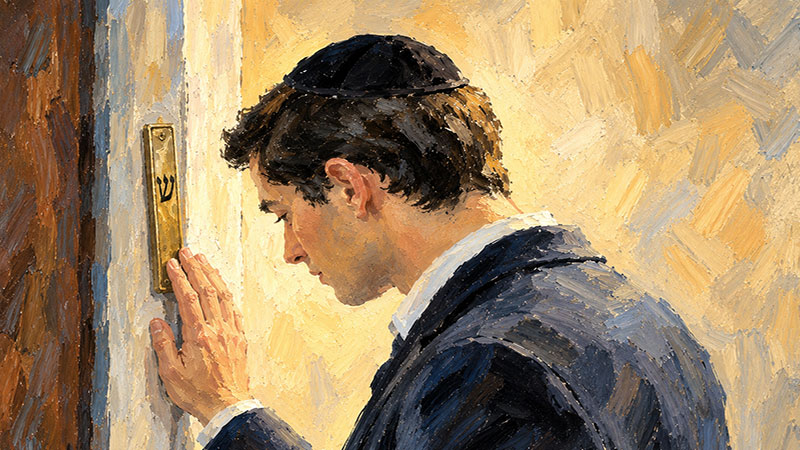
Let’s start first with the mezuzah. Here’s my strategy: Try to do this drill five times a day. We pass scores of mezuzos every day. Here’s the discipline: Do this before you kiss the mezuzah. Because, once we kiss the mezuzah, it’s just another reflexive act done without thought. Let’s pick a mezuzah-moment: You’re returning home from work, from shopping, or from exercising and you encounter the mezuzah at the entrance of your home. Before kissing the mezuzah, reflect upon the fact that the mezuzah represents the true Title and Deed to your home, for it really belongs to G-d. Thank Hashem for allowing you to live in this home. Then, give the mezuzah a kiss. Now, that was an exciting moment with Hashem.
Another time during the day when you enter your kitchen, before kissing the mezuzah, ponder that Hashem will watch you while you are eating, will protect you from choking, and will help you with your digestion. Then, kiss themezuzah. Another time before entering the kitchen, you might focus on the fact that you have a well-stocked refrigerator and never lack for food. Rav Vichtig of Queens told me that in his youth, poverty was so great that there were times when he went to bed without eating. He couldn’t sleep because of hunger pains. Today, we don’t know about such things. The only situation we have is deciding what we should eat. Perhaps a plum, an ice-cream sandwich, yogurt, or some cold cuts. For this, we should surely thank Hashem before kissing the mezuzah. Likewise, when we enter our master bedroom, if we’re married, we can thank Hashem for the blessing of having a partner. If we are unmarried, we can thank Hashem for a comfortable bed and for the blessing of sleep. Then, kiss the mezuzah. These are all glorious moments with Hashem.
A man who ties the tefillin to his arm and head has a wonderful opportunity to meditate on connecting his mind and his heart to his Creator. For when we put on tefillin, we are putting Hashem upon us. As the Gemara in Menachos says, “Hashem aleihem yichyu – When Hashem is upon them (those who wear tefillin), they will live.”
Shabbos is a wonderful time to think about Hashem, for it is the day that we reflect and acknowledge that the world did not come about from a big bang or evolve during millions of years. The world was created by Hashem in six days, and He rested on the Shabbos. It is the day that we desist from any creative labor whatsoever, to remember once a week that we have a Boss in heaven Who can tell us what to do and what not to do.
When we daven properly, we take three steps forward to enter Hashem’s Palace and we can connect directly with Hashem. Our daily 100 berachos are 100 wonderful opportunities to meditate about Hashem as long as we slow down and say meaningfully, “Baruch Attah Hashem,” thanking Hashem for all our blessings. Every day, we open our eyes and say hello to Hashem with the declaration, “Modeh ani L’fonecha,” thanking Him for another day of life, and we end our day with, “Shema Yisrael, Hashem Elokeinu, Hashem Echad,” declaring the Oneness of Hashem.
What a wonderful commitment for Rosh Hashanah, when we once again coronate Hashem as our King, to tell Hashem that we plan to think about Him on a regular basis in the coming year. In this merit, we are sure to get the blessing of the verse, “B’chol drachecha dei’eiHu – In all your ways you should acknowledge Him, “V’Hu siyasher orchosecha – And He will make straight your path.”
As we conclude the year of 5786, I’d like to thank The Jewish Press for spreading my words of Torah to Jews all over the globe, and to wish that my dear readers and their families be inscribed in the Book of Good Health, Happiness, Sweetness, and Everything Wonderful.
My wife, Shoshy Weiss, LCSW-R, is offering “IFS Inner Circle,” a small group for women, limited to 7 participants, for authentic sharing, connection, and growth through the IFS method. Registration is now open. Beginning after Sukkos, on October 19th at 8:30pm (by phone) and on October 20th at 10:30am (on Zoom) for 5 weeks, the groups will meet once a week for 75 minutes. For more information and to see the full ad, call/text 845-270-3699 or visit ShoshyWeissIFSTherapist.com.