 August 14, 2026
 Categories: Arts
A Medieval Jewish Counter-Narrative About the Life of the Founder of Christianity
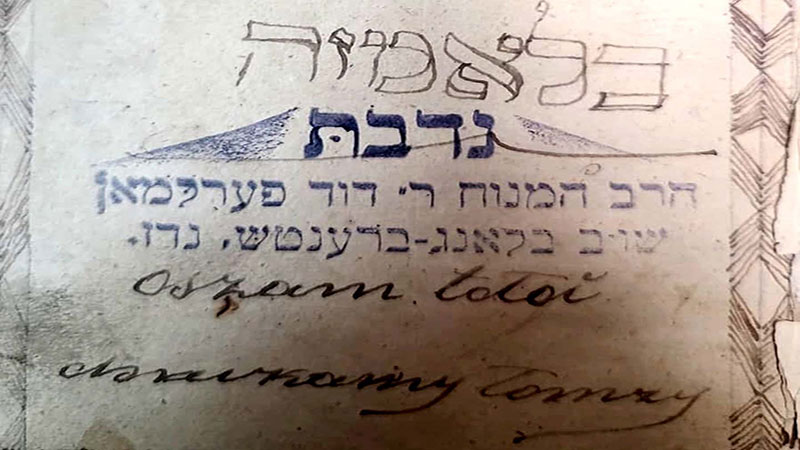


There are few moments more gratifying for a collector of Hebrew manuscripts than opening a volume that quietly challenges accepted assumptions about Jewish literary history. Such was my recent experience upon acquiring a fascinating Hebrew manuscript copied in Łomża around 1850: a carefully penned copy of Toledot Yeshu.
At first glance, the acquisition appears almost paradoxical. By the middle of the nineteenth century, Hebrew printing had long since revolutionized Jewish learning. The Babylonian and Jerusalem Talmuds, Midrashim, halachic codes, responsa, ethical works, kabbalistic treatises, and even obscure medieval texts had all found their way into print. Throughout Eastern Europe, Torah study revolved around printed editions whose pagination had become standardized across the Jewish world. One might reasonably assume that the age of manuscript copying had effectively come to an end.
Even in an era dominated by the printe
d page, certain works continued to circulate almost exclusively in handwritten form. Among the most notable was Toledot Yeshu, the medieval Jewish counter-narrative concerning the life of the founder of Christianity. Because of its highly controversial content and the fear of the response it might evoke, the work never entered the accepted canon of Jewish literature. It was excluded from the Hebrew presses, omitted from communal libraries, and transmitted instead through private copying among individuals who wished to preserve a text that could not safely or respectably be published.
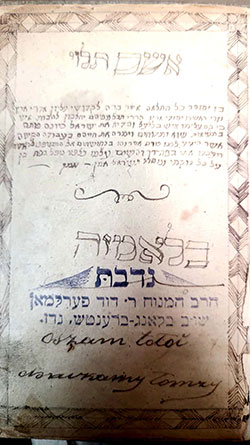
The manuscript before us was copied in Łomża, then one of the foremost centers of traditional Torah scholarship in the Russian Empire. Renowned for its distinguished rabbinic leadership and vibrant yeshiva culture, Łomża was hardly a peripheral community. It was a city whose intellectual life revolved around rigorous Talmudic learning and halachic scholarship.
Its existence demonstrates that manuscript culture remained very much alive well into the modern era, not because printing had failed, but because certain texts occupied a unique place outside the boundaries of conventional Jewish publishing. Works deemed too controversial, too politically sensitive, or too marginal for the printing press continued to survive through the older, quieter medium of handwritten transmission.
The manuscript itself belongs to what scholars identify as the "Helena" recension of Toledot Yeshu, opening with the familiar words: "And it came to pass in the days of Queen Helena."
This opening immediately places the work within one of the principal literary families of the text. Modern textual scholarship has shown that Toledot Yeshu never existed as a single, fixed composition. Unlike the Mishna or the Talmud, whose textual traditions gradually stabilized through widespread printing, Toledot Yeshu remained fluid for centuries. Scribes copied from whatever exemplars were available, frequently introducing additions, omissions, stylistic revisions, and entirely new narrative episodes. Rather than preserving a single "original" version, the manuscript tradition reflects a living text continually reshaped by its transmitters.
The Łomża manuscript is especially noteworthy because it preserves a substantially expanded recension. Its elaborate title-page introduction immediately distinguishes it from many simpler copies. Throughout the text, the Hebrew is unusually polished, employing a consciously biblical style that lends the narrative an air of antiquity and literary refinement. Numerous narrative embellishments suggest that the scribe participated in the long process of literary development that characterized the work's transmission.
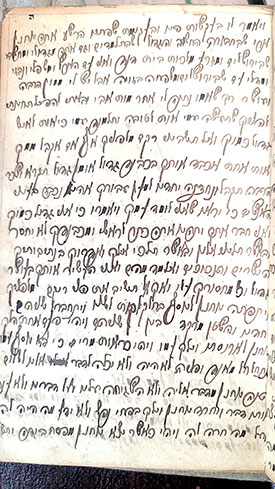
In this respect, every surviving manuscript of Toledot Yeshu serves as an independent witness to the text's evolution. No two copies are entirely alike. Each preserves the editorial choices, linguistic preferences, and narrative expansions accumulated over generations of copying. For historians of Jewish literature, these manuscripts function almost like archaeological strata, revealing how successive communities adapted an already fluid tradition to their own literary tastes and historical circumstances.
Equally fascinating is what this manuscript reveals about nineteenth-century Jewish readers themselves. By 1850, Eastern European Jewry had undergone enormous intellectual transformation. The Haskalah had begun reshaping segments of Jewish society. Hebrew printing flourished in Warsaw, Vilna, Lemberg, and beyond. Yet beneath this expanding world of printed books survived an older manuscript culture whose purposes had changed. Manuscripts were no longer copied because printing was unavailable; they were copied because certain texts could not, or would not, be printed. Their transmission depended upon personal networks, trusted acquaintances, and the quiet diligence of individual scribes.
This phenomenon is not unique to Toledot Yeshu. Magical texts, practical Kabbalah, amulets, family chronicles, and collections of segulot likewise continued to circulate in manuscript long after printing became commonplace. These handwritten works occupied a parallel literary universe alongside the printed Hebrew book.