 September 4, 2026
 Categories: Headline / Perspectives / Op-Eds
A Return to Berlin
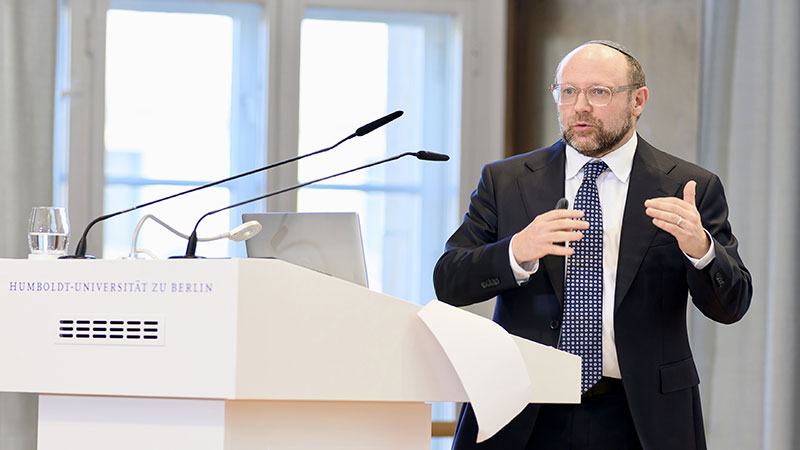


Last month I delivered the annual Hildesheimer Lecture at the Humboldt University of Berlin. Humboldt is one of the most prestigious universities in the German-speaking world, famous for hosting scholars such as Albert Einstein, Erwin Schrödinger, and G. W. F. Hegel. The university also figures prominently in the formation of some of the central rabbinic leaders of the twentieth century. As young men, three future luminaries – R. Joseph B. Soloveitchik, the Lubavitcher Rebbe, and R. Yitzchok Hutner – studied in Berlin during overlapping years and formed relationships that would shape the world of twentieth-century Orthodoxy.
The Hildesheimer Lecture is co-sponsored by Humboldt’s Law Faculty and the reconstituted Rabbinerseminar of Berlin, an institution that was founded in 1873 and existed in its original form until 1938. The lecture is named for R. Azriel Hildesheimer (1820–1899), a leader of German Orthodoxy who founded the Rabbinerseminar and offered an early model of how traditional halachic study and academic study each provided a complementary basis for professionalized rabbinic education. R. Hildesheimer himself studied mathematics and Semitic languages and wrote a doctoral dissertation in the philological style of nineteenth-century Germany that focused on correct methods of biblical interpretation.
He was succeeded by R. David Zvi Hoffmann, and eventually by R. Yechiel Yaacov Weinberg, known as the Seridei Eish. Each of these figures was both a leading talmid chacham and a “rabbi doctor,” what today we might call a scholar of Jewish studies. They established a distinct German/Berlin tradition of yeshiva learning. R. Hildesheimer shared the broad neo-Orthodox commitment to Torah im Derech Eretz associated with R. Samson Raphael Hirsch and firmly rejected the Reform movement. But his distinctive contribution was the creation of an Orthodox rabbinical seminary that was open in certain ways to university scholarship and the academic study of Judaism. This version of neo-Orthodoxy – somewhat parallel to what later became known as Torah u-Madda – might well have continued to develop in Berlin, but it too was destroyed by the Nazis.
This background came into focus in the scheduling of the lecture, which was primarily determined by the availability of the university’s central Senate building. I was initially perplexed as to why the specific location loomed so large; surely Humboldt has many suitable lecture halls. But the significance of Humboldt’s elegant nineteenth-century Senate House became clear as I was being introduced at the event. The building overlooks what is today known as Bebelplatz, the central Berlin square where, in 1933, the Nazis burned Jewish and other “un-German” books – a chilling preview of what was to come. Joseph Goebbels headlined the event before a crowd of tens of thousands.
Introducing the lecture, the vice-chancellor of the university made this connection explicit. He was followed by the dean of the law school and the professor chairing the event, each of whom framed the lecture as part of the Law Faculty’s broader effort to recognize Jewish law as one of the world’s great legal civilizations – a tradition that belongs at the heart of intellectual life in Berlin, in the university, and in German culture.
More subtly, the association with Hildesheimer makes an additional claim: that Judaism and Jewish law speak to a broader academic audience not only through figures such as Samuel Holdheim, Leopold Zunz, and Abraham Geiger – leading intellectuals of Berlin’s nineteenth-century Reform and Wissenschaft movements – but also through the Orthodoxy represented by R. Hildesheimer.
The lecture itself was based on my book, Halakhah: The Rabbinic Idea of Law, which naturally fits with the themes the Hildesheimer lecture aims to emphasize. Yet the trip to Berlin, and the connection to Hildesheimer, drew me to investigate more deeply my own family roots and their connection to Berlin and the Rabbinerseminar.
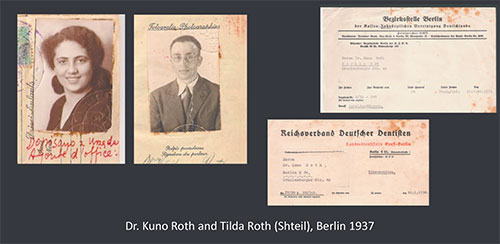
My grandparents, Kuno (Elkana) Roth and Traudel Roth née Steil, moved to Berlin following their wedding in 1937. We have an extended correspondence between Kuno and the Nazi dentistry authorities regarding his professional licensing. Kuno was born in Poland, and as a non-citizen was prohibited from joining the dentists’ guild. This precluded him from using the title Zahnarzt – akin to doctor of dental medicine – in his practice, despite having passed the qualifying exams. A series of documents show how he was forced to remove the Zahnarzt from his sign and stationery and replace it with a lesser professional designation, akin to dental technician.
During the Polenaktion, which began in late October 1938, the Gestapo came to deport Jews such as Kuno that had Polish papers. He received word that this might be coming and developed an escape plan to stay with friends who were citizens. When the Gestapo came to the house, a neighbor was sent to see whether the officers were stationed out back. Seeing that the coast was clear, the neighbor clattered the garbage cans as a signal. Kuno and Traudel quickly tied sheets together, allowing Kuno to climb down and escape from the window.
After Traudel folded and put away the sheets, she finally answered the door. The officers inquired where her husband was, and she feigned ignorance. They did not believe her until, pointing to her pregnant belly, she exclaimed, “You know how men are.” She stood guardedly by the phone, making sure to get to it before the Nazis. When it eventually rang, she yelled that she had no time to deal with the “patient’s” teeth because the Gestapo was searching for her husband. In this way she received the message that Kuno had reached safety, while also letting him know that he should remain in hiding for a few days.
My grandparents left Berlin a few weeks later, in December 1938, just about a month after Kristallnacht. Following a few months in Trieste, Italy – where their first daughter was born – they arrived in Eretz Yisrael in September 1939. The original building still stands on one of Berlin’s central streets, and during this trip I was able to see the very windows from which Kuno escaped.
Though Kuno was not a rabbinical student, he studied in the Hildesheimer beit midrash, where he formed a relationship with R. Weinberg, the last rector of the pre-war seminary. Rav Weinberg lived on the other side of the city from the yeshiva, and much to Traudel’s chagrin, the yeshiva did not provide him with a room in which to rest. The rav would therefore take his afternoon nap, the Schlafstunde, in my grandparents’ apartment.
Though she was not generally inclined toward halachic chumrot, Savta related how she would peel the lemons for the tea she made for R. Weinberg, because he was makpid regarding the possibility of insects on the peel. The connection with the institution continued years later in Tel Aviv, where Kuno maintained an ongoing havruta with Azriel Hildesheimer, grandson of the original Rav in Berlin, who served as a Judaica librarian in the Tel Aviv library.
Though I had not initially intended to do so, my time in Berlin compelled me to open my lecture with this personal story, detailing my family’s connection to Berlin and the Rabbinerseminar. I certainly had not planned on tearing up – very un-German and unprofessional! – but in the moment I was unable to hold back.
Looking out over the square, standing before representatives of the elite German academy, I could only imagine the disbelief Saba and Savta would have felt had they been present to witness the event. Nearly nine decades after they were forced to flee Berlin, their grandson was invited back to deliver an endowed lecture named for R. Hildesheimer, in the university’s central hall, overlooking the square where the Nazis burned Jewish books. The Shoah obliterated the world they knew, but in this small way their story had come full circle.
Maaseh avot, siman labanim.