 October 9, 2026
 Categories: Features On The Jewish World
A Sefer Plucked from the Fire


This past week, I was privileged to obtain a volume that is not merely a book, but a witness – a witness to greatness, and a witness to destruction. A relic that bridges two worlds of Jewish history in one handsome volume.
The book is a Kabbalistic work, the Tikune Zohar, printed in 1863 in Zhitomir by the illustrious Shapira Brothers, grandsons of the famed rav of Slavuta, heirs to a tradition of sacred craftsmanship that elevated the very act of printing into a religious worship. In an era when the printed sefer was treated with reverence, the Shapiras stood apart. Their press was not a business alone; it was a mission. Their editions were treasured not only for their textual fidelity, but for the sanctity that many of the chassidim believed they imbued.
Indeed, Zhitomir itself occupies a unique place in the annals of Jewish printing. Under the restrictive policies of the Russian Empire, it was one of only two cities granted permission to produce Hebrew books. Into this narrow opening stepped the Shapira Brothers, Hanina Lipa, Aryeh Leib, and Yehoshua Heshel, who carried forward their grandfather’s legacy with devotion. Their sefarim, printed on thick, distinctive paper and adorned with crisp, elegant type, set a new standard of beauty and durability. They printed no trifles. Only works of Torah were printed in their press; no general literature made its way there.

Remarkably, it retains its original leather binding, a rarity for Zhitomir printings of this period. This very volume found its way, decades later, into the so-called “Ghetto Central Library” of Theresienstadt.
Theresienstadt was the Nazis’ cruel illusion, a “model ghetto” designed to mislead the world. Behind the staged appearances shown to the Red Cross lay suffering beyond description. And yet, even there, the Jewish spirit refused to be extinguished. A community of scholars and intellectuals in the ghetto established a cultural underground, at whose center stood a library overseen by Professor Emil Utitz, a sanctuary of the mind amid the degradation of the body.
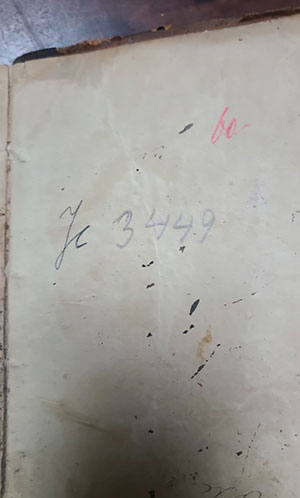
This book bears the quiet but powerful testimony of that chapter: its original catalog label and the handwritten marking “IC 3449.” They tell us that this sefer passed through hands that clung to Torah under the most desperate of circumstances. That it sat on a shelf in a place where learning itself became an act of resistance.
From the sanctified press of Zhitomir, where chassidim saw in each printed page a source of blessing, to the shadowed barracks of Theresienstadt, where those same pages may have offered solace to broken souls. This is not simply provenance. It is a journey through the peaks and valleys of Jewish destiny.
Collectors often speak of rarity. And indeed, while Zhitomir editions are prized in their own right, examples that can be definitively traced to the Theresienstadt library are exceedingly scarce if not unknown. What we have here is something far greater: a sefer that embodies both the glory of our past and the resilience of our people. A silent testament that, even in the darkest hours, the Jewish book, and the Jewish spirit, endures.