 October 9, 2026
 A Song to Start the Year And a Festival of Joy


Parshat Ha’azinu & Sukkot
G’mar Chatima Tova, dear readers.
About 60% of the time, there is no Shabbat between Yom Kippur and Sukkot. This happens in one of two scenarios: When Rosh Hashana is on Thursday and Friday, then Yom Kippur falls on Shabbat, and Sukkot will be the Thursday after Yom Kippur – thus no Shabbat between Yom Kippur and Sukkot. When Rosh Hashana is Shabbat and Sunday, Yom Kippur will be on a Monday, and Sukkot will be on the following Shabbat – here too, no Shabbat between Yom Kippur and Sukkot.
In such cases, Nitzavim and Vayeilech are combined for the last Shabbat of the outgoing year, and Ha’azinu is read on the Shabbat between Rosh Hashana and Yom Kippur, known as Shabbat Shuva.
But when Rosh Hashana is Monday and Tuesday or Tuesday and Wednesday (as it was this year, 5786), then Yom Kippur is on Wednesday or Thursday and Sukkot begins on Monday or Tuesday – and thus there is a Shabbat between Yom Kippur and Sukkot. That happens about 40% of years.
When it does, Ha’azinu is needed for that Shabbat (between Yom Kippur and Sukkot), and Vayeilech becomes the reading for Shabbat Shuva, leaving Nitzavim to finish the year on its own.
Because of the two roles that Ha’azinu can play, it is paired with two different haftarot. When it is read on Shabbat Shuva, we follow it with “Shuva Yisrael Ad Hashem Elokecha” from Hoshei’a 14 and “Tiku-u Shofar” from Yoel 2, in combination. (There are other customs besides this one.)
But when it is read on the Shabbat between Yom Kippur and Sukkot, its haftara is one of the longest ones, from Shmuel Bet 22 – a whopping 51 pesukim. Ha’azinu only has 52 pesukim, so reading another 51 pesukim is off the charts (so to speak). This haftara contains Shirat David, David’s Song, which complements Ha’azinu as the latter is made up mostly of Moshe’s Song.
At 52 pesukim, it ranks 51st out of the Torah’s 54 sedras – followed by Vezot HaBeracha with 41, Nitzavim with 40, and Vayeilech with 30 pesukim. Because its pesukim are relatively short, Ha’azinu drops to 52nd place in word and letter count, behind Nitzavim which takes over at 51st place.
Ha’azinu’s song is written in a different way from the rest of the Torah. Shirat Hayam (The Song of the Sea) in Parshat Beshalach is also written differently from the rest of the Torah. But Ha’azinu’s song and Shirat Hayam are also written differently from each other.
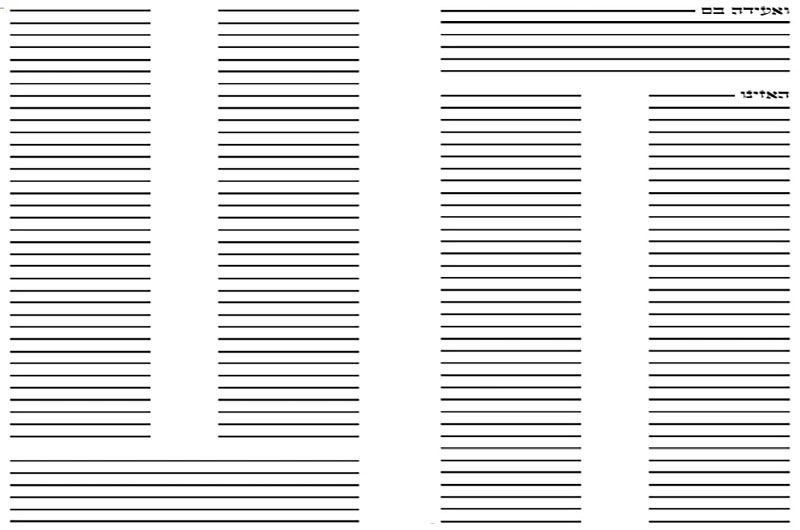
The most common Sefer Torah today is written in 245 columns of 42 lines each. Ha’azinu’s song is written in a Torah scroll on 70 lines, divided evenly (35 + 35) on the preantepenultimate and the antepenultimate columns of a Torah. (I’m just showing off, but it makes for fun trivia knowledge. The last item of a group is the ultimate. Next-to-last is called penultimate. Those two are relatively well-known. Third-to-last is antepenultimate, and fourth-to-last is preantepenultimate – that’s an 18-letter word.)
The column which contains the first half of the song begins with the words “V’a’ida bam et hashmayim v’et Haaretz,” from the end of Vayeilech (Devarim 31:28). Vayeilech and perek 31 finish on the top six lines of the V’a’ida column. Then there is a line left blank, and the first 35 lines of Ha’azinu finish the column. The second 35 lines continue on the top of the following column, followed by a blank line and then six more lines of the non-song text that continues Parshat Ha’azinu. The following column finishes Ha’azinu in 14 more lines. Vezot HaBeracha then finishes the whole Torah with the 28 remaining lines of the column and all 42 lines of the final (ultimate) column of the Torah.
If you said “Huh?” at any of the above, I apologize. (Try rereading it slowly.)
Ha’azinu’s 52 pesukim are divided (unevenly) between song and regular prose. The song comprises 44 pesukim on 70 lines in a Sefer Torah (the first 6 aliyot of the sedra), and the remaining 8 pesukim – consisting of regular prose – comprise shv’ii (the seventh aliyah). The last five of those pesukim are reread for the Maftir.
Each line of the Shira consists of a phrase, a blank space, and a phrase. The two columns of the Shira look like this:

A couple of comments on the content of the beginning of the Shira:
Moshe Rabeinu calls upon Heaven and Earth to hear what he is about to say. A few pesukim earlier, at the top of the Ha’azinu column (before the song began), he called upon Heaven and Earth to witness his words.
The second pasuk of the Shira translates as “My lesson will drop like rain; my words will flow like dew; like storms on vegetation and like showers on grass.” Rain, dew, storm, shower – different intensities of falling water. Water is to the physical as Torah is to the spiritual. This is a wide-ranging analogy in many teachings. Here it indicates that different people handle Torah-learning differently. There are individuals who “learn up a storm” – they spend most of their waking hours learning Torah extensively and intensely. There are others who have the time and can handle a shiur here and a shiur there. Some need the light touch of short Divrei Torah. Some can learn on their own; others need guided lessons. Some can learn straight Gemara; others use Artscroll or other translations and commentary. Torah is taught and learned on many different levels, just as rain and dew differ.
One more pasuk: “Ki Sheim Hashem ekra havu godel leilokeinu,” When I call out the name of G-d, you ascribe greatness to our G-d. Among other things that are learned from this pasuk is the practice of bentching mezuman. If at least three men – or in their absence, if there are at least three women – who are eating together, then one invites the others to say Birkat HaMazon together. Zimun anashim (men’s mezuman) is required; zimun nashim (women’s mezuman) is voluntary. The minimum of three for zimun is learned from this pasuk: “When I [singular] call out... you [plural, minimum plural is two] ascribe greatness...”
With no rest for the weary, Sukkot begins on the Monday evening following Shabbat Parshat Ha’azinu. Hopefully, the sukkah is ready to go, the Arba Minim have been acquired, guests for Yom Tov have been invited, and wonderful Yom Tov meals have been prepared...
For Sukkot numbers, let’s begin with the Korban Musaf of the chag (the generic term is also used specifically for Sukkot).
On the first day of Sukkot, in the Beit HaMikdash, the Musaf consists of 13 bulls, 2 rams, and 14 lambs – all Olot (burnt offerings) – plus a goat for a communal Chatat (sin offering). The rams, lambs, and goat numbers are the same for all seven days of chag; the number of bulls (parim) decreases by one each day. Over the seven days, there are 13 + 12 + 11 + 10 + 9 + 8 + 7 = 70 bulls, which corresponds to the iconic 70 Nations of the World. This lends a universal flavor to our holiday of Sukkot.
Aside from the unusual number of bulls, the numbers of rams and lambs is also noteworthy. The standard numbers for the Musafim of Rosh Chodesh and the other chagim (including Shemini Atzeret) is one ram (ayil) and seven lambs (kevasim). On Sukkot, the rams and lambs are doubled.
This points to a dual nature of Sukkot. On the one hand, Sukkot is the third and final holiday of the Shalosh Regalim, the three Pilgrimage Festivals – Pesach, Shavuot, and Sukkot – each with its own agricultural significance and each with an interrelated history in the saga of Jewish nationhood.
But Sukkot can also be viewed as the third and final holiday of the three Tishrei holidays – Rosh Hashana, Yom Kippur, and Sukkot, each with a part of the story of teshuvah, atonement for national and individual sins. The obvious focus of the Yamim Nora’im (Days of Awe) is supplemented by the dimension of teshuvah mei-ahava (repentance motivated by love) that accompanies the simcha of Sukkot – and particularly of Hoshana Rabba.
We see a further hint to the dual nature of Sukkot in Parshat HaMoadim (the portion of the Festivals found in Vayikra 23). Verse 4 is the intro to the chagim: “These are G-d’s appointed [holy days], holy occasions, which you shall designate in their appointed time…” This is followed by presentations of Pesach, the Omer period, Shavuot, Rosh Hashana, Yom Kippur, and Sukkot. Then verse 37, a summary statement: “These are G-d’s appointed [holy days] that you shall designate them as holy occasions...”
That’s it – but not quite. Because verse 39 states: “But on the fifteenth day of the seventh month, when you gather in the produce of the land, you shall celebrate the festival of G-d for a seven-day period; the first day shall be a rest day, and the eighth day shall be a rest day.” This is followed by the mitzvot of lulav and etrog and Sukkot. Then another summary statement – verse 44: “And Moshe told the children of Israel [these laws] of G-d’s appointed [holy days].”
What? Sukkot again? And that is the point. Sukkot has two roles in the cycle of our holy days. It is truly Z’man Simchateinu – the Time of Our Joy – because it combines the joy of the Exodus and of the giving of the Torah with teshuva mei-ahava, returning to G-d with joy.
Wishing you all a Shabbat Shalom and a Chag Sameach.