

 November 27, 2026
A Torah in a Forgotten Tongue
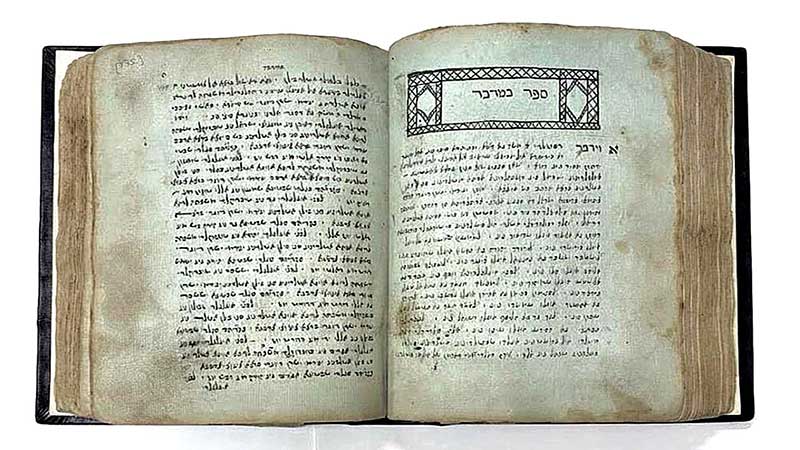


There are manuscripts that preserve the words of a sacred text, and there are manuscripts that preserve something even more elusive: the language, intellectual world, and cultural identity of an entire Jewish community. My recent acquisition of the Koknay-Eidlisz Judeo-Tatar Manuscript Pentateuch, an exceptionally significant 18th-century translation of the Torah into the Judeo-Tatar language of the Crimean Karaites, represents an important opportunity to reconnect with a largely forgotten chapter of Jewish history. Dating to the 18th century and originating in Crimea, likely in one of the historic Karaite centers of Gözleve (modern-day Yevpatoria) or Çufut Qale, this substantial handwritten codex contains the Five Books of Moses rendered into the native Turkic vernacular of the Crimean Karaite community. Written in a flowing Hebrew cursive script, with headings distinguished in square Hebrew characters, the manuscript is a striking testament to a Jewish tradition that developed along a linguistic and religious path quite distinct from that of the larger rabbinic world. Its significance, however, extends far beyond its considerable age or its physical survival. It represents a rare intersection of biblical scholarship, Jewish communal history, and the development of one of the lesser-known languages of the Jewish diaspora.
For centuries, the Crimean Karaites maintained a distinctive religious and cultural identity, with communities concentrated in the Crimean Peninsula and other parts of the Black Sea region. Their religious tradition placed particular emphasis on the Hebrew Bible, and over generations they developed a rich literary culture that expressed their religious life through the languages spoken in their surrounding environment. Among the most fascinating products of this tradition were translations of the Torah into Karaim, a Turkic language belonging to the Kipchak branch of the Turkic language family, historically cataloged in some collections under the designation "Judeo-Tatar." These translations are particularly interesting because of their unusual relationship to the Hebrew original. Whereas many traditional Jewish translations incorporated explanatory interpretations, rabbinic terminology, and considerable freedom in rendering biblical passages, Crimean Karaite translations frequently adhered with remarkable closeness to the wording and grammatical structure of the Hebrew text. The translators sought to preserve not merely the meaning of the biblical passage but, to a considerable extent, its linguistic architecture, following the sequence of words, syntax, and grammatical constructions of the original.
This approach produced an extraordinary and largely unintended consequence: the preservation of archaic Turkic vocabulary and linguistic forms that might otherwise have disappeared from the historical record. By translating the Torah so closely according to its Hebrew structure, the Karaite scribes preserved older expressions and grammatical constructions within a religious text that continued to be copied and studied over generations. The result is a linguistic time capsule, providing modern researchers with an opportunity to examine earlier stages of Crimean Karaim and to trace the evolution of a language that underwent substantial changes as its speakers interacted with neighboring linguistic communities. The Koknay-Eidlisz manuscript is particularly noteworthy in this respect, offering a substantial biblical text through which scholars can examine the relationship between Hebrew and an archaic form of Kipchak Turkic. Its vocabulary, spelling conventions, and grammatical constructions are of interest not only to students of Karaite history but also to Turkologists and researchers investigating the development of Jewish languages.
The manuscript's Hebrew-letter script places it within a much broader tradition of Jewish vernacular literature. Throughout the centuries, Jewish communities adapted the Hebrew alphabet to record the languages they spoke, producing an extraordinary body of literature in Judeo-Arabic, Ladino, Yiddish, and numerous other Jewish linguistic traditions. The Crimean Karaite manuscripts belong to this same remarkable phenomenon, although their linguistic and religious circumstances were distinctly their own. The decision to write the vernacular in Hebrew characters maintained a visible connection between the language of everyday communal life and the sacred literary tradition of the Jewish people. In the present manuscript, the flowing cursive hand, accompanied by square Hebrew headings, reflects the practical requirements of a substantial handwritten religious codex while preserving the distinctive visual character of Jewish scribal culture. Such manuscripts are particularly valuable because they document not merely the existence of a language but the manner in which that language was employed in the transmission of one of Judaism's most important texts.
The chronology of the Koknay-Eidlisz Pentateuch adds another important dimension to its significance. The manuscript predates the first printed Tatar translation of the Bible, published in the 1830s at Orta-Köy, near Constantinople, traditionally dated to 1833–1835. It therefore belongs to an earlier period in the history of Jewish biblical translation, when the transmission of vernacular sacred texts depended upon individual scribes, communal institutions, and the painstaking reproduction of handwritten manuscripts. Before printing transformed the dissemination of biblical translations, codices such as this one served as important vehicles for religious education and the preservation of communal language. Their production required considerable effort, and their survival depended upon generations of individuals who recognized the importance of preserving both the biblical text and the linguistic traditions through which it was understood. The Koknay-Eidlisz manuscript offers a tangible connection to that world, documenting a period when the Torah was being transmitted through the particular linguistic and religious framework of the Crimean Karaite community.
The acquisition of a manuscript of this nature is therefore significant on several levels. It is a Torah manuscript, but it is also a document of Jewish linguistic history, a witness to the literary achievements of the Crimean Karaites, and an important artifact in the broader history of Jewish life around the Black Sea. For collectors of Judaica and Hebrew manuscripts, its appeal lies not simply in its antiquity but in the unusual nature of its contents and the historical world it represents. Manuscripts containing extensive biblical translations in lesser-known Jewish vernaculars are especially important because they preserve evidence of traditions that are not always adequately represented in the surviving manuscript record. The history of the Jewish people is often told through its great centers of scholarship and its most familiar languages, yet the cultural achievements of smaller and more geographically isolated communities are equally deserving of attention. The Crimean Karaites maintained distinctive traditions of biblical study, communal education, and literary production for centuries, and manuscripts such as this one provide direct evidence of their intellectual and religious lives.
Ultimately, the Koknay-Eidlisz Judeo-Tatar Pentateuch is more than an unusually interesting biblical manuscript. It is a surviving record of a Jewish community's effort to preserve the Torah in the language it spoke, while maintaining the linguistic and textual connection to the Hebrew original. Its pages preserve not only the Five Books of Moses but also traces of an older Turkic linguistic world, offering a rare opportunity to study the intersection of Jewish religious tradition and the historical development of the languages of the Crimea. In an age when much of the world's attention is directed toward the better-known centers of Jewish history, the appearance and acquisition of a manuscript such as this serves as a reminder that Jewish civilization developed across a remarkably broad geographical and linguistic landscape.