 October 23, 2026
 Categories: Arts
A Torah Pointer-Plus & A Knockoff Challah Knife


Dear Tsadik,
Hi. Attached are some pictures of our silver Judaica. Can you please tell us the value? I really appreciate it.
Ditty Grussgott
Vienna, Austria
Dear Ditty,
What a wonderful collection you have of authentic, antique silver Judaica. I will address your best piece in my answer to you here: the Torah pointer, also known as a yad (hand).
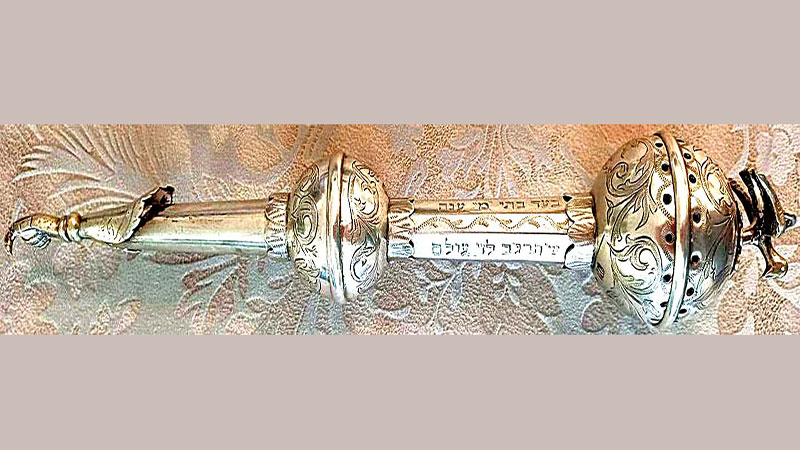
It has been a very long time – years – since I was asked to appraise an old silver Torah pointer from Europe, and which actually was old and from Europe, as the most forged pieces of Judaica are new silver Torah pointers made to look old, with fake European hallmarks on them. So, when you sent me photos of your yad, it was a pleasure to see “the real deal,” and I’m going to reveal something about your piece that I’m quite positive you had no idea about – as it’s not just a Torah pointer, but has another built-in use as well!
Your piece is of a typical shape of Torah pointers from Eastern Europe, where the end and center feature hollow spherical shapes. There is engraved “wriggle-work” and scrolling decoration throughout, and on numerous parts it has various stamped hallmarks including the number 12, which indicates that it was made either in Poland or in the western part of Ukraine. Judging from the craftsmanship and quality of work, I would say your pointer was made around the year 1850. There is a lengthy Hebrew dedication that is engraved on all sides of the pointer, including a Hebrew date of 1892. At the very end of the pointer, affixed to the hollow ball piece, is a lovely little three-dimensional representation of a bird, and there is a loop built into the back of the bird, above its feathers; that loop is there so a chain can be attached to the pointer so it can hang off of the end of the handles of the Torah scroll when stored in the synagogue ark.
Now, as to the aforementioned other use... You can clearly see that while the spherical shape in the center of the pointer is solid, the larger-sized spherical shape at the end is pierced in two sections with numerous holes. The reason for those holes is not for a decorative effect; rather, that sphere can be used as a besamim (spice) container! Your Torah pointer is constructed in such a way where the little bird at the end is attached to the ball with a built-in screw, so if you slowly but firmly twist the bird off, the top half of the ball shape and the connecting center ring can be removed, spices inserted, and then it can all be put back together. So, if, at the conclusion of services in the synagogue on Saturday night, the congregation wishes to make havdalah, the spice box needed can be located instantly – just have someone retrieve the yad hanging off the Torah scroll from inside the ark!
If your Torah pointer appeared at auction today, it would likely sell for somewhere between $1,500 and $2,000. In a retail environment, such as from a higher-end antique store in New York City, Los Angeles, or where you live – Vienna – expect to pay twice those figures.
Best,
Tsadik
Dear Tsadik,
Shalom! A coworker of mine found these bookends at a local antique store. Can you tell me anything about this piece?
Chana
Seattle, Washington

Dear Chana,
Your coworker picked up an attractive pair of bookends made in Israel by the company Dayagi. Your bookends, like most other pieces made by Dayagi, were made sometime during the late 1950s or 60s, and due to the sleek, modernist-style designs of many of their wares, they were popular with tourists to purchase and bring back home as souvenirs. These bookends feature bold designs of the Twelve Tribes of Israel. Value: $30-$40.
Best,
Tsadik
Dear Tsadik,
I remember my father, a Holocaust survivor, using this foldaway knife to slice the challah every Shabbos since I was about three years old, over 70 years ago. To me it has great nostalgic value. I wondered if it has any value otherwise. Thank you.
Shirley
Cedarhurst, New York

Dear Shirley,
Your folding knife has the Hebrew words “Holy Sabbath” atop a mother-of-pearl background. Folding knives similar to yours were made in Czechoslovakia shortly before and after World War I, and were usually purchased by Jews when visiting the hot springs in Karlsbad (also known as Karlovy Vary).
What you have is a very well-made, handsome imitation of those one-hundred-year-old Czech knives; your example was made in Japan during the 1950s, as it is so hallmarked on the inner part of the blade – “Stainless Steel Japan.” Following World War II, Japan rebuilt its manufacturing economy, producing affordable yet durable folding knives for export.
Your father may have remembered an old Czech-made “Holy Sabbath” folding knife used by his father to cut challah on Shabbos, and after surviving the Holocaust, saw the new Japanese copy for sale in a store and bought it, as it reminded him of the happy, safe times with his family before the war. Value: $40-$60.
Best,
Tsadik
Dear Tsadik,
My mother passed away recently and I have a candelabra from her. Would you be able to tell me anything about it? Thank you.
Dvora
Brooklyn, New York

Dear Dvora,
Technically, what you have is a secular piece, a five-light candelabra made for both Jews and non-Jews. On its face it is not Judaica, and not appropriate for this newspaper column. However, since this was an heirloom and it is from pre-war Europe, and likely used by your late mother at one time to light Shabbos candles, I will make an exception and answer you as best I can.
After deciphering the hallmarks seen on the base of the candelabra, I can see it was made sometime between 1920 and 1939 in Czestochowa, Poland. It is made of 80% silver, which is less than the modern standard of silver, which is 92.5%, better known as “925 Sterling.” In my correspondence with you, I asked if you could tell me the weight of the piece, as the precious metals markets of silver and gold in the last year have reached historic highs, and you replied that it weighs 1,380 grams. That weight of 80% silver is equivalent to 1,104 grams of pure silver. As of today’s market price of $65.88 per troy ounce of silver, your candelabrum has a melt or “scrap” value of $735.88. As an antique, there is little interest to be found among collectors for such a piece, and at auction, your candelabrum would likely sell for less than the melt value. This evaluation may sound bizarre but (and I am loath to use this saying), “it is what it is.”
Best,
Tsadik