 September 25, 2026
 Categories: Torah
Accurate Accentuations & Kislev’s Variability


Parshat To-l’dot
This week, Torah by the Numbers goes off subject for a bit – to “Torah by the Syllables.”
Most native English speakers (and many others) pronounce the name of this week’s sedra as TOL DOT (or TOL DOS). That’s wrong.
The first letter, TAV (not TUFF, as many of us learned way back when), is voweled by a CHOLOM. That’s a VAV with a dot above it. CHOLOM is a strong vowel and makes its own syllable with the TAV. So, the first syllable is TO (sounds like the English words toe and tow).
The next letter is a LAMED with a SH’VA under it. SH’VAs come in two types – SH’VA NA (a moving SH’VA) and SH’VA NACH (a resting SH’VA). A letter with a SH’VA NACH does not add any sound to the letter. For example, in the word shulchan (table), the LAMED has a SH’VA NACH under it and together they finish off the syllable SHUL. Notice that the LAMED contributes an L sound and that’s all.
The LAMED in TO-L’DOT has a SH’VA NA, the LAMED + SH’VA begins the next syllable, and there is a very short vowel sound with the LAMED. I transliterate the SH’VA NA using an apostrophe.
Take the word for blessing. Some will write it in English as bracha. But that blends the B and the R (BET and REISH), as in the English words brake, breakfast, or brew. In Hebrew, the consonants are not supposed to be blended – each stands on its own. But writing beracha (which some do) exaggerates the vowel sound of the SH’VA NA. I prefer writing it as b’racha.
Back to the second syllable of this week’s sedra-name. The second (and final) syllable is L’DOT. A letter with a SH’VA NA is too weak to stand as its own syllable. It is joined to the syllable that follows it. So: TO-L’DOT.
Another sedra-name that behaves the same way is SHO-F’TIM. Not shof-tim.
Does it make a difference if one reads the Torah and says Tol-dot instead of TO-L’DOT? If you mean, “Does it change the meaning of the word?” – no, it does not. Should the baal k’ri’a (many say baal korei) be corrected in this case? No. So what difference does it make? The difference between correct and incorrect, between careful and careless, fine-tuned and slightly out of focus.
* * * * *
Back to numbers – connected to Kislev, before we get to some for To-l’dot.
Actually, let’s back up even further. Let me first tell you why I like to share calendar details with you, dear readers.
It was the very first mitzvah that G-d commanded the Jewish People as a whole. We weren’t even out of Egypt yet when G-d made us partners with Him in the matter of kedushat z’man, the sanctity of time. He had previously – at Creation – sanctified the Shabbat. We are commanded to keep the Shabbat, but it was G-d who sanctified the day. That’s why the text of the beracha is “M’kadeish HaShabbat” – He (G-d) Who sanctifies the Shabbat.
When it comes to our months and our holy days, there is a different story. G-d fixed the dates and commanded us to observe them, but only on the condition that we – Bnei Yisrael, led by the Sanhedrin – sanctify each and every month of the year. “HaChodesh hazeh lachem” – focus on the word “lachem,” for you. And the pasuk says “lachem” again. G-d wants us to be His junior partners in sanctifying time.
The Sanhedrin (past and future), act on behalf of the Jewish People. In this period between Sanhedrins, we use a mathematical system designed by a Sanhedrin of old to create our calendar. It was that Sanhedrin of old that sanctified all months until the Sanhedrin will be re-established.
But the point is that part of the mitzvah of Kiddush HaChodesh (sanctifying each month) is for all of us to know about the calendar. It isn’t required, but we should want to understand how the calendar works.
And so... Here’s part of that story (just a part).
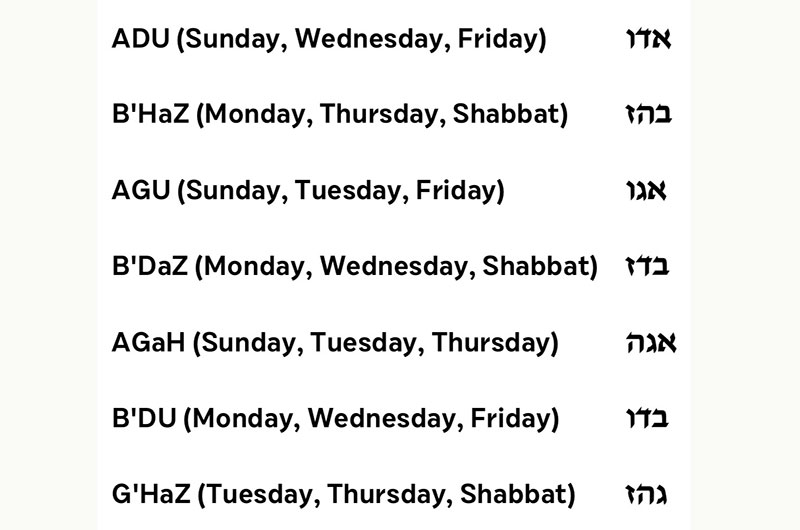
In our current fixed calendar, Rosh Hashanah cannot begin on three specific days of the week. The rule is called LO ADU ROSH. ADU stands for Alef (Sunday), Dalet (Wednesday), and Vav (Friday). (The days of the week are Sunday = Alef; Monday = Bet; Tuesday = Gimel; Wednesday = Dalet; Thursday = Hei; Friday = Vav or U; Shabbat = Zayin.) Thus, Rosh Hashanah can begin on Monday, Tuesday, Thursday, or Shabbat. Four days – yes; three days – no.
If the first day of Tishrei cannot be on Sunday, Wednesday, or Friday, then it follows that the second day of Rosh Hashanah cannot be on a Monday, Thursday, or Shabbat. And the third day of Tishrei cannot fall on a Tuesday, Friday, or Sunday. And so on...
There are seven variations on LO ADU (see below and accompanying graphic). By the eighth day, we are back to the original LO ADU, which applies to the first and eighth days of Sukkot as well as the first day of Rosh Hashanah. The variations are:
LO B’HaZ (not Monday, Thursday, or Shabbat – applies to Simchat Torah in Chutz LaAretz).
LO AGU (not on Sunday, Tuesday, or Friday – this applies to Yom Kippur and many other dates).
LO B’DaZ (not on Monday, Wednesday, or Shabbat)
LO AGaH (not on Sunday, Tuesday, or Thursday)
LO B’DU (not on Monday, Wednesday, or Friday – this one applies to Pesach)
LO G’HaZ (not on Tuesday, Thursday, or Shabbat – this one applies to Shavuot)
Every date from the 1st of Adar (or Adar Rishon) through the months of Adar, Nissan, Iyar, Sivan, Tammuz, Av, Elul, Tishrei, and up to and including the 29th of Marcheshvan – 295 dates, all told – cycles through the seven variations of LO ADU.
And then we come to the day after 29 Marcheshvan. In many years (55%), the following day is 1 Kislev. But in other years (45%), the day after 29 Marcheshvan is 30 Marcheshvan (a.k.a. the first day of Rosh Chodesh Kislev), and the day after that is 1 Kislev (and the second day of Rosh Chodesh Kislev).
The date of 30 Marcheshvan (when there is one) does not follow LO ADU or any of the other 6 variations. It cannot fall on a Monday, Wednesday, Friday, or Shabbat – only on a Sunday, Tuesday, or Thursday. This is a unique configuration of yes/no days.
But look what 30 Marcheshvan on/off does to 1 Kislev. The first day of Kislev can fall on any day of the week except for Shabbat. Unlike the majority of dates (295 or 385 possible calendar dates), a different cycle applies to the first 29 days of Kislev. Those dates cycle as follows: Not on Shabbat (the 1st, 8th, 15th, 22nd, 29th); Not on Sunday (the 2nd, 9th, 16th, 23rd); Not on Monday (the 3rd, 10th, 17th, 24th); Not on Tuesday (the 4th, 11th, 18th, 25th); Not on Wednesday (the 5th, 12th, 19th, 26th); Not on Thursday (the 6th, 13th, 20th, 27th); and Not on Friday (the 7th, 14th, 21st, 28th).
So, if your birthday is in Nissan or Tammuz or Tishrei, it can fall on four different days of the week. But if your birthday is in Kislev, it can fall on any of six days of the week.
The 30th of Kislev is also on/off depending upon the year, and that will affect the days of the week possible for dates in Tevet and Sh’vat. But we’ll stop for now and save that discussion for another time.
* * * * *
And now let’s look at some numbers for To-l’dot.
First, the TorahStats:
Here are some averages to put the numbers into perspective. The Torah is written in 245 columns (that’s the usual number, but it can vary) of 42 lines per column. That’s over 10,000 lines. With 54 sedras, the average number of lines per sedra is about 190 lines of a Sefer Torah. The range is from V’zot HaBeracha’s 70 lines to Naso’s 311. To-l’dot, at 172 lines, ranks 36th, just about two-thirds down the list.
Pesukim: The 5,846 total in the Torah means an average of a bit over 108 pesukim per sedra. To-l’dot’s 106 puts it close to average, in 29th place, tied with Vayigash and Bo, each of which is larger than To-l’dot in words and letters.
To-l’dot’s pesukim are on the short side; it ranks 34th (words) and 33rd (letters).
In Parshat Chayei Sara, we read about the ages of three people whose deaths are mentioned: Sara Imeinu died at 127 years of age; Avraham died at 175; and Yishmael died at 137.
When Sara died, Avraham was 137, and he had 38 more years to live. Yishmael was born when Avraham was 86 years old, so Yishmael was 51 when Sara died, and 89 when Avraham died. Yishmael and Yitzchak buried their father at 89 and 75 years of age, respectively.
At the beginning of To-l’dot, the Torah tells us that Yitzchak was 40 years old when he married Rivka. So, Avraham was 140 at the wedding and lived for another 35 years.
The Torah also tells us that Yaakov and Eisav were born when Yitzchak was 60 years old. Avraham was then 160, and he died when the twins were 15 years old.
This was the long way of pointing out that last week’s sedra, Chayei Sara, closed with events that happened much later in the Book of Bereishit.
Chayei Sara ends in the year 2171 from Creation (1589 BCE). To-l’dot begins in 2088 (1672 BCE).
We’ve seen this pattern earlier. Parshat Noach ended with Terach’s death at 205 years of age. Avraham was 135 at the time. Lech Lecha began when Avraham was 75 years old.
Speculation: The Torah finishes one “story” before beginning the next, when the individuals of the earlier “story” no longer impact on the new “story.”
There is a well-known “fact” about the Torah that sometimes events are presented out of chronological sequence – Ein seder mukdam um’uchar baTorah. Reasons for this vary (that is, when we know the reason).
Here’s another example from this week’s sedra. First topic: the birth of Yaakov and Eisav. Next, the deal – 15 years later – of the transferring of the birthright. Then Yitzchak and Rivka escape a famine and pose as brother and sister in Gerar. They live there for years, digging wells. And more. And then the second major episode of Yaakov and Eisav: Yitzchak is old and blind, and wants to bless Eisav. Rivka has other ideas. And so on…
When did the whole Avimelech in Gerar episode happen? Many commentaries say that it was during the 20 years between the marriage of Yitzchak and Rivka until the birth of the twins. This can explain how Yitzchak and Rivka could have posed as siblings. Hard to do that with children.
It is worth noting that bechora (birthright) and beracha (blessing) are anagrams in Hebrew. They are intimately related.
Let’s finish off with an observation of the Vilna Gaon. The word bechor (firstborn) is spelled BET-CHAF-REISH. Each of those letters has a numeric value double that of the previous letter in the Alef-Bet. BET is 2, ALEF is 1; KAF is 20, YUD is 10; REISH is 200, KUF is 100. This alludes to the double portion due a b’chor. No other letters are double the letter before them.
Shabbat Shalom.