 October 9, 2026
 Categories: Jewish Community / Political Scene
Albany Beat - July 31, 2026


DSA Wins Big in NY Primaries
It seems clear to me that next year’s legislative session will have a different look to it. It is likely the session will be filled with acrimony and hostility towards Jews and Israel as the Democratic Socialists of America gain ground in the Senate and Assembly. The hate spewed by the DSA towards Jews and Israel may be muted for purposes of decorum during session debates, but mostly will be prevalent in rallies and news conferences throughout the legislative session.
In total, 39 primaries were held on Tuesday, June 23, constituting only 14.1% of the 426 possible primaries. There were 31 contested primaries for the Assembly and eight contested Republican primaries. There were 10 Assembly races and one Senate race where Republicans left the line blank, giving the winning Democrat on each of those ballots a free ride to victory for a two-year term in Albany this November. This goes against the rule of always running a qualified candidate in every election.
Three-term assemblywoman Stefani Zinerman (D – Bedford-Stuyvesant, Brooklyn), will be packing up her office at the end of the year after losing her primary battle to Eon Huntley, a member of the DSA, by 3,100 votes out of 14,000 votes cast. Huntley is running unopposed in the November election.
Three-term assemblywoman Jenifer Rajkumar (D - Woodhaven, Queens) got walloped at the polls by DSA candidate David Orkin (D - Ridgewood, Queens), an immigrant workers’ rights attorney and union organizer, by approximately 18 percentage points (59 to 41 percent).
Aber Kawas, who once described the 9/11 terrorist attacks as “a couple of people died,” defeated Assemblyman Steve Raga (D - Woodside, Queens) who ran for the state Senate after vacating his assembly seat. Kawas is a self-described civil-rights advocate and “the daughter of Palestinian refugees,” according to her campaign website.
In the category of “Every vote counts,” marketing professional Patrick Martinez defeated Shamsul Haque by a mere seven votes and was outspent by Martinez by approximately 6:1. A third candidate in the race, Somnath Ghimire, was far behind in the vote count. Martinez ran for Raga’s seat in western Queens. Martinez will face Brandon Castro who is running on three lines – the Republican, Arts & Culture, and Reform parties.
Like it or not, the progressive DSA will be increasing their ranks from nine to 15 members in the Assembly and Senate chambers. Two longtime assemblymen, five-term (10 years) lawmaker Erik Dilan (D - Cypress Hills, Brooklyn) and 14-term (28 years) lawmaker Bill Magnarelli (D - Syracuse, Onondaga County) were defeated by small margins by DSA-aligned members. Dilan lost to DSA member Christian Celeste Tate, who will have a free ride in the November election as he is unopposed.
Magnarelli lost to Morris “Mo” Brown (D - Syracuse) by 104 votes (3,471 to 3,367) in an election where about 23 percent of Democrats in the district turned out to vote, according to unofficial election results. Brown will face Shawn Fiato (R - Syracuse) in the November election. She is the co-founder of the Park Avenue Neighborhood Association and a former member of the Onondaga County Legislature.
Nachman (Carl) Caller, 78, and Bernie Vaiselberg, 68, squared off in a Republican primary battle in Brooklyn. Caller is leading Vaiselberg by seven votes, 513 to 506. Vaiselberg initiated a court challenge based on voter irregularities. Overseeing the legal portion of the case is Peter Sweeney, a Kings County Supreme Court judge covering Civil Term cases. A determination in the case was expected on Friday, July 24, but testimony by witnesses in the case went longer than expected. The judge called it a day at around four p.m. The testimony by several other witnesses was to continue this week. A decision is expected to be handed down after The Jewish Press goes to print.
If attorneys for Vaiselberg are victorious in proving his case, it would set up a three-way general election with Caller on the Conservative line. The winner will face incumbent Senator Sam Sutton, a Democrat, who turns 77 next month.
Pesach Osina (D - Far Rockaway, Queens), a yarmulka-wearing Orthodox Jew, was successful in his primary bid against Mike Scala to succeed the retiring Assemblywoman Stacy Pheffer Amato. In previous elections, Osina failed twice, in 2013 and 2021, in his bids for a New York City Council seat. He has worked behind the scenes in various government positions, including as a community liaison for Queens Borough President Donovan Richards, within the Eric Adams administration as the Queens commissioner for the NYC Commission on Racial Equality, as well as a community engagement officer within the Emergency Services Division in the office of NYC Council Speaker Adrienne Adams, who is now Governor Kathy Hochul’s running mate. Osina has also served as a community partner within the NYPD’s 101st Precinct in Far Rockaway.
Osina still has a battle ahead of him, and he is not taking any chances of losing the seat in a heavily Democratic district. Besides the Democratic line, Osina has created an independent line called the “Community First Party.” His Republican opponent, Thomas Sullivan, has two other political lines. He is running on the Conservative Party line and the independent We the People Party. Scala will still be on the ballot holding an independent line labeled “People Over Politics Party.”
Looking ahead to the general election, Assemblyman Alec Brook-Krasny (R - Seagate, Brooklyn) is in a battle for his political life, facing Democrat Chris McCreight in November. Assemblyman Michael Novakhov (R - Sheepshead Bay, Brooklyn) is another member of the Jewish contingent facing a bruising battle in November against Joey Cohen-Saban, a Democrat, who is also on the independent line he created labeled the “Fight Anti-Semitism Party.” Cohen-Saban is chief of staff to Senator Sam Sutton and, like his boss, is a Sephardic Jew.
Jewish Man Financed General George Washington’s War for Independence
Most people believe America’s independence came on July 4, 1776. That was the date the Declaration of Independence was signed, but the British kept the war going for another seven years until the Treaty of Paris was signed on September 3, 1783, putting a final end to the Revolutionary War.
Haym Solomon (or Salomon) was a Polish-born American merchant best known for his actions during the American Revolution. He was also one of the primary financiers of the Continental Congress.
He was born on April 7, 1740, to Jewish parents in Leszno, in the Polish-Lithuanian Commonwealth. Solomon studied finance in Western Europe before emigrating to New York City in 1775, when he was 35 years old, establishing himself as a financial broker for American merchants engaged in overseas trade. This was the same year the American Revolutionary War broke out.
Solomon supported the Patriots by providing financial services while working alongside financier Robert Morris, the superintendent of finance of the United States. Solomon helped convert French loans into hard currency by selling bills of exchange on Morris’ behalf. He also brokered large donations to the Patriot cause.
In August 1781, the Continental Army trapped Lieutenant General Charles Cornwallis in the Virginia coastal town of Yorktown. General George Washington and the main army, along with Count de Rochambeau with his French army, decided to march from the Hudson Highlands to Yorktown and deliver the final blow. However, Washington’s war chest was completely empty, as was that of Congress. Without food, uniforms, or supplies, Washington’s troops were close to mutiny.
Washington determined that he needed at least $20,000 to finance the campaign. When Morris told him there were no funds and no credit available, Washington said: “Send for Haym Solomon.” Solomon raised $20,000 through the sale of bills of exchange. With that contribution, Washington conducted the Yorktown campaign, which proved to be the final battle of the Revolutionary War. From 1781 to 1784, Solomon helped provide over $650,000 (equivalent to $15.1 million in 2025). He also brokered the sale of a majority of the war aid from France and the Dutch Republic, selling bills of exchange to American merchants.
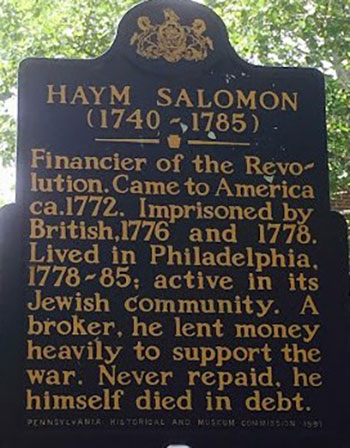
Solomon was an advocate for religious liberty and co-founded Philadelphia’s Mikveh Israel synagogue, challenging discriminatory laws. Despite donating his entire fortune to the Continental Army and several Founding Fathers of the United States, Solomon was still in debt when he died of a heart attack in Philadelphia on January 6, 1785, at the age of 44. Historians maintain that this was due to the failure of government officials and private lenders to repay the debt they owed him. He is buried at the Mikveh Israel Cemetery in Philadelphia.
Solomon received many honors after his death, including a commemorative stamp issued by the United States Postal Service in 1975 for his contributions to the cause of the American Revolution. This stamp, like others in the “Contributors to the Cause” series, was printed on the front and the back. On the glue side of the stamp, the following words were printed in pale green ink: “Financial Hero – Businessman and broker, Haym Solomon was responsible for raising most of the money needed to finance the American Revolution and later to save the new nation from collapse.”
The Magen David on the One-Dollar Bill
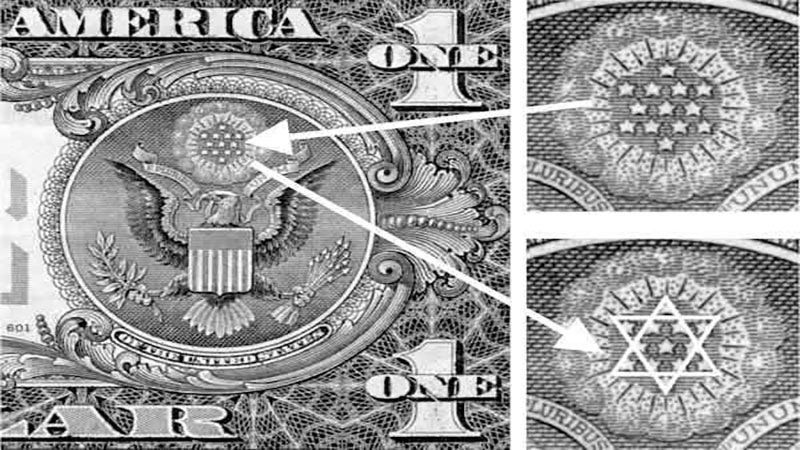
Under the category of “If you say it enough times it becomes a reality,” many people believe in the theory that the 13 stars representing the colonies on the one-dollar bill were arranged in the shape of the Star of David in commemoration of Solomon’s contributions.
The Star of David was hidden from plain sight when the Treasury Secretary under Washington wanted the Jewish symbol on the one-dollar bill. Washington objected due to the principle of separation of church and state and having no official religion in the newly-formed country. This made it past all the eagle eyes because the 13 stars were meant to represent the 13 colonies and afterwards, the original 13 states. (See main picture.)
A New Torah Finished in the Hippie-Dippie Town of Woodstock
On Sunday, June 28, Yud-Gimmel Tammuz, known as the Chag HaGeulah of the Frierdiker Rebbe in the Chabad movement, a new Torah was unveiled by the leaders of the Ulster County-based Woodstock, NY Chabad, with Rabbi Mendy and Shaindy Karczag as the co-directors.
Rabbi Karczag told The Jewish Press, “The Torah comes from Argentina. My brother-in-law is a sofer in New York and he knows the sofer in Argentina where labor is a little bit cheaper, so Torahs there are a bit cheaper than [in] Israel and America.” He said that the Torah, including the handles and cover, cost about $55,000 to $56,000, and the crown an additional $5,000, all of which were paid for by one anonymous donor. “The actual event cost over $10,000, which was fully sponsored by donors,” he added.
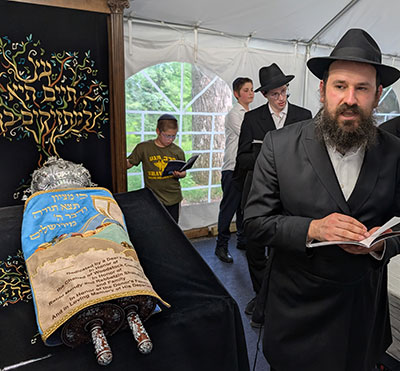
“He’s not a very wealthy person,” Rabbi Karczag said of the donor who covered the cost of the entire Torah. “He’s a middle-class guy and it really means a lot to him. He’s giving away a lot of his savings for this. The donor came up with the idea. He came to me. He initiated it.”
He continued, “It’s a member that comes to us every Shabbos and is very much part of our community, but he still wants to remain anonymous. Someone in the Woodstock area that prays, that comes to our weekly minyan.” But this donor wanted other people to be part of the experience, the rabbi explained. “It shouldn’t just be a one-person Torah. It should be communal. He was very gracious about that. Thank G-d we raised quite a bit of money for the event plus for the community, for Chabad.”
The response to this Torah completion was overwhelming in a mostly secular Jewish area.
“There are approximately 1,000 to 1,200 Jews in Woodstock,” Rabbi Karczag shared. “It’s fascinating to see the Jewish spark that so many people have here. It’s inspiring to see that every Jew matters and to see the joy as well as the pride that a little town like Woodstock has. We used to struggle for a minyan. These days we have 20 to 30 congregants attend services. We’re really growing. What I want your readers to know is to reach out to another Jew. You see a Jew in your neighborhood that maybe is unaffiliated – reach out, invite them.”
It was an interesting juxtaposition of Chabad rabbis wearing black hats and black coats marching through the streets of the town for the one-mile walk with the Torah under the chuppah to the village green, where scantily clad and shirtless musicians were playing their music and where, prior to the event, pro-Palestinian protesters had been demonstrating.
“Woodstock represents pleasure. Chabad represents intellect. Therefore, you’re going to have a certain discipline with that intellect, and this is the quintessential antibody,” the incomparable Rabbi Shea Hecht, chairman of the board of the Crown Heights-based National Committee for the Furtherance of Jewish Education, told The Jewish Press. “People are coming here to visit Woodstock. Why? Because that is almost – if I can say an extreme word – the source of the opposite of holiness. Observing Jews from all walks of life, young and old, is really electrifying and very, very beautiful.”
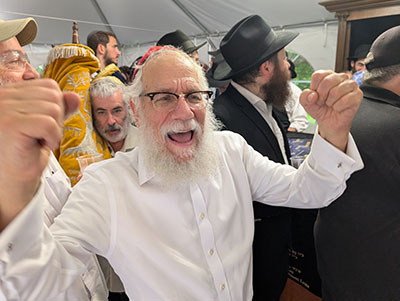
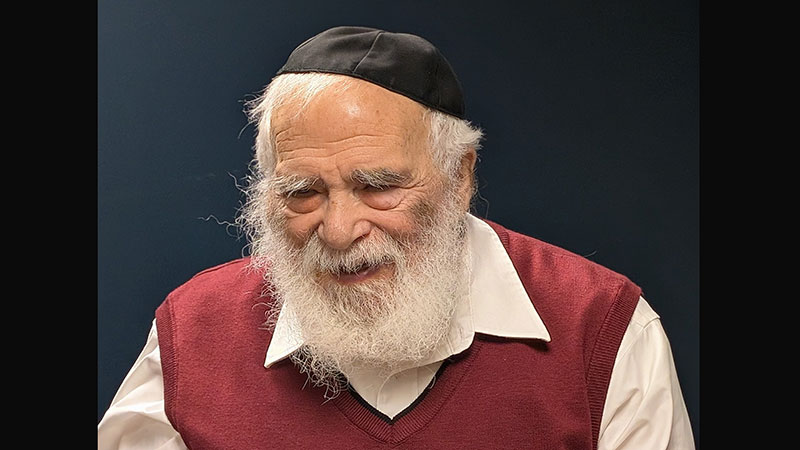
The spiritual leader for the Chabad Centers in Ulster, Dutchess, and Sullivan counties was impressed by the turnout and the reception from Woodstock residents.
“Wow, this is a big deal – we’re on the map in a big way,” Rabbi Yitzchak Hecht, co-director of the Chabad of Kingston, told The Jewish Press. He described the event as “awesome” both on a communal level and a personal level.
“When I moved out to Kingston 25 years ago, it was a few weeks later that someone started coming to Shabbat services in Kingston. He said to me, ‘You know, Rabbi, you should teach a class on Tanya in Woodstock.’ I said, ‘Okay, I don’t know where Woodstock is.’ We started teaching Tanya at the Woodstock Library and one thing led to the next. Eventually, we were able to recruit the Karczaks to come here and start a full-time Chabad house here. Then again, that was a major milestone.”
The population of the town, according to the latest census figures, is 6,241.