 October 9, 2026
 Categories: Headline / Political Scene
At Manhattan Protest, Calls for Feds to Investigate Mamdani
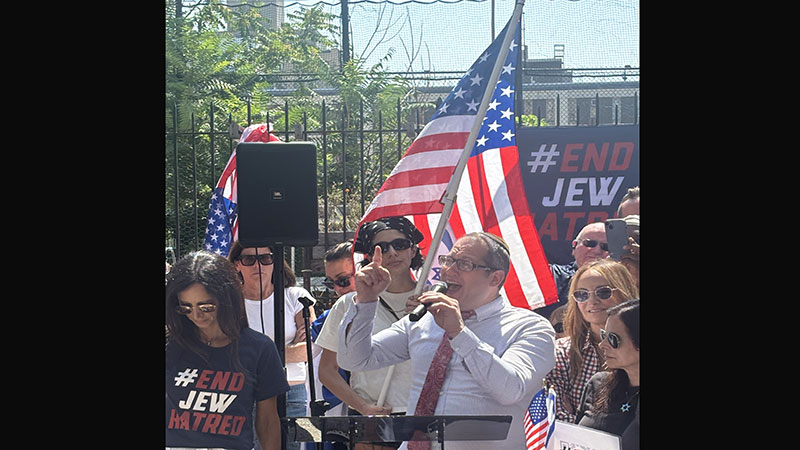


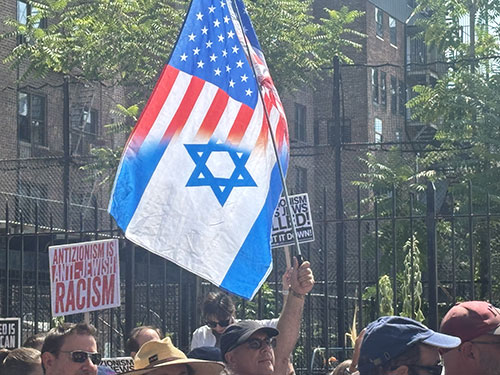
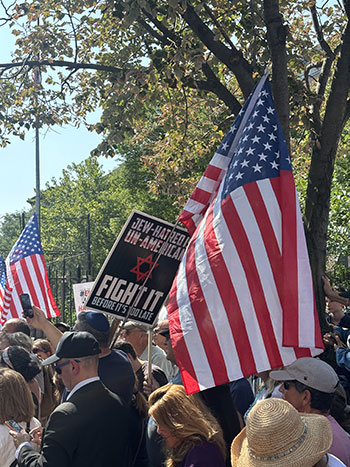
In response to a Jewish man being stabbed near his synagogue, approximately 200 people gathered on Manhattan’s Upper West Side Sunday morning to rally against rising antisemitism and the anti-Israel views of New York City Mayor Zohran Mamdani. Demonstrators wrapped themselves in American and Israeli flags and chanted for the removal of the controversial mayor, who they accuse of fostering a climate hostile to Jewish New Yorkers.
“We have the mayor of one of the greatest cities on earth spewing these horrific conspiracy theories, hate, libel, slander. Blood is on Mayor Mamdani’s hands,” event organizer Michelle Ahdoot, executive director of #EndJewHatred, told The Jewish Press.
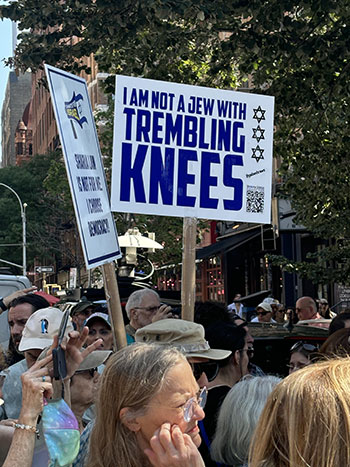
New York State Assembly Member Michael Novakhov, a Republican representing Brooklyn’s District 45, announced he was taking the fight to Washington. Novakhov told the crowd he is sending a letter to the U.S. Department of Justice (DOJ) demanding a civil rights investigation into New York City, New York State, and Mayor Zohran Mamdani. He said he intends to press for an inquiry into “Mamdani’s hatred against the Jewish population of New York City and New York state.”
In a social media post detailing the announcement, Novakhov put it more bluntly: “Jewish New Yorkers should not have to hide their Stars of David, tuck away their kippahs, or fear walking their own streets.” He drew a parallel to a separate federal action, adding, “If the DOJ stepped in to protect Jewish students at Columbia, it must now step in to protect Jewish New Yorkers.”
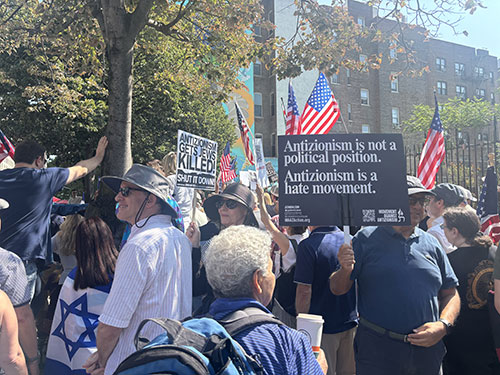
The “United Against Hate” rally was organized by the advocacy group #EndJewHatred, an initiative of The Lawfare Project, and took place two blocks away from Amsterdam Avenue and West 86th Street where, days earlier, a man shouted “Allahu Akbar” and stabbed an Orthodox Jewish man in the chest with a screwdriver. The attacker was arrested.
Police say the suspect, 51-year-old Raul Morales, targeted two victims blocks apart last Thursday afternoon: Moshe Yezhak Grunhaus, a 50-year-old Jewish man stabbed near his synagogue, and Chok Sung, a 57-year-old Asian man. Both assaults have since been classified as hate crimes, and Morales faces charges including attempted murder. Grunhaus has since been released from the hospital. As of the latest available reports, Sung was still in the hospital but recovering.
Blakeman Cites Lack of Leadership
Bruce Blakeman, the Nassau County Executive and the Republican nominee for New York governor, placed the blame squarely on City Hall and Albany. “There has been a darkness that has permeated over this city since January 1,” he told the crowd. “Darkness by the leadership, or the lack of leadership, of Mayor Mamdani, with the acquiescence of Gov. Hochul and so many others that will not condemn the anti-Jew rhetoric coming out of this mayor.”
He went on to warn that hatred does not stay contained to a single target: “And now we’ve seen, first it was the Jews, now it’s the Asian Americans.”
Blakeman tied the stabbings directly to the mayor’s posture on crime and to the state’s bail reform laws, arguing the two had combined to put New Yorkers in danger.
“Let’s stop beating around the bush: this is what happens when the sitting Mayor of New York City actively demonizes Jewish residents and normalizes antisemitism while Kathy Hochul’s disaster of a bail law ensures that hate-mongers walk free before the police report is even typed up,” he said.
The gubernatorial candidate called for stiffer criminal penalties for anyone convicted of a hate crime and pinning the blame for the attack on policies championed by both the mayor and the governor.
“You cannot attack the Jewish community with radical rhetoric, close jails and then act surprised when innocent New Yorkers are stabbed on a Thursday afternoon,” he said. “New York’s laws need to change to protect the victims, not the criminals.”
Mounting Tension
Demonstrators chanted “Remove Mamdani” and carried signs reading “Never again is a promise,” framing the rally as a demand for accountability rather than simple protest.
The mayor addressed the controversy, telling reporters on Sunday that there is “no room for hate or bigotry of any kind” in New York City. He said criticism of a nation-state’s policies should never be mistaken for criticism of a people or a faith, and claimed that rooting out antisemitism “across the five boroughs” remains a priority for his administration.
For many at Sunday’s rally, the attack was not an isolated act of violence but the culmination of months of what they describe as inflammatory political rhetoric by Mamdani. Organizers pointed specifically to a video Mamdani released two days before the stabbing in which he acknowledged that his administration lacked the legal authority to arrest Israeli Prime Minister Benjamin Netanyahu should he travel to New York for the UN General Assembly in September. He called Netanyahu a “war criminal” and urged activists to protest against him.
“The mayor knows fully well that he cannot arrest Bibi Netanyahu,” Ahdoot told The Jewish Press. “So the only purpose of that video was to incite hatred towards the Jewish community and enhance the Islamism that he is completely embracing.” She urged Hochul to use the governor’s legal authority to remove Mamdani from office for cause.
Moshe Spern, a history teacher and president of the United Jewish Teachers advocacy group, told the crowd that prejudice has a way of spreading once it takes hold. He also believes the mayor’s video about Netanyahu helped create the conditions for the Upper West Side attacks.
“Mamdani’s video was seen by 300 million people, and at the end he said ‘we must do something to speak up against the genocide.’ That was a message that they should do something against the Jewish community,” Spern explained to The Jewish Press after his speech.
Rabbi Avi Weiss, founding rabbi of the Hebrew Institute of Riverdale in the Bronx (N.Y.) and a longtime activist, told the crowd that a mayor is supposed to unite a city’s communities rather than divide them. Weiss said Mamdani was “throwing gasoline on the fire, pitting one community against the other after that vile video,” adding, “you’ve placed a target on the back of each and every one of us, including that attack on the west side.”
After the event, an invited rabbi spoke to The Jewish Press about how he was moved by the diverse backgrounds of the speakers and participants. “It’s beautiful to be here with so many fellow Jews, to show up with Ahavas Yisrael, to stand up for a fellow Jew,” said Chabad Rabbi Shlomo Litvin who was visiting from Kentucky. “To see Jews and non-Jews come together and say antisemitism doesn’t have a place in our society is very inspiring.”