יום שבת, ו׳ חשוון תשפ״זSaturday, October 17, 2026



Follow Us


Rabbi Michael J Broyde, author of a dozen books and countless articles, is a law professor at Emory University and the Berman Projects Director in its Center to the Study of Law and Religion. He has served in a variety of rabbinic roles in the United States, from director of the Beth Din of America to Rabbi of the Young Israel in Atlanta and much more.
Read More
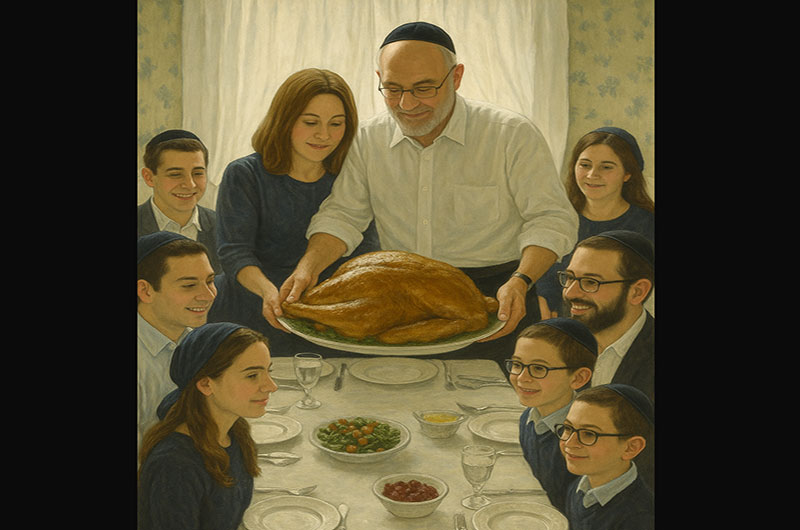
For the Orthodox Jew, Thanksgiving presents a rare opportunity. It is not a religious holiday. It does not ask us to compromise halacha or identity. Instead, it calls us to practice something Jews know almost intuitively: gratitude (hakarat ha-tov).

Some will argue that silence is cowardice, that in critical times rabbis must declare who to vote for. That is nonsense.
This article discusses the final category: federal holidays that are religious in origin but are now seemingly celebrated secularly, with New Year’s Day as an excellent example of that.

One can say that eclipses could be different from all other created natural anomalies as a matter of Jewish law and are not covered by the general idea of a wonder such that a blessing should be made.
If you think this is factually true – that generally these fight can be won if only we tried harder – I would urge you to look closely (and honestly) at today’s America and examine the data before claiming this fight is winnable.
Let me explain what Rabbi Feinstein is hinting at. An alternative to “live and let live” is that the government promulgates (to use Rabbi Pruzansky’s word) substantive moral values such as family values, revealed truth, social justice, or national identity.
We all know accommodation isn't popular, does not have the cache of moral purity and absolutism, of defiant declarations. But life is usually lived in a grayer place, unattractive as that is.
Certainly, one could debate the halachic consequences of these scientific fact, but never their undergirded truth.
In the face of tragedy and evil, there are naturally two responses. One is to help the victim of the wrong and the second is to punish the evil-doer and make sure the wrong does not happen again.
To describe Rabbi Henkin by that singular – albeit incredible – accomplishment of advanced Torah study for women would be incomplete, to say the least.
Rabbi Lamm was prepared, indeed proud, to be an “intellectual diplomat” who sought to make peace between competing ideas.

He was among the first in America to have special tefillot for Israel’s Independence Day, but he was simultaneously least inclined to word these prayer along the lines of the arrival of the redemption or the heralding of the messianic era.
We should support such a law since our community thrives in a meritocracy and withers in discriminatory environments.
Indeed, there are several reasons that a ketubah should not be enforced in New York – or anywhere in America – beyond those which the court mentioned.
The law gives everyone just enough rights to hurt children, not help them.
Jews should support legislation prohibiting denial of services or employment due to beliefs.
The Orthodox community should support laws that prohibit commercial discrimination in activity
The higher the standard of review, the less likely it is the law will be constitutional.
Israel – the land and the nation – lost a giant earlier this month with the passing of Justice Menachem Elon, a monumental talmid chacham who served on the Israeli Supreme Court from 1977-1993, and as its deputy president from 1988-93, bringing a deep Torah viewpoint to the highest tiers of the Israeli judiciary.

We know that genuine halachically viable solutions to the agunah problem are hard to come by and might not even be within our grasp. But we also know the agunah problem can be functionally solved in practice, even if not in theory, and the solution is clear and obvious.


 October 16, 2026