יום חמישי, כ׳ תשרי תשפ״זThursday, October 1, 2026



Follow Us


Rabbanit Shani Taragin is educational director of Matan-Bellows Eshkolot Tanakh teachers’ programs and Mizrachi Olami Lapidot. Shani directs, leads tours, coordinates, and teaches Tanach, Talmud, Halacha and women’s health in numerous seminaries and adult education programs in Israel and worldwide. Shani lives with her family in Alon Shvut, Gush Etzion-Israel.
Read More
As our table is comparable to the Altar, and our bread like an offering brought on the Altar, we wash our hands before eating bread and thereby sanctify our eating.
Boker tov is not merely a salutation to others wishing them a “good morning,” it is also a mandate for myself to set a proper mindset to start my day.
Miriam – a woman of water and wellness, in whose merit a miraculous well provided Bnei Yisrael with water in the wilderness for forty years, sustained the fledgling nation physically and spiritually.
The Lubavitcher Rebbe, zt”l, explained, when two Jews shake hands, the five fingers of one person become intertwined with the five fingers of the other, together forming a covenant reflecting the two tablets of the Ten Commandments.
As we must go out to battle again, we are reminded of the chain of succession and success from the time of Moshe Rabbeinu and Yehoshua ben Nun.
These somber laments/dirges expressing public mourning and grief are composed with short meters resonating with sentiments of loss and incompletion.
Something already touched me then; the clouds atop the hills, the winds across my face, the sun peeking between the eagle-shaped yeshiva, all contributed to a spiritual connection with Hashem, drawing me to return.
Kavod, honor, respect and esteem judged by societal standards, is in fact taught by chazal, a value and sense of self-esteem bestowed by us to other creations of Hashem.
Ruach is described in various contexts in Tanach as wind, spirit and breath. As the physical world had not yet been created, the first mention of ruach connotes a spiritual desire of Hashem.
As I study the pages of Gemara, the literature of Torah Sheb’al-Peh is transformed to a live discussion between Tannaim and Amoraim across generations...
As reflections of the image of Hashem we must maintain our healthy bodies, selves and souls.


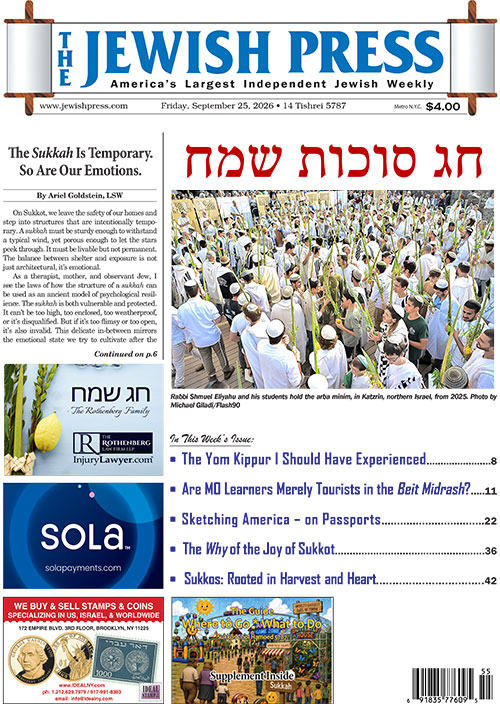 September 25, 2026