 October 23, 2026
 Categories: Halacha & Hashkafa / Torah
Bounced Check Fee Feud
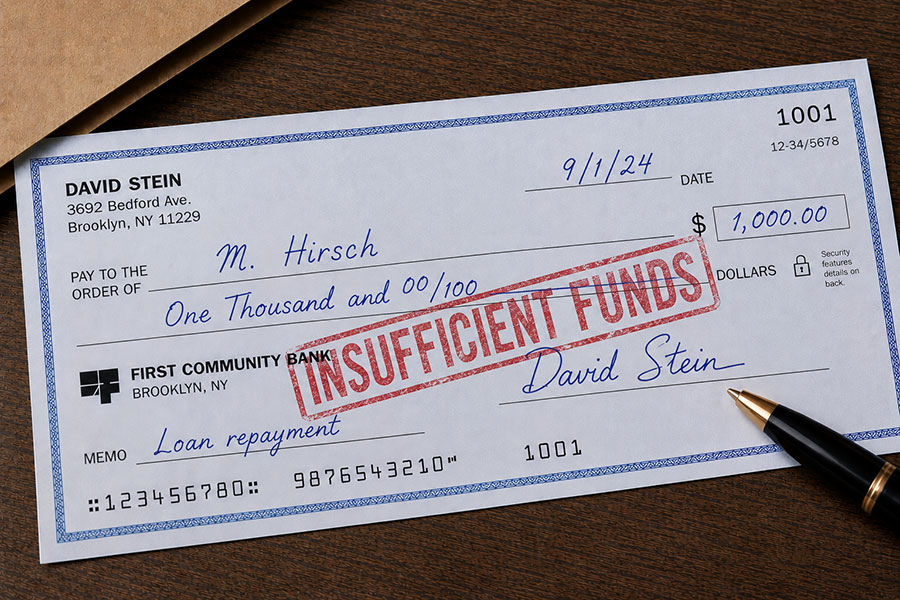


Mr. Stein borrowed $1,000 from Mr. Hirsch for a three-month period, issuing a check post-dated for September 1 as repayment.
“Don’t worry,” Mr. Stein assured him. “The funds will be there when the check is due.”
However, Mr. Hirsch was away on an extended vacation when September 1 arrived. The check remained in his drawer until he returned home two weeks later. Only after Yom Kippur did he remember to deposit it.
Meanwhile, the Steins were busy with Yom Tov preparations. Between groceries, clothing, and other expenses, their account balance dropped to only $500.
Just before Sukkos, Mr. Stein received an alert from his bank: The check had bounced!
He frowned as he reviewed the details. The bank had charged him a $40 insufficient funds fee. In addition, Mr. Hirsch informed him that his own bank had charged a $20 fee for the returned check.
“You need to reimburse me for the $20 fee,” Mr. Hirsch said. “It was your check that bounced.”
Mr. Stein was taken aback. “You deposited it three weeks late!” he replied. “Had you deposited it on time, the funds would have been there. I shouldn’t be responsible for your fee – if anything, you should reimburse me for the $40 that I was charged!”
Mr. Stein hesitated, then added, “Besides, paying you $20 extra might be a problem of ribbis.”
Mr. Hirsch shook his head. “You gave me a check that wasn’t covered. That’s your responsibility.”
Unable to resolve the dispute, they turned to Rabbi Dayan and asked:
“Who is liable for the fees? Is there a concern of ribbis if Mr. Stein pays either of the fees?”
“When someone incurs unnecessary expenses based on another’s unfulfilled commitment, the party at fault is liable as garmi, one who directly caused damage,” replied Rabbi Dayan.
For example, if two people arranged to litigate before a beis din in another city, but one party did not appear, he is liable for the expenses incurred by the other party (Rema C.M. 14:5).
Similarly, if someone sold defective merchandise and was aware that the customer intended to take it elsewhere, the seller is liable for the return expenses. If he knew beforehand that the merchandise was defective, he is also liable to reimburse the customer for his needless expenses in transporting the item there (C.M. 232:21).
Thus, when a check bounces, if the lender deposited the check when due (or a few days later), the borrower is also liable for the lender’s fee, unless unforeseen, uncontrollable circumstances made it impossible for him to cover the check (Pis’chei Choshen, Halva’ah 2:41[100], Nezikin 3:26[63]).
However, if there were sufficient funds when due, but because of the lender’s delay in depositing the check there was no longer coverage, the borrower is not liable for the lender’s fee, since the borrower is not necessarily at fault.
Regardless, there is no issue of ribbis in covering the fee of the lender, even if the borrower is not liable but nonetheless chooses to reimburse the lender the fee he incurred (Bris Yehudah 9:6[10]; The Laws of Ribbis 4:1).
Conversely, the lender is not liable for the borrower’s insufficient funds fee, even if he delayed in depositing the check, since people do not always deposit checks promptly. The borrower is responsible for managing his account, including outstanding checks. Furthermore, in most cases the issuer either has or doesn’t have coverage for the check, regardless of whether it is deposited on or after the date.
If, however, the borrower specifically instructed the lender to deposit on time, since otherwise there might not be coverage, but the lender nevertheless delayed, he should verify whether there is coverage. If he failed to do so, he directly caused the borrower’s fee by depositing late in contravention of the arrangement with the borrower.
“Therefore, in our case,” concluded Rabbi Dayan, “neither party is liable for the other’s fee, since there was coverage for the check had it been deposited on time, but Mr. Hirsch delayed. Nonetheless, if Mr. Stein should choose to pay Mr. Hirsch’s fee, there is no concern of ribbis.”
Verdict: If a person deposited a check promptly, which bounced and incurred a bank fee, the issuer is liable for the depositor’s fee unless unforeseen, uncontrollable circumstances prevented the issuer from covering it. If the recipient of the check delayed in depositing it, though, so that there was no longer coverage, the issuer is not liable. Regardless, there is no concern of ribbis in covering the fee.