 September 25, 2026
 Categories: Headline / Business/Finance / Money Matters
Budgeting with Purpose: A Torah-Guided Approach
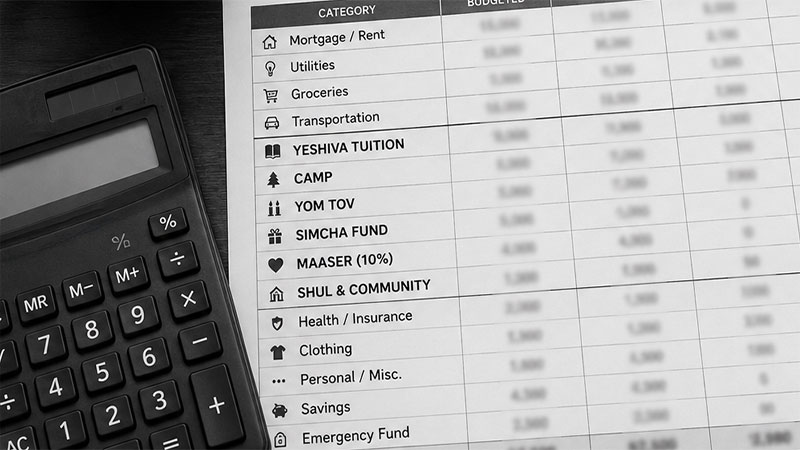


My wife and I sat down one Motzei Shabbos in May and did something we'd been avoiding for months. We added up a full year of expenses. Tuition for three children came to just over $50,000. Two simchas added another $15,000. Yom Tov, including preparation, new clothing, and food, ran close to $10,000. Summer camp added another $20,000 among all the kids. None of these numbers appeared on any generic budgeting worksheet we downloaded, yet together they represented a meaningful portion of our annual spending. We weren't overspending based on our income; we were simply spending on categories the budgeting apps don't have. Do you have any budgeting advice specifically geared toward frum families?
Reviewing expenses honestly is the real starting point for financial planning in an Orthodox home. Standard advice built around rent, groceries, and gym membership misses the categories that drive frum family budgets. A useful plan must name them before it can manage them.
The Categories a Frum Budget Actually Needs: Naming frum-specific categories explicitly, rather than forcing them into a generic budgeting framework, is often the single biggest improvement a family can make to its budget.
1. Yeshiva tuition and camp costs are usually the largest line item a family will carry, often for fifteen or twenty consecutive years across multiple children. It deserves its own multiyear projection rather than a single monthly guess.
2. Simchas, including bar and bat mitzvahs, weddings, and sheva brachos, arrive in clusters and can be planned for years in advance, knowing how many are coming and roughly when.
3. Yom Tov expenses, covering food, clothing, and travel, spike predictably several times a year. They should be treated as scheduled rather than surprises.
4. Tzedakah and maaser function as a fixed obligation the same way rent does and belong at the top of the budget rather than leftover generosity.
5. Kosher food costs meaningfully more than a general market basket, particularly for larger families, and may need planning, especially for Shabbos, which is the equivalent of having a Thanksgiving-style meal twice every week.
6. Shul membership, mikvah dues, eruv contributions, and other local commitments round out a set of recurring communal expenses that rarely appear in mainstream financial planning.
The Basics, Adapted: The familiar budgeting philosophies still hold value once adjusted for frum life.
50/30/20 split: This approach divides after-tax income into needs, wants, and savings, at 50%, 30%, and 20% respectively. In the frum world it works better when that 20% is split evenly between savings and tzedakah, and when the 50% for needs incorporates tuition, simchas, and Yom Tov preparation from the outset.
Reverse budgeting: Popular among high-income professionals, this is also known as the “pay yourself first” approach. Savings and maaser transfer out the moment a paycheck arrives, before the month's bills are considered. The remaining money can go toward lifestyle without tracking every line item. This may not work as well for families with a more strained budget.
Zero-based budget: This approach assigns every dollar, including tuition, simcha savings, and Yom Tov funds, a specific job, so the balance reaches zero by month's end with nothing unallocated. This works especially well for larger families, where the number of moving pieces makes vague spending dangerous.
Envelope method: This strategy sets a fixed spending limit for each category and places that amount in a separate envelope, physical or digital. Once an envelope is empty, spending in that category stops until the next month. This suits elastic categories like clothing and dining, while communal categories are better handled through dedicated savings accounts.
Whichever structure a family chooses, give it ninety days before deciding whether to adjust. Switching methods every few weeks, before any of them has a chance to work, defeats the purpose.
Advanced Tactics Built for Orthodox Families: Once the basics are in place, a frum family has access to strategies that rarely appear in general financial advice because they depend on communal structures unique to Orthodox life.
Tuition conversation: If paying yeshiva tuition is a struggle, begin the conversation with the school's scholarship committee early, ideally in the winter before the following school year, rather than waiting until a crisis develops. Schools can work far more effectively with a family that approaches them with a clear financial picture than with one that simply falls behind. It also helps to build a running, multiyear tuition projection across all children, since a family with four children spread across a decade and a half of schooling is managing one long financial project.
Simcha fund: Open a dedicated simcha fund years before it is needed, treating it the way a pension fund treats retirement, contributing steadily on a schedule tied to the ages of the children rather than scrambling when an engagement is announced. Families with several children close in age benefit from mapping out roughly when each simcha will arrive and smoothing contributions across those years.
Gemachs: Use community gemachs deliberately as part of a financial plan rather than as a last resort. Interest-free loan funds for simchas, medical costs, or short-term cash flow gaps exist to prevent families from turning to high-interest debt. Treating a gemach as a normal financial tool, rather than a sign of failure, changes how a family relates to its own cash flow.
Location matters: Consider the real cost differential between in-town and out-of-town communities, since housing, tuition, and cost of living can differ dramatically. Some families find that a move meaningfully changes their long-term financial trajectory.
Make the most of bonus money: Whenever a raise, bonus, or new source of income arrives, commit at least half of it to tuition, the simcha fund, and savings before adjusting day-to-day lifestyle. This single habit does more to prevent the slow creep of financial strain so many frum families describe where income rises every year, yet the pressure never eases.
The Mishkan Principle: The Torah's account of building the Mishkan offers a financial lesson that speaks directly to everything above. Before any gold, silver, or copper was collected, Hashem gave Klal Yisrael a mission, "V'asu Li Mikdash," make for Me a sanctuary. Purpose came before numbers. A frum family's budget should work the same way, built around clarity of values first. Those values should be laid out, whether a child's chinuch, a couple's ability to make a simcha without debt, or a household's ability to give tzedakah consistently, and only then translated into spreadsheet categories.
The Torah praises the donors to the Mishkan as “nediv lev,” generous of heart, yet the giving was structured, requested in specific amounts, and stopped by Moshe once the goal was reached. This models disciplined generosity for a modern household. Maaser and yeshiva tuition are planned line items, not impulsive afterthoughts, and a family can allocate its funds with real purpose while still giving within a structure that protects its own stability.
The Torah also devotes an entire section to accounting for every material used in the Mishkan, essentially a public audit, modeled by Moshe Rabbeinu himself. Financial transparency, whether a couple reviewing their numbers monthly or a family being honest with a tuition committee, is not a secular add-on to Jewish life. It is closer to the Torah's own standard.
The Mishkan itself was stunning, filled with gold and precious fabric, yet every measurement was deliberate rather than excessive. Spending on a simcha, a Yom Tov table, or a home should elevate a family's life without inflating its lifestyle. Beauty without structure becomes indulgence while beauty within structure becomes holiness.
Choosing Tools That Fit: General tools like YNAB, Monarch Money, or a simple spreadsheet remain useful for day-to-day tracking, and any of them can work well once tuition, simcha, and Yom Tov categories are built in.
For the communal side of frum finances, the most valuable tools are often not apps at all. A written, multiyear tuition and simcha projection, along with a relationship with a financial advisor or a knowledgeable rav, can make the biggest difference. The reality is that not every family can absorb these costs no matter how well they budget. In such a situation, free financial counseling for struggling families offered by the Orthodox Union may be impactful.
Budgeting, approached through this framework, stops being a chore of arithmetic borrowed from a world that doesn't share a family's priorities. It becomes an honest reflection of what a household values, planned with the same purpose, structure, and consistency that built the Mishkan itself.