 October 16, 2026
 Categories: Headline / Business/Finance / Money Matters
Buying or Leasing a Car


A few weeks ago, my wife was driving along Central Avenue in the Five Towns when a car pulled out of a parking spot and slammed into her. Baruch Hashem no one was hurt. The other driver accepted responsibility, and the police and insurance company handled the situation professionally. Still, the experience shook us. While our car sat in the autobody shop, my wife and I found ourselves asking a question many families in our community confront: Should our next car be bought or leased?
On the surface, it sounds like a simple financial choice. In reality, it is one of the most misunderstood decisions families make. Too often people focus on the monthly payment while ignoring long-term cost, lifestyle implications, and the realities of family life. Buying is usually better for long-term transportation costs. Leasing can be better for cash flow management and convenience. The right decision depends on how long you keep cars, how much you drive, where you live, your family dynamics, and what you value financially. Let’s dive into some of these issues:
The Financial Planning Lens: Buying a car generally produces the lowest lifetime cost. It tends to work best for people who keep their vehicles for many years and value long-term cost efficiency over having the newest model. The drawbacks are the upfront cost, depreciation, maintenance as the car ages, and tying up cash in a vehicle.
Leasing suits people who want a new car every few years, drive relatively few miles, and value predictable payments. The drawbacks are mileage restrictions, potential wear charges at lease end, no equity, and the fact that monthly payments never end. Electric vehicles add another wrinkle. Leasing can sometimes be financially attractive because manufacturers may pass federal incentives through the lease differently than a direct purchase. Furthermore, electric vehicle technology can change often. Leasing prevents being stuck with an antiquated model after just a few years that is unable to update its systems properly.
Do Not Compare Only the Monthly Payment: One of the biggest mistakes consumers make is comparing only the monthly payment. A $500 lease payment is not necessarily cheaper than a $700 purchase payment. A three-year lease at $500 per month totals $18,000, but the real cost may include fees, taxes, and wear charges. A purchase at $700 per month for five years totals $42,000, but after five years you own an asset with value. The better comparison is the total cost of leasing versus buying, including the value of the vehicle you still own at the end.
New Versus Used: A new car experiences its greatest depreciation during the first few years. Leasing means you pay to use the vehicle during those highest value years without owning it after depreciation. Buying new means that you absorb that depreciation. It makes the most sense when you plan to keep the car for many years and you prioritize maximum reliability in the initial years.
Buying used means someone else has absorbed part of that initial depreciation. For families dealing with significant financial pressure from tuition, simchas, or other obligations, a reliable used car purchased with a manageable loan is usually the safest choice while preserving more cash for other priorities. Once the loan is paid off, the family has a car with no monthly payment. Families should be cautious about stretching a loan simply to reduce the monthly payment or rolling negative equity into a new loan. Regardless of the purchase price, families should also set aside money for maintenance and repairs to prevent an unexpected expense from becoming a financial emergency.
Where You Live Changes the Math: Geography affects the decision more than people realize. In high-tax states such as New York, New Jersey, and Connecticut, leasing can be helpful by reducing upfront cash requirements and spreading certain costs over the lease term. Leasing may also be attractive in places with heavy snow and road salt, which causes vehicles to deteriorate faster. However, dense suburban areas often mean more parking dings and minor damage, which can create problems at lease end. It’s also important to consider insurance costs, which can vary significantly geographically.
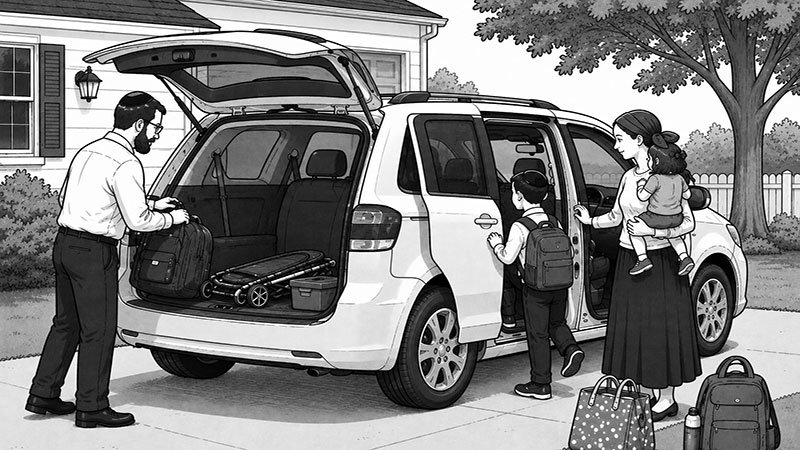
Family Life Matters More Than the Spreadsheet: For frum families, the decision becomes personal. Mileage is easy to underestimate. A frum family that drives multiple children to school, camp, activities, appointments, and relatives can quickly accumulate fifteen to twenty thousand miles a year. Children also mean car seats, strollers, sports equipment, camp gear, spilled snacks, and plenty of wear and tear. Those realities can make leasing less attractive due to mileage limits or damage charges at the end of the lease. Leasing may be a good fit for growing families with changing transportation needs. A family may move from a sedan to SUV to minivan as children arrive, and leasing can provide flexibility during those transition years.
What Makes a Car a Financial Drain: Lifestyle inflation as income rises is a particularly relevant danger. It is not uncommon to see professionals who spend years in training immediately lease or purchase a luxury vehicle once they finally start to earn a lucrative wage. People often upgrade their cars without realizing how much of their additional income is being consumed by transportation. The purchase price is only one part of the equation. Depreciation, insurance, financing, maintenance, repairs, and opportunity cost can make certain vehicles far more expensive than they appear. Two cars that cost $60,000 can have dramatically different long-term ownership costs. One might be inexpensive to maintain and hold its value well. Another might require expensive tires, brakes, specialized repairs, and higher insurance premiums.
Financing can also create problems. A long seven-year loan may make an expensive vehicle appear affordable by lowering the monthly payment. However, it also means you may be making payments long after the car has lost a significant portion of its value. Chazal remind us that true wealth is knowing what is enough, and that perspective applies to cars as much as anything else.
The Bottom Line: Buying is generally the stronger financial choice for families that can keep a reliable car for many years. Leasing can make sense when lifestyle, geography, mileage, or business needs tilt the scales, but it is rarely the lowest cost option over time. A practical middle ground is buying a two- to four-year-old dependable used vehicle and keeping it for seven to ten years, which avoids steep early depreciation while providing years of stable ownership.
As for our own situation, the insurance company determined that our car was not totaled, and the autobody shop did a beautiful job fixing it. When I mentioned to people that we got our 11-year-old car back with everything repaired, a few lamented that we could not take the insurance money and lease something newer and nicer. That is not how we view automobiles. A car is simply a way to get from point A to point B, not a status symbol.
In a community where tuition, housing, and simcha expenses stretch families, the right car is the one that supports your life, your values, and your financial stability.