September 11, 2026
 Categories: Halacha & Hashkafa / Torah
Can One Fulfill Another’s Tzedakah Pledge?
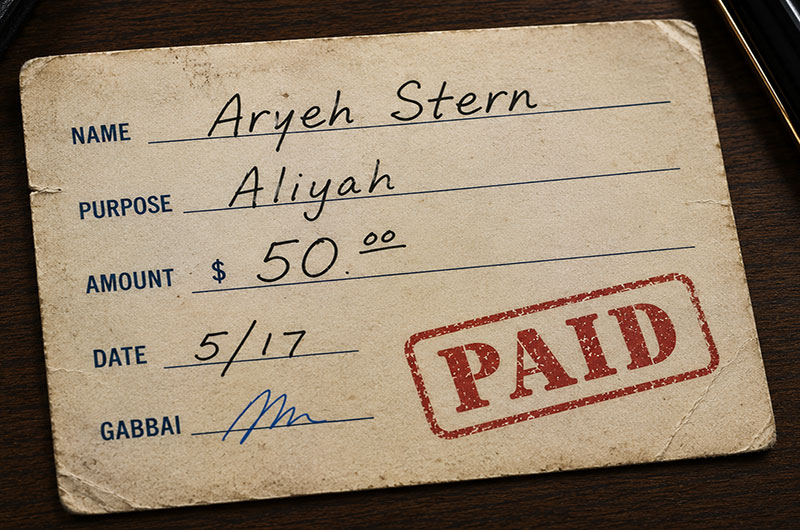


Mr. Stern always looked forward to the occasions when his married son, Aryeh, came for Shabbos. The house felt livelier, the grandchildren filled the rooms with energy, and the Shabbos meals stretched pleasantly longer than usual.
That Shabbos, the gabbai called up Mr. Stern’s son for an aliyah.
“Ya’amod Aryeh ben…” the gabbai announced warmly. Mr. Stern smiled proudly as Aryeh approached the bimah.
As was customary, Aryeh pledged a donation to the shul after his aliyah. “Fifty dollars,” he declared generously.
After Shabbos, the family packed up to head home. Between loading suitcases, searching for missing shoes, and ushering sleepy children into the car, the pledged donation quickly slipped everyone’s mind.
Sunday morning, though, Mr. Stern returned to the shul for Shacharis. After davening, he approached the gabbai.
“Aryeh pledged $50 yesterday for his aliyah,” Mr. Stern said. “I’d like to cover it for him.” He gave the gabbai $50.
The gabbai thanked him and recorded the payment.
A few minutes later, Mr. Stern sent Aryeh a message: “Your aliyah pledge is covered! No need to pay the shul anymore.”
Aryeh smiled, touched by his father’s thoughtfulness. Still, the message left him wondering.
Indeed, the shul received the money and the donation was paid. On the other hand, after his aliyah, he had pledged that he would donate.
That evening, Aryeh called his father.
“Are you sure that your payment completely clears my obligation?” he asked. “I pledged that I would give tzedakah – perhaps I still have a personal obligation because of my pledge.”
Mr. Stern shrugged. “The shul got the money,” he replied. “Why should you still owe anything?”
But Aryeh remained uncertain. The next day, he called Rabbi Dayan and asked:
“Do I still have any obligation to honor my pledge?”
“When you owe money to someone, and a third party pays the creditor of his own initiative, you are thereby relieved of your obligation to pay,” replied Rabbi Dayan. “The poskim debate whether the third party can demand reimbursement from you, which depends on the circumstances surrounding the debt” (E.H. 70:8; C.M. 128:1).
Pischei Choshen (Halva’ah 5:34[91]) suggests that perhaps the reason you are relieved of your obligation to the creditor is because of mechila, since the third party implicitly stipulates that his payment is on the condition that the creditor forgo your obligation to him. Alternatively, the third party may be considered your agent, although you did not appoint him, based on the principle of zachin l’adam shelo b’fanav. Thus, once he pays the creditor on your behalf, your debt is considered paid.
Nonetheless, Responsa Oneg Yom Tov (#87) questions whether one who pays your tzedakah pledge relieves you of your obligation if he did not first transfer ownership of the money to you. Although a third party can relieve you of a monetary obligation incumbent upon you, perhaps he cannot remove your personal obligation to fulfill your words and give tzedakah.
Similarly, although the Gemara (Arachin 21a-b) teaches that a person can bring sacrifices to fulfill another’s obligation, Oneg Yom Tov suggests that perhaps this applies only to obligatory offerings, such as Chatas and Asham. However, when one pledges a voluntary offering, perhaps this creates a personal obligation upon the person himself to honor his pledge, and if so, he is not exempt until he brings an offering from his own money.
This issue may depend on the underlying rationale for why third-party payment relieves a debtor.
The first reason – mechila – clearly does not apply to a korban pledge. It might not even apply to a tzedakah pledge. If someone pledged tzedakah to a certain needy person but the latter refuses to accept the donation, the Acharonim dispute whether the donor is relieved of his pledge or has to give tzedakah to another needy person (see Taz Y.D. 203:3; Tzedakah U’Mishpat (4:9[28]).
However, the other rationale – that the third party is considered the debtor’s agent based on zachin – could possibly apply to relieve a donor of his obligation to offer a korban or give tzedakah, but on the other hand, an obligation on the person to uphold his words might remain.
“Oneg Yom Tov does not reach a clear resolution,” concluded Rabbi Dayan. “In cases of doubt concerning tzedakah, usually you should try to be stringent and give” (Y.D. 258:13; C.M. 212:8). However, several poskim are lenient on this issue, especially regarding an aliyah pledge, since the primary purpose is to benefit the shul, and the pledge is pronounced by the gabbai, not the donor (see Kol Nidrei (Shtesman) 61:26-27, 61:47[102]).
Verdict: Oneg Yom Tov questions whether covering another’s pledge relieves him of his personal liability to honor his words. Several poskim are lenient regarding an aliyah pledge.