 October 23, 2026
 Categories: Headline / Halacha & Hashkafa / Holidays / Torah
Can You Take In Shavuot Early?
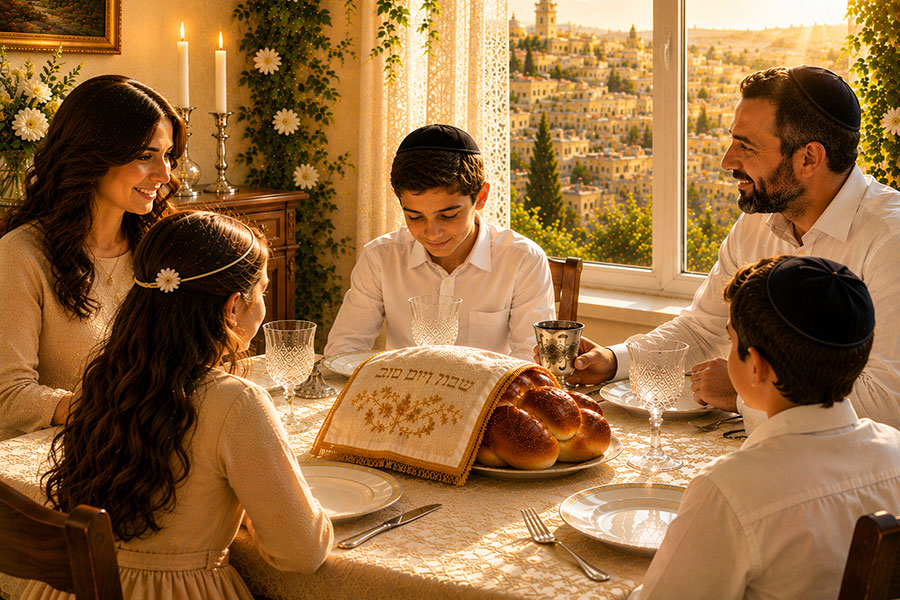


In the summer, people commonly avoid eating a very late Friday evening meal by accepting Shabbat early and beginning the repast well before dark. But on the first night of Shavuot – which falls near the height of the summer – many refuse to avail themselves of this option, and insist on davening Maariv and making Kiddush after nightfall (regarding the second night, see jewishpress.com/an-early-second-night-of-shavuot/).
Eating so late, however, is difficult for many people – and becomes even more difficult the farther north one resides. It is surprising, then, that this practice is so entrenched, especially since it has no basis in Chazal or the Rishonim. According to strict Talmudic law, it seems one may daven Maariv and make Kiddush after plag hamincha on Erev Shavuot just as one may do so on Erev Shabbat (Berachot 27b; cf. Tosafot, Pesachim 99b s.v. “ad”).
In the late 16th century, however, two Eastern European authorities record a tradition not to recite Kiddush on the first night of Shavuot until nightfall (Emek Berachah by R. Avraham Horwitz [father of the Shelah] p. 69c; Responsa Mas’at Binyamin, endnotes, Orach Chayim 4). They explain that the practice is rooted in the Torah’s description of the seven weeks of the Omer as temimot, “complete” (Leviticus 23:15). According to this interpretation, bringing in Shavuot early (by making Kiddush) eats into the final day of the Omer (Erev Shavuot), thereby improperly making the Omer somewhat less than seven full weeks.
This tradition was originally limited to Eastern Europe, but in time gained currency throughout the Ashkenazic world (many Sephardic communities to this day permit making Shavuot early; cf. Yechaveh Daat 6:30). It is a bit difficult to understand the popularity of this minhag, since Chazal interpret the word “temimot” in a different manner (Menachot 66a), and we generally do not derive halachic rulings based directly on novel, post-Talmudic biblical exegesis.
Furthermore, the earliest sources for this tradition make clear that one need only wait to make Kiddush at home; Maariv, in contrast, may be davened early (including Kiddush in shul). But the distinction between Kiddush and Maariv is difficult to understand. If formally accepting Shavuot early improperly subtracts time from the last day of the Omer, one should seemingly delay both Kiddush and Maariv until after tzeit hakochavim.
Indeed, the Taz famously takes “temimot” to its logical conclusion and rules that one should wait until tzeit hakochavim even to daven Maariv (Orach Chayim 494:1, see also Shulchan Aruch HaRav 494:2). Many congregations nowadays follow his view, likely due in part to its endorsement by the Mishnah Berurah (494:1).
But the older custom, supported by many great authorities (see Hilchot Chag beChag, Shavuot ch. 8, n. 34), was clearly to recite Maariv before nightfall. How does it make sense to wait until tzeit hakochavim for Kiddush, but not Maariv?
Rabbi Moshe Mordechai Karp, a contemporary authority, offers an original explanation of “temimot” to answer this question. He argues that temimot does not prohibit accepting Shavuot early because doing so detracts from the previous day; rather, it directs that Shavuot be consecrated only after the preceding seven weeks have fully elapsed.(1)
Rabbi Karp bases his understanding on the fact that the Torah describes the counting of the Omer both as 7 weeks and as 50 days (Leviticus 23:15-16). Although we only count 49 days, the sanctification of the 50th day as a holiday is itself part of the mitzvah of counting the Omer (cf. Rokeach, end of Hilchot Pesach and Rosh Hashanah 5b). Just as one must count each of the 49 days of the Omer on the actual halachic day (i.e., after nightfall), so too one must complete Sefirat HaOmer by reciting the 50th day’s “count” – i.e., Kiddush – on the day of Shavuot itself.
Thus, there is no reason for both Maariv and Kiddush to be said after tzeit hakochavim – one of the two suffices to consecrate Shavuot at the proper time.(2)
In fact, one could argue that one should specifically not wait until tzeit hakochavim to daven Maariv, as davening Maariv of Shabbat and Yom Tov early expresses eagerness for the sanctity of the day (see Siddur R’ Yaakov Emden, Shavuot). Furthermore, since it is important to study Torah on the night of Shavuot (whether or not one does so all night long), delaying Maariv will necessarily delay the meal and reduce the time available for uninterrupted learning.(3) Those davening at home, however, may prefer to wait until after nightfall for Maariv, since doing so would only minimally delay the seudah.
To this day, there are Ashkenazic congregations – including my own – that have continuously maintained the older minhag and daven Maariv before nightfall on Shavuot eve. It seems that any synagogue that wishes to adopt this practice is at liberty to do so, as both early and late Maariv offer meaningful religious advantages. Those who are ill or find it exceedingly difficult to eat late may make Kiddush early as well (Nitei Gavriel, Shavuot 13:1).
Regardless of when one davens Maariv and makes Kiddush, the obligation of tosefet Yom Tov requires one to accept the restrictions of Yom Tov before sunset. The Shavuot candles should also be lit at their proper time, shortly before sunset.(4) Of course, when Shavuot falls on Saturday night, Maariv, candle lighting, and Kiddush must all be delayed until after nightfall, as on any Yom Tov which falls on Motzaei Shabbat.
________________
- The Netziv writes similarly (Meishiv Davar, Orach Chayim 18). The Torah states that Shavuot should be sanctified “b’etzem hayom hazeh – on this very day” (Leviticus 23:21; see also Haamek Davar ad loc. and Responsa Binyan Shelomo 2:36). The Netziv maintains that this phraseology teaches us that on Shavuot, in contrast to Shabbat and other festivals, one must wait until the actual calendar day of the holiday before officially declaring its holiness via Kiddush. The Netziv’s approach is highly original and, like the derasha regarding “temimot,” appears nowhere in Chazal.
- It seems that Rabbi Karp’s logic would also sanction reciting Kiddush early, eating the meal, and subsequently fulfilling the requirement to consecrate Shavuot at the proper time by davening Maariv after nightfall. It should also be noted that since the counting of the Omer is only a rabbinic obligation nowadays according to most poskim, many authorities permit counting the Omer before certain nightfall (Tosafot, Menachot 66a s.v. zeicher lamikdash, but cf. Be’ur HaGra on O.C. 489:2). Some apply this logic to Kiddush on Shavuot as well (Yosef Ometz 850, Responsa Melamed LeHo’il 1:108), and permit reciting it during halachic twilight (bein hashemashot, normally assumed to begin at sunset).
- Some suggest that even if there is no halachic imperative to daven Maariv after nightfall on Shavuot, it is nevertheless advisable to do so (see Piskei Teshuvot, 494 n. 2). When davening Maariv early, one is required to repeat Shema after tzeit hakochavim. For this purpose, people often rely on the Shema recited just before bed. But since many people stay up all Shavuot night and do not recite the bedtime Shema, they might forget to recite Shema at its proper time. By davening Maariv after nightfall, one is ensured of properly fulfilling the mitzvah of Shema on Shavuot night.
- Piskei Teshuvot (494:2 citing Luach Eretz Yisrael) rules that candle lighting should also be delayed until after nightfall. This ruling is difficult to justify, as it is only the explicit mention of Shavuot such as in Maariv and Kiddush that could conceivably affect temimot, and even that concern is rooted only in post-Talmudic custom. Furthermore, in contemporary circumstances it is especially important to light Yom Tov candles before sunset. See jewishpress.com/yom-tov-candles-obligation-or-violation/.