 October 23, 2026
 Categories: Headline / Perspectives
Collective Pain, Collective Joy
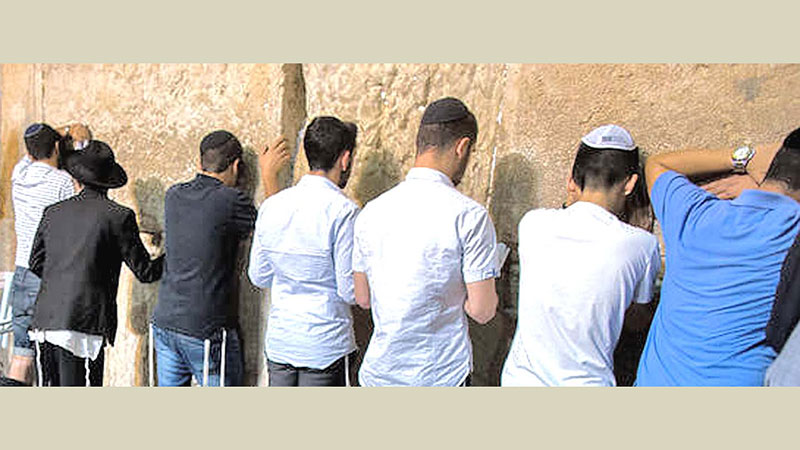


As much as the 21 days of the Three Weeks are a time of deep, collective pain, during which we mourn the many calamities that befell our people throughout history (including the destruction of both Holy Temples), they are also days of reflection and rebuilding. We look at the walls we’ve erected in our lives and assess whether they’re healthy or detrimental. We look at our relationships and ask whether they enable us to live the fullest versions of ourselves or whether they can be improved – or should be dropped altogether. We look at how we behaved toward others, and toward ourselves. But, to paraphrase Reb Shlomo Carlebach, do we only see the brokenness in our realities, or can we also see the wholesome potential that lies buried beneath that rubble?
A Parable of Love
For this reason, the Shabbos preceding Tisha B’Av is referred to as Shabbos Chazon, the Shabbos of Vision, taken from the opening words of that Shabbos’s haftarah. The Kedushas Levi, Rebbe Levi Yitzchak of Berditchev, teaches that on this Shabbos, we’re each granted a vision of the rebuilding of the Third and final Holy Temple (which will reemerge immediately, be”H!). On this Shabbos, we’re able to envision the potential of how great we can be as individuals and how harmonious our collective world can become – despite how we may be now, and how chaotic and confusing our realities may seem at present. He explains this with a parable:
A father once gifted his only son with a magnificent garment as a sign of his deep love for him. However, the child was still quite young and not yet able to appreciate the uniqueness of this gift and what it represented, and consequently, absentmindedly ruined his new gift while playing outdoors. Yet, because of his great affection, the father prepared a second garment – only to witness the same negligent pattern occur again. This time, when the father prepared a third garment, he didn’t give it to his son right away; instead, he periodically revealed it to him on special occasions, as a way of gradually conditioning more positive and favorable behaviors. Upon learning how to control himself and reconnect to the genuine individual buried beneath those behaviors, the son – now an adult – finally received the special garment and was able to value, enjoy, and safeguard its worth.
The Lubavitcher Rebbe, Rebbe Menachem Mendel Schneerson, questions this metaphor. Why would the Kedushas Levi base his parable on a garment, something so delicate that can easily be ruined, as opposed to a house or building, which is far more permanent? He teaches that, on one hand, a garment reveals much about a person (such as height, shape, etc.), but also, each garment can only be made for a specific person who fits its measurements. On the other hand, a house can fit many people because it doesn’t recognize differences to the same extent. A house is open to all, despite anyone’s unique circumstances or backgrounds. This is why, when G-d manifested His presence within the finite universe following the episode of the Golden Calf, He did so within a Mishkan, a temporary house, so that everyone could access and connect with Him in a welcoming and open space.
Celebrating Differences
Our Mystics teach that G-d created the finite universe with 10 statements, even though He infinitely had the ability to do so with just one. This is because details matter. Differences are important. We’re each created to be authentic individuals and contribute to our shared reality in ways that only we uniquely can. While the Holy Temple did, indeed, have a collectiveness that was welcoming to all, the Lubavitcher Rebbe points out that it also had its garment-like aspects. There was a women’s balcony, a place for the Levites to sing, the Holy of Holies, and various other unique spaces and vessels that were used by certain individuals and at designated times. This is why G-d created our reality through the act of tzimtzum, contraction and concealment. Yes, He is unchanged and exists the same in every one of the different realities and the many layers of concealment within each, but depending on who we are as individuals, we each connect with Him in our own personal way.
Our Sages teach that one of the reasons why we lost the Holy Temple was because of baseless hatred that we harbored within our nation. Discussing the mitzvah of v’ahavta l’rei’acha ka’mocha, loving others as ourselves, the Tzemach Tzedek, Rebbe Menachem Mendel of Lubavitch, offers a similar metaphor to that of the Kedushas Levi: The human body is comprised of many important facets, each of which provide a vital service to our overall functioning. Yet as distinct as they each are, these many pieces are all interconnected because they collectively make up our total body; pain in one area can influence several others, and healing in one region can positively impact many others. Metaphorically, we are each a different limb or bodily function rooted within a collective body (or, more specifically, a collective soul) that we all share as a nation. This is why there’s an explicit mitzvah to love our brothers and sisters – because we each complete the other. By extension, when we harbor hate towards each other, we sever a part of our own “body.”
The Tzemach Tzedek teaches that this is why Hillel phrased this mitzvah in the negative (in contrast to the Torah’s literal wording, which is in the positive): “What is hateful to you, do not do to others.” He explains that so many times, we’re able to overlook our lower moments and areas we might need to work on, and we feel angry, annoyed, or threatened when others point them out to us. As such, it’s not our place to seek out faults or point out areas we believe others could improve on. Just as we discover ample creative ways to overlook, minimize, or justify what we are not as strong in, so too, we must creatively look for the good points in others as well.
Temporariness
This is why the Kedushas Levi emphasizes a garment in his parable and not a permanent structure. Our behaviors are never permanent. We each have the right to grow. We can always transform ourselves as we come closer to the individuals we were created to become. We each have good points within us that only the details of a garment can reveal. And not just us, as individuals, but our external realities, as well. There are so many hidden, holy sparks of goodness waiting for us to discover and reveal across the finite universe. This is why Hillel tells us that the mitzvah of loving others as we love ourselves is the entire Torah (and the rest is mere commentary) – because, if we can’t get it right amongst ourselves “on the ground floor,” so to speak, we will never be able to get it right in other areas of our lives (both spiritually and physically) either.
G-d doesn’t just appear to us when times seem good and life feels stable; He’s accessible at all times, if we’re courageous and creative enough to seek Him out. Rabbi Adin Even-Yisrael Steinsaltz teaches that just as the darkness of night precedes the rising of the sun, so too, we experience pain or trauma right before moments of redemption. But we have to want to experience that redemption. We have to give up on reality as we know it today, and cry out – both to G-d and to each other – for what we know tomorrow can be. G-d will only redeem us when we appreciate that this Exile isn’t our true place. It’s through the pain and the sadness that we realize that we cannot continue living like this.
This Shabbos, we’re gifted with a vision – of how great we, each other, and our shared existence can be. Let’s come together to transform it from a state of abstraction into a practical reality!
May this Tisha B’Av be the final collectively painful experience we have to endure, and may we merit to enter into the Messianic Era and rejoice in the Final Redemption immediately thereafter – amen, kein yehi ratzon!