 October 16, 2026
 Categories: Torah
Colorful Names
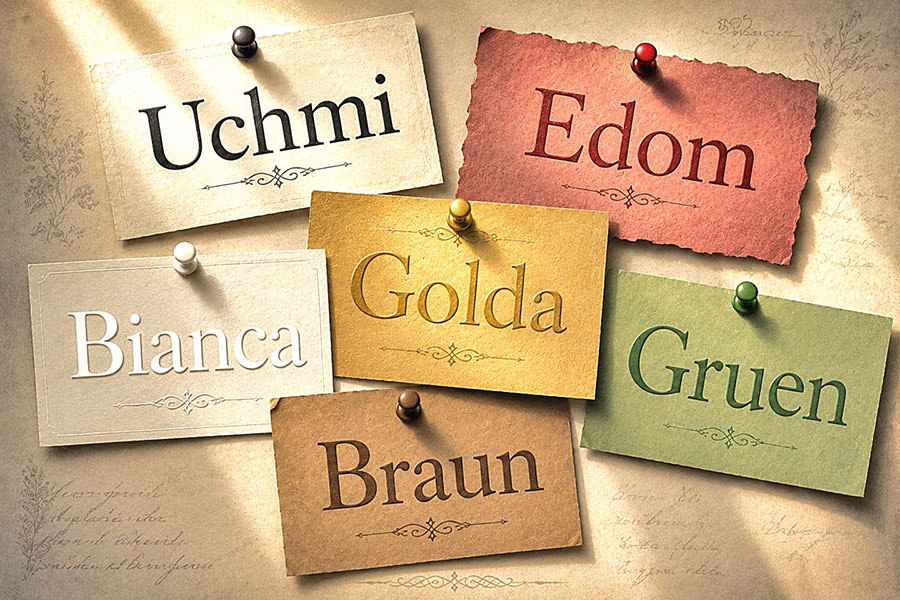


From the striking contrast of a newborn’s hair to the earthy tones of a tradesman’s dye, color has long been woven into the fabric of human identity. This connection is immortalized in our very names, where first names and surnames across cultures echo words for specific colors. The origins of these chromatic names, however, are often shrouded in ambiguity. Were they inspired by physical traits like ruddy complexions or raven hair? Did they denote an occupation dealing with pigments or metals? Or did they, perhaps, emerge from symbolic meaning or random adoption? In this essay, we explore various names that are associated with colors to reveal a fascinating intersection of linguistics, history, and culture.
In Biblical Hebrew, we have Jacob’s father-in-law Laban, whose name Lavan literally means “white.” But it remains to be explained why this trickster was named “white.” In fact, the Midrash (Bereishis Rabbah §57:4) states that his real name was Kemuel (under which he is listed among Bethuel's sons in Gen. 22:21), thus making the question of why he was called Lavan (“white”) all the more acute.
Rabbi Shimshon Pincus (1944-2001) explains the meaning behind the name Laban by noting the fact that the color white possesses no independent chromatic identity of its own; it is entirely without hue. In optical terms, white is simply the undifferentiated combination or reflection of all visible wavelengths, with no single wavelength asserting itself. In the same way, Laban himself was the absolute archetype of a deceiver – one whose own identity never manifested with any true color or integrity.
Rabbi Moshe Batzri in Shem U’Neshama offers a different way of explaining Laban's name and its connection to the color white: Laban attempted to "whitewash" his dirty deeds by giving off the outward appearance of being wholly "white" (see also Bereishis Rabbah §60:7).
Rabbi Batzri then notes that there are only two people in Tanach named after colors: Laban and Esau. The latter refers to the fact that when Esau demanded that Jacob pour red lentils down his throat, the Torah comments that for this reason he is called Edom – related to the Hebrew word adom, "red" (Gen 25:30). Perhaps unlike Laban, Esau never even bothered to hide his wretched deeds or even pinkwash them.
After doing some research on the topic, I found two names in the Talmud that seem to be related to Aramaic words for colors: The Talmud (Beitzah 26b) mentions the name of an unreliable tradent of Tannaic teachings named Ada bar Uchmi. If you’re unfamiliar with this particular sage, don’t feel bad, this is the only place he is mentioned in the Talmud. Either way, his father’s name Uchmi is actually the Aramaic for the color “black” and is a fairly common word in Talmudic Aramaic.
Interestingly, the name Mar Zutra bar Uchamai (spelled Ukkamay in academic sources) appears in three different Jewish-Aramaic incantation bowls housed in the British Museum. In all three cases, the person who bore that named is specified as the adversary of the bowl's owner and the spell inscribed on the bowl is directed at him. Names in these bowls usually follow a specific formula, with a given name and a matronymic (i.e., the person and his mother's name, like when we give a mi sheberach for a choleh). According to this, Mar Zutra bar Uchamai would literally mean "Mr. Little, son of Black," with Black being his mother's name. Some scholars see this name as a pejorative pseudonym used to avoid giving the actual name of one's enemy. But Dr. Shaul Shaked notes that the name Zutra seems to have been common in Aramaic, just like the names Small in English or Klein in German are. Indeed, there were several Amoraic and Geonic sages named Zutra, which means that Uchamai could likewise be an actual personal name that happens to also mean the color “black” (not unlike the surnames Black in English or Schwartz in German respectively). By the way, this Aramaic word for “black” has found a new meaning in Modern Hebrew, where uchmanit refers to a “blackberry.”
Another personal name derived from a word for a color can be found in the sage “Rabbi Yochanan ben Dahavai” (Chagigah 2a, 4b, Nedarim 20a, Sanhedrin 4b, Menachos 42b, Erachin 2b). The name Dahavai seems to be a form of the Aramaic world dahav, “gold.” The Aramaic word dahav is related to the Hebrew word zahav, as the Hebrew letter zayin often changes into a dalet in Aramaic. Dr. Alexander Kohut (1842-1894) in Aruch Ha’Shaleim argues that perhaps Dahavai was not the actual name of Rabbi Yochanan’s father, but rather suggests that Ben Dahavai was a description of Rabbi Yochanan’s occupation, presuming that he was goldsmith.
By the way, the theme of “gold” continues in Jewish names down to modern times: The Yiddish feminine name Golda – which is clearly related to the German/English word gold – can be traced back almost 1,000 years and still remains a popular choice for naming girls. Likewise, the feminine name Zlata is derived from the Slavic words for “gold” (zlato in Czech and Slovak, or zoloto in Russian, Polish, and Ukranian, or zolata in Belarussian), although scholars are undecided as to whether Zlata came about as a translation of Golda when Ashkenazi Jews moved eastward, or is an independent development. Other related names that scholars do see as calques, or translations, of the Yiddish name Golda are the Hebrew forms of that name: Zehavah, Zehavit, Zehavee.
There is also a Greek form of this name. In the Karaite cemetery of Istanbul, there are approximately 100 tombstones from the 17th-20th centuries with given names of Greek origin and some of those names also appear in the cemetery of the Greek-speaking (“Romaniote”) Rabbanite Jews of Constantinople. One name that stands out is the Greek feminine name Chrisi/Chursi, which means “gold.” The Latinate form of this name is Aurelia (which is not to be confused with Ariella, a feminine form of the masculine name Ariel).
Laban wasn’t the only person in history whose given name means “white.” In fact, names meaning “white” or “bright” have a storied history, particularly in European nobility. The Italian Bianca and Spanish Blanca, both meaning “white,” have been used in royal families since the Middle Ages, evolving from Old French influences (Blanche). This linguistic root also explains Slavic names like the Czech Bela or Russian Bely. And now you know why the historical term “White Russia” has been replaced in modern times with the place-name Belorussia.
Likewise, personal names meaning “black” appear across linguistic families: The Greek name Melanie (and its Latin form Melania) derives from melas, meaning “black, dark,” likely describing hair or complexion. Similarly, the English name Nigel stems from the Latin Nigellus (which itself is a diminutive of the Latin word niger, “black”). And Jewish naming conventions also follows this trend, as the Yiddish feminine name Tcharna/Charna originates from the Slavic čarny, also meaning “black.”
Beyond this monochrome base, a full spectrum emerges. Brown, too, finds its place in names like the Germanic masculine name Bruno and the Yiddish feminine Bryna, both meaning “brown.” The color red, often associated with hair or complexion, is reflected in the Latin Rufus (“reddish”) and the Hebrew name Edom mentioned above. Historical records from the 14th century Genoese city of Caffa list the Jewish name Cacanachi as belonging to a local Jew. Dr. Alexander Beider sees that name as derived from the Greek word kókkinos meaning "red."
There are also several popular Jewish surnames that come from the German words for various colors: like Schwartz (“black,” whose Hungarian equivalent is Fekete), Weiss (“white,” whose Slavic equivalent is Bialik), Gruen/Green (“green”), Blau/Bloi (“blue”), Roth (“red”), Brown/Braun (“brown”), and Gelber/Geller (“yellow”). Sometimes words for colors are combined with other German words to create a last name. Examples of that include: Graubart (“gray beard”), Rothschild (“red shield”), Schwartzman (“black man”), Greenberg (“green mountain”), Greenfield (“green field”), Greenspoon/Greenspan (“verdigris,” that is greenish coloring on a sheet of metal), Blaustein (“blue stone,” perhaps a reference to sapphire or lapis lazuli), Gelbman (“yellow man”), and Gelbstein (“yellow stone”).
By the way, not all of these etymologies are totally agreed-upon. Some Blaus have a family tradition that their family comes from Spain before the Expulsion of 1492 and that as they fled Spain, they settled in the French city of Blois (famous for the blood libel that killed many of its Jews in 1171), before eventually migrating to Hungary. According to this tradition, the name Blau has nothing to do with the color blue, but is derived from the name of a French city.
Additionally, other explanations of the surname Geller see that surname as related to the German gellen ("to yell") or view it as a form of Heller (with the initial h turning into a g as often happens in Slavic languages) – which means “bright, light, or fair.”
The Jewish surname Himmelfarb is also related to the color blue, as that name can be parsed as comprising of two German words: himmel (“heaven”) and farb (“color), and it is as clear as day that the color of the heavens is blue.
But what color does the Jewish surname Gutfarb refer to? That family name can be broken down into gut (“good” in German) and farb. But which color is the “good” one? I tried researching this, but could not come up with anything intelligent to say. Yet, I did find that according to the Theory of Colours by Johann Wolfgang von Goethe (1749-1832), each color has a special quality/symbolism attached to it. In his system, the term gut is used to describe the color yellow. According to this, it's quite possible that Gutfarb refers to the color yellow, especially because Ashkenazi surnames solidified in German-speaking regions during the period Goethe’s ideas permeated the culture.
There are also Jewish family names that are related to various precious metals – intrinsically linked to color. Common examples of that include: Silver (Silber, Silverman, Silverstein, Silverberg, Silverstone, Silbermintz), Gold (Goldman, Goldsmith, Goldberg, Goldstein), and Copper (Kupfer, Copperman, Coppersmith).