 August 28, 2026
 Categories: Collecting / Arts
The Wild ‘Falafel Wars’ and the Role of Falafel In One Intriguing Israeli Holocaust Remembrance
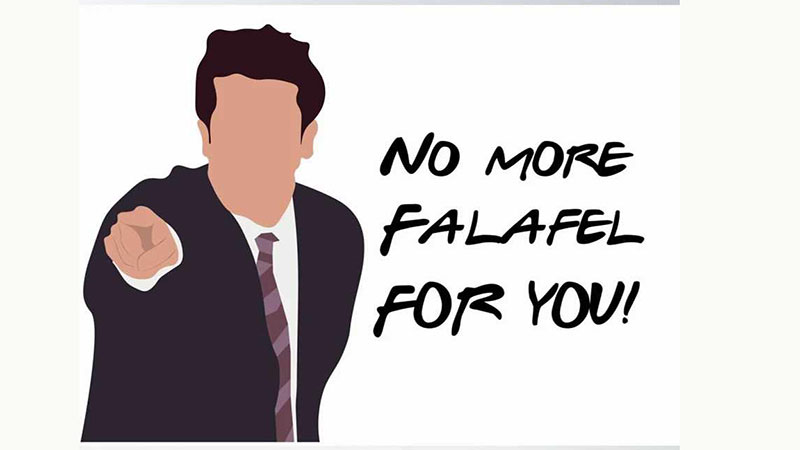


Widely recognized today as one of the emblematic foods of Israel, falafel has a history that is both ancient and contested, reflecting the complicated cultural and political Middle East landscape. The small fried balls of ground legumes, typically chickpeas or fava beans, served in pita with salads and sauces have become a symbol of Israeli street food culture; yet, the dish’s origins long predate the modern State of Israel and are rooted in a broader regional culinary tradition shared among numerous Middle Eastern peoples. The debates over falafel’s cultural ownership have at once been comical and acrimonious, sometimes revealing deeper tensions in the Arab- Israeli conflict.
The precise origin of falafel is uncertain, though most historians believe it began in Egypt. One widely cited theory attributes its invention to Egyptian Coptic Christians, who needed a meatless dish during Lent and therefore developed fried balls made from fava beans. From Egypt, it spread through the eastern Mediterranean and the Levant, regions encompassing Israel, Lebanon, Syria, and Jordan. As is often the case with cuisine, the dish evolved as it traveled; for example, in Egypt it continued to be made primarily with fava beans, while in the Levant chickpeas became the dominant ingredient.
Jewish communities in the Middle East were part of this culinary exchange. Syrian and Egyptian Jews ate falafel long before the modern Zionist movement, and when Jewish immigrants began settling in Eretz Yisrael under Ottoman rule in the late nineteenth and early twentieth centuries, they encountered the dish among the local Arab population and among neighboring Jewish communities. The food’s plant-based composition made it compatible with Jewish dietary laws, since it is considered pareve and can be eaten with either meat or dairy meals and it also presents fewer kashrut obstacles than meat. (But, as always, consult your local rav!)
Ironically, early Zionist settlers did not initially embrace falafel, as many immigrants from Eastern Europe retained the foods of their homelands, such as bread, potatoes, cabbage, and other staples of Ashkenazi cuisine. In the 1920s and 1930s, some European Jewish settlers even viewed local Arab dishes as foreign or unfamiliar, so that only gradually did falafel gain acceptance among the Jewish residents of Eretz Yisrael.
The transformation of falafel into an Israeli national dish occurred largely after the establishment of the State of Israel in 1948, when the young country absorbed large waves of Jewish immigrants from North Africa and the Middle East, communities that were already very familiar with the dish. At the same time, the new state faced severe food shortages and rationing so that falafel, made from inexpensive legumes and served quickly as street food, provided a cheap and filling source of protein, and its practicality helped to propel it into the everyday diet of Israelis.
Another key development was the rise of the falafel sandwich in pita bread. The earliest documented mention of falafel served in pita in Eretz Yisrael dates to a 1939 newspaper article, but the sandwich format became especially popular in Israel during the 1950s. Yemeni Jewish immigrants in particular are credited with popularizing the street-food version familiar today, falafel balls stuffed into pita with chopped salad, pickles, tahini sauce, and sometimes amba, a tangy mango condiment of Iraqi origin.
In the late 1950s, with falafel becoming an emblematic part of everyday life in the young country, songwriter Dan Almagor and composer Moshe Vilensky created a humorous folk‑song celebrating falafel as a kind of national dish, and the ditty became widely performed on state radio and in public venues, cementing falafel’s status in the national imagination:
Every country in this world, has a well‑known national food,
and every kid in kindergarten knows, the macaroni eater is Italian.
The Viennese have tasty schnitzel, and the French eat frogs.
The Chinese eat slender long rice, and the cannibals eat one another.
And we have falafel, falafel,
for dad, a gift – Mom buys one here too,
for old grandmother, we’ll buy half a portion.
And my mother-in-law too today, will get falafel, falafel.
with lots and lots of pepper.
Once, when a Jew came to Israel, he would kiss the ground and bless.
Today, as soon as he gets off the plane, he’s buying falafel and drinking soda...
Here they sell to all, the whole street smells of sesame scents and paraffin oil.
You can even get heartburn here from falafel, falafel,
with lots, and lots, and lots of pepper.
Making falafel is no simple thing, making falafel is an art,
And any child of Yemen can tell amateur falafel from artisan.
The funniest is, “Allah help the goats,” falcon made by Ashkenazim!
In such a falafel you’ll always taste, a strange flavor of gefilte fish...
Dan Almagor, born Dan Elbelinger in 1935 in Ramat Gan and one of Israel’s most prominent lyricists and playwrights, wrote hundreds of widely performed Hebrew songs and translated many important theatrical works into Hebrew, including Fiddler on the Roof. His early work often celebrated Israeli themes, such as heroism and pioneering life, while later work took a more critical and satirical tone about Israeli society.
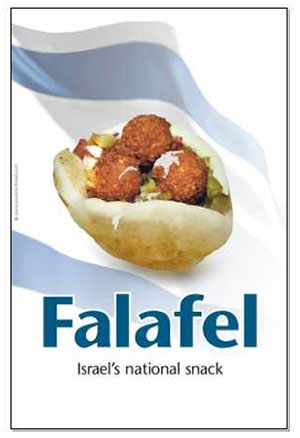
By the 1960s falafel had become deeply embedded in Israeli culture. Popular songs celebrated it, postcards advertised it as the “national snack,” and falafel stands proliferated in cities across the country. The dish came to symbolize a new Israeli identity: young, energetic, and rooted in the Middle Eastern environment rather than the European past of many Jewish immigrants. Yet, this transformation also sparked controversy when Palestinians and other Arabs began objecting to what they perceived as the “Israelization” of a traditional regional food. Critics argued that Israel was culturally appropriating dishes such as falafel, hummus, and shawarma and marketing them internationally as inherently Israeli cuisine. Some scholars have described the debate as an example of “gastronationalism,” in which food becomes a symbol of national identity and political legitimacy.
The arguments themselves have often been comical. Lebanese activists once attempted to establish intellectual-property claims over certain Middle Eastern foods, claiming that international companies might need permission to label hummus or falafel correctly. One Beirut falafel vendor reportedly declared that the dish was actually Turkish in origin, adding to the confusion of competing national claims.
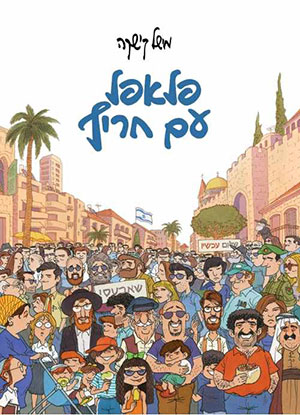
One of the most famous – and absurd – episodes was the 2008 Lebanese “Food Copyright” lawsuit, when Lebanese industrialists, supported by government officials, proposed suing Israel internationally over hummus and falafel. Fadi Abboud, then president of the Lebanese Industrialists’ Association (and later a Lebanese government minister), argued that Israel was illegally profiting from Lebanese food, claiming that Israel was marketing “original Lebanese food like tabbouleh, kubbeh, hummus, falafel and Fattoush.” He suggested a lawsuit modeled on the EU’s protection of feta cheese, proposing that only Lebanon should be able to market hummus under that name internationally. At one point, he even went so far as to suggest that Western supermarkets might eventually have to rename hummus “chick-pea dip” if it was not produced in Lebanon, and the entire affair quickly became known in the media as the “Hummus Wars.” The idea that an international court might adjudicate the intellectual property of a chickpea paste produced across half the Mediterranean region struck many observers as, at best, surreal.


In 2018, Palestinian Authority television aired a segment accusing Israel of a broader campaign of cultural theft that included food, declaring that Israel had carried out a “brutal attack against the Palestinian heritage . . . including Palestinian foods” and that it had engaged in the “theft of the Palestinian falafel [and] the Palestinian hummus.” The program went on to frame food festivals promoting Palestinian dishes as a form of cultural resistance to Israeli “appropriation.”

A particularly colorful claim came from Mohammad Shtayyeh, a senior Fatah Central Committee member (later Palestinian Authority prime minister), who asserted that Israel had invented a fake origin story for the dish, claiming that Israel had “fabricated the falafel.” The accusation was that Israel had not merely adopted a regional food, but that it had also created a fraudulent narrative that it was historically Jewish. Another Palestinian official, identified in reports as a member of the Palestinian parliament, made an even more literal claim that Israel had “falsified the falafel ball.” This statement became widely mocked in commentary because it seemed to suggest that a deep-fried chickpea sphere could itself be subject to historical forgery.
Palestinian journalist Muwaffaq Matar, writing in the Palestinian press, framed the issue as part of a broader pattern of Israeli cultural theft, accusing Israel of stealing “our clothing, our keffiyeh, our falafel, and our hummus.” In this narrative, culinary disputes were linked to political symbolism in the same way as the keffiyeh or traditional embroidery. Indeed, statements by Palestinian diplomats sometimes present the issue as part of a larger cultural struggle; for example, one Palestinian ambassador complained that Israelis had attempted to claim ownership of Palestinian heritage items including food: “They even tried to claim falafel and hummus as their own, but these are traditionally ours.” In that same speech, he also complained that that Israelis had appropriated traditional Palestinian dress. Academic and political writers in the Arab world sometimes frame the debate in explicitly colonial language; for example, commentators have argued that the adoption of dishes such as hummus or falafel by Israelis represents “appropriation by colonizers.”
Ironically, these accusations are often accompanied by contradictory claims from different Arab countries about the same foods. For example, Egyptians claim to have invented falafel; Lebanese activists claim hummus and tabbouleh are Lebanese; Syrians and Jordanians assert Levantine regional origins, so that the resulting situation borders on parody. During the 2008 debate, one Beirut vendor dismissed the Lebanese claim to falafel entirely, insisting that “falafel is originally Turkish.”
One of the most theatrical episodes in the culinary dispute arguably occurred between 2009 and 2010, when Lebanon and Israel engaged in a competition to produce the largest bowl of hummus in the world. The contest began after Lebanese officials and food industry leaders argued that Israel’s marketing of hummus internationally as “Israeli” was a form of cultural theft and Lebanese tourism and agriculture leaders publicly supported efforts to demonstrate Lebanese primacy through a world-record hummus dish. In October 2009, Lebanese chefs in a village near Beirut produced a two-ton bowl of hummus in an attempt to reclaim the Guinness record from Israel, and the Lebanese minister of tourism at the time, Fadi Abboud, framed the effort in nationalistic terms, declaring that Lebanon needed to “protect Lebanese products from Israeli competition and appropriation.”
Israelis quickly responded. In January 2010, Israeli chefs prepared a larger bowl weighing roughly four tons at an Arab-Israeli village in northern Israel, and the event was widely covered in Israeli media as a humorous counterstrike in the hummus wars. In May 2010, Lebanese chefs constructed an even larger bowl, reportedly over 10 tons of hummus (!), served in a giant replica of a traditional Lebanese ceramic plate; Lebanese politicians attended the event, which was explicitly framed as a national victory over Israel’s alleged culinary appropriation. In this manner, a dispute about chickpea paste briefly became a matter of international prestige and national pride.

The infamous – and absurd – University at Buffalo falafel controversy (2026) is a recent and illustrative episode in the broader cultural and political disputes surrounding Middle Eastern food, identity, and the Israeli-Palestinian conflict. The episode originated with a routine campus event organized by the Student Association at the University at Buffalo (SUNY Buffalo), a multicultural food festival called the International Food Fiesta. To promote the event, the Student Association posted a graphic on social media that listed the cuisines that would appear on different days of the festival and paired dishes with their national or cultural origin – one of which was a falafel bar labeled “Israeli.”
When the graphic appeared, pro-Palestinian activists, BDS haters, and social media commentators’ students objected to the characterization of falafel as Israeli, protesting that such false labeling is “culturally insensitive” and “erases Palestinian identity and heritage.” The Student Association responded by deleting the original graphic and issuing a public apology acknowledging that a mistake had been made and committing to addressing the harm and improving future programming. When the promotional graphic was reposted, the national labels were removed entirely, leaving all the dishes without national attribution.
The apology was widely mocked outside the activist community. Critics argued that the incident illustrated campus ideological pressure surrounding Israel, and Jewish commentators and advocacy groups raised broader concerns regarding a double standard regarding Israeli identity and a campus climate in which acknowledging Israel could be treated as offensive. The pro-Israel group StopAntisemitism circulated the story widely on social media, framing it as an example of hostility toward Israeli or Jewish cultural identity.
Although the Buffalo episode is unusually explicit, it is not unique as several similar incidents have occurred in recent years, including the furor that arose during the Philadelphia Falafel Restaurant Protest (2023), when pro-Palestinian demonstrators protested outside Goldie, a Philadelphia falafel restaurant owned by Israeli chef Michael Solomonov, which had made the unforgivable crime of advertising its cuisine as “Israeli.” The demonstration drew national attention and condemnation from political leaders, including condemnation by Jewish Pennsylvania Governor Josh Shapiro, who called the protest “a blatant act of antisemitism.”
The monumental and earth-shattering “falafel wars” even extended to the realm of publishing. Some Arab commentators have criticized Israeli cookbooks that present hummus or falafel as staples of Israeli cuisine, arguing that this amounts to rewriting history, and writers in Palestinian and Lebanese newspapers have accused such books of “erasing the Arab origins” of the dishes. Ironically, many Israeli cookbooks themselves explicitly acknowledge that these foods originated in the broader Middle Eastern culinary tradition and were adopted by Jewish immigrants from Arab countries.
Hummus and falafel are not the only foods caught in the controversy; other dishes frequently mentioned include shakshuka, the humble herb mixture za’atar, and knafeh (a syrup-soaked pastry made with shredded phyllo and cheese), but that’s another story for another day.
Israelis often respond to accusations of cultural theft with a mixture of amusement and exasperation. One popular humorous anecdote from decades ago describes a tourist asking a falafel vendor whether the food is Israeli or Arab; the vendor shrugs his shoulders and replies: “It depends; if you like it, it’s Israeli, if you don’t, it’s Arab.” When all is said and done, however, cuisines throughout the world share foods that evolved through centuries of cultural interaction and no sane person really cares about who claims credit for falafel. Nonetheless, in Israel, the dish has acquired unique symbolic meaning, and one the most striking examples of that symbolism is found in the life of Holocaust survivor David “Dugo” Leitner and the commemorative event known as Operation Dugo.


Leitner (1930-2023) was born in Nyíregyháza, northeastern Hungary, into an Orthodox Jewish family in a region that contained a significant Orthodox presence influenced by the rabbinic traditions of nearby Galicia and Carpathian Ruthenia. Contemporary accounts from family members and interviews conducted with Leitner later in life describe his parents as traditionally religious, maintaining Jewish practices within the home that kept kosher and observed the major religious holidays. Leitner attended Jewish school and studied Hebrew prayers and biblical texts and, although the Holocaust cut short his formal schooling, the memories of Jewish learning and communal life remained part of his identity throughout his life.
His childhood was shattered by the Nazi occupation of Hungary in 1944, when Nazi authorities and their Hungarian collaborators forced Hungarian Jews into ghettos and soon afterward deported them to Auschwitz-Birkenau. Leitner, then only fourteen years old, was transported to the camp with his family in May 1944. Like all prisoners, he endured starvation, forced labor, and the constant threat of death, and many of his family members were murdered in the Holocaust. However, there was one specific memory that sustained him during the darkest moments of his imprisonment: the stories that his mother had told him about Eretz Yisrael.
According to Leitner’s later recollections, his mother had described the country in almost mythical terms, telling him that in Israel small golden rolls called bilkelach grew on trees. These round bread rolls were a familiar food in Central European Jewish cuisine, but in his mother’s storytelling they became symbols of abundance and hope, and during the terrible months of his captivity, the boy clung to this image. When the Soviet army approached Auschwitz in January 1945 and the SS began evacuating the camp, Leitner was among the tens of thousands of prisoners who were forced on death marches westward under freezing winter conditions. He later recalled that the only thing that kept him moving was the vision of those imagined golden rolls waiting for him in the Land of Israel.
After surviving the march, he was transferred through several camps, eventually reaching Mauthausen and then the Gunskirchen subcamp in Austria, where he remained until liberation by American forces in May 1945. In 1949, he made aliyah, thereby fulfilling the dream that had carried him through the hell of the Shoah, and he settled in the moshav of Nir Galim in southern Israel, which had been founded largely by immigrants with religious backgrounds. The moshav’s social atmosphere included a visible degree of Jewish traditional observance and residents typically maintained synagogue life, communal religious events, and holiday celebrations. Leitner’s marriage to his wife, Miriam, took place within the traditional framework of a Jewish wedding ceremony, including a chuppah and sheva brachot, and he raised his children as Jews and Zionists.
It was in Jerusalem’s Mahane Yehuda market that he encountered falafel for the first time, and the sight of the round, golden fried balls reminded him of the bilkelach that his beloved mother had described years earlier. The connection was immediate and emotional; at that moment, he made a decision that would shape the rest of his life: every year on January 18, the anniversary of the death march, he would eat falafel to celebrate his survival.
For decades, the ritual remained private. Each year Leitner visited a falafel stand and ordered a double portion; his surviving family, who knew the date was meaningful to him, generally left him alone to observe it quietly, making the ritual both a memorial and a personal celebration of life. Over time, however, the story began to spread: friends and neighbors joined him, the event attracted attention from journalists and educators interested in Holocaust remembrance; and, eventually, the tradition evolved into a public initiative known as Operation Dugo.
The formal campaign began in 2016 when Leitner’s daughter Zahava Kor, who had written a book about his experiences, partnered with Beit HaEdut (“the Testimony House”), a Holocaust education center in the moshav of Nir Galim where Leitner lived. They encouraged people to mark January 18 by eating falafel and sharing photographs and messages on social media in memory of Holocaust survivors and victims, and the idea quickly gained momentum. Schools across Israel began participating, often incorporating educational programs about the Auschwitz death marches; Government offices, military units, and workplaces joined in as well; and participants would eat falafel together while learning about Leitner’s story and the history of the Holocaust.
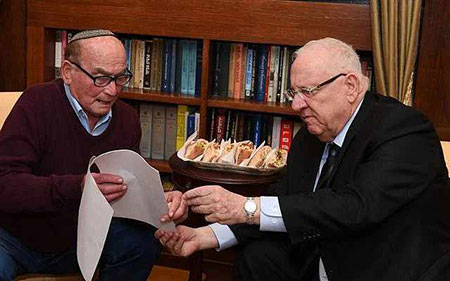
Israeli political leaders soon embraced the initiative. In 2019, President Reuven Rivlin invited Leitner to the presidential residence in Jerusalem to share a falafel meal marking the occasion, and other prominent figures, including President Isaac Herzog and Israel Defense Forces Chief of Staff Aviv Kohavi, also participated in the tradition. Israeli soldiers were encouraged to take part in Operation Dugo activities as part of educational programs about the Holocaust and the historical responsibility associated with defending the Jewish state, events that reinforced the longstanding connection in Israeli civic culture between Holocaust memory and national identity. The Israeli government eventually incorporated the event into broader commemorative activities, and in 2024 the Speaker of the Knesset announced that a special falafel stand would be set up annually in the parliament building to mark the day.

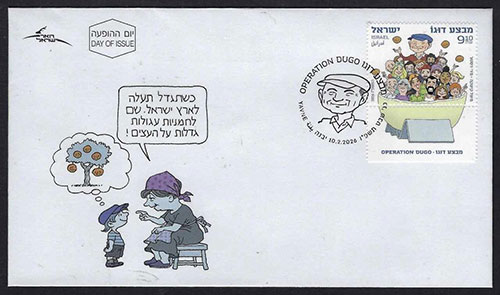
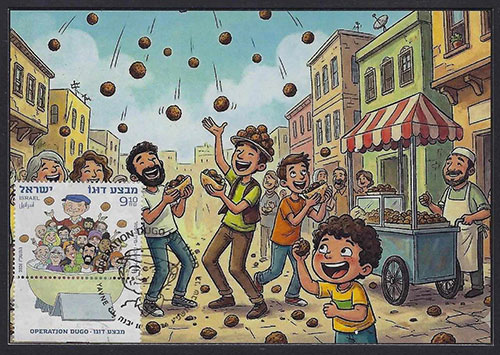
Rabbinic leaders in Israel generally welcomed Operation Dugo as a creative form of Holocaust remembrance, and many educators and rabbis praised the initiative for connecting younger generations to historical memory through an accessible cultural symbol. Falafel, already associated with everyday Israeli life, thus became an important vehicle for teaching about the past, as Holocaust educators emphasized the symbolic power of the ritual. Unlike many traditional memorial ceremonies centered on mourning, Operation Dugo highlights survival and resilience and, in a strange but beautiful way, eating falafel represents the triumph of life over the Nazi attempt to destroy the Jewish people.
The Israeli press covered the initiative extensively, especially as it spread through social media. Newspapers and television programs often featured photographs of participants holding falafel sandwiches with the hashtag associated with the campaign, and the story of the elderly survivor whose childhood dream of food had sustained him during a death march proved compelling to journalists. The event also expanded internationally, as Israeli embassies in various countries distributed free falafel to commemorate the day and to raise awareness about Holocaust history. In London and Warsaw, for example, diplomatic missions provided falafel meals to the public and to charitable organizations serving the homeless. Some Jewish communities abroad adopted the practice as well. Schools and youth groups in the United States, Britain, and elsewhere hold educational programs combining Holocaust lessons with the falafel ritual.
Leitner himself became a beloved figure in Israeli public life. Known affectionately by the nickname “Dugo,” he appeared in interviews and public events, often holding falafel sandwiches while recounting his story and spreading a message emphasizing optimism and gratitude rather than bitterness. When he died in July 2023 at the age of ninety-three, tributes poured in from all across Israel and many commentators characterized him as embodying the resilience of Holocaust survivors who had rebuilt their lives in Israel.
Nevertheless, Operation Dugo has not been entirely free from criticism. Some critics, particularly in Arab and Palestinian circles (big surprise), continued to spew their pablum about how Operation Dugo is just one more example of reinforcing the fraudulent identification of falafel with Israeli national culture. Others have raised broader philosophical questions about the commercialization or trivialization of Holocaust memory, some suggesting that associating remembrance with food risks oversimplification and even trivialization of historical tragedy. Supporters of the initiative respond that the ritual does not replace traditional memorial ceremonies but, rather, complements them by reaching younger audiences.