 October 9, 2026
 Categories: Halacha & Hashkafa / Torah
Daddy, I Want to Give My Own Machatzis Hashekel!
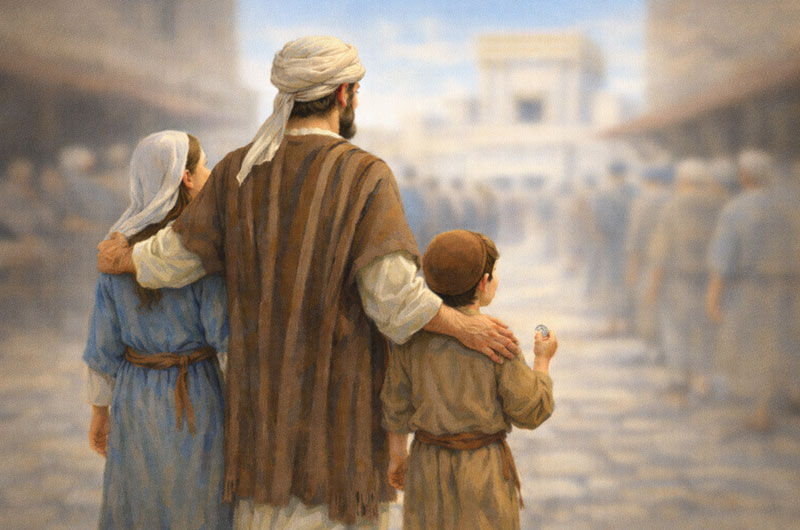


When the Beis HaMikdash stood in its glory, the streets in cities throughout Israel hummed with purpose after Purim. Special stands were set up to collect the annual machatzis hashekel, mentioned in Parshas Ki Sisa, primarily used to purchase communal offerings.
Let’s fantasize about that era, which we hope to experience again soon in our days...
Mr. Silverman prepared to head out one morning, holding a pure silver half-shekel coin wrapped carefully in cloth. He adjusted his jacket and was ready to join the steady stream of men heading toward the collection tables.
“Abba,” his 17-year-old daughter called after him. “I’ve recently begun getting paid for my tutoring,” she said. “Since I’m earning my own money now, I’d be happy to give machatzis hashekel if I can.”
Before Mr. Silverman could respond, his 10-year-old son rushed forward, cheeks flushed with excitement. “And I got money last week when I delivered mishloach manos! I want to give, too!”
Mr. Silverman looked from one eager face to the other. “I’m proud of you both, but the mitzvah is generally fulfilled by adult men,” he explained gently. “I’m not sure whether you can give, but you can come with me. Let’s go and we’ll ask!”
The two kids took some of their money and, with their father, made their way through the streets. Merchants called out their wares, children darted between doorways, and throngs walked together toward the stands.
As they turned a corner, they spotted Rabbi Dayan greeting townspeople near one of the collection tables.
“Rabbi,” Mr. Silverman called, approaching him, “I have a question.”
The kids waited, money clutched tightly in their hands, their eyes bright with hope.
“Can my daughter and 10-year-old son also give machatzis hashekel?”
“The Mishna (Shekalim 1:3,5) teaches that women and minors are not obligated to give machatzis hashekel,” replied Rabbi Dayan. “The Rishonim dispute whether the obligation starts from age 20, like the census in the Torah, or from bar mitzvah age (Sefer HaChinuch #105; Rambam, Hil. Shekalim 1:7; Ramban, Shemos 30:12).
“Nonetheless, women and children can donate voluntarily. Rav Ovadia Bartenura qualifies, though, in his commentary to the Mishna, that they must grant ownership of the money to the community so that the sacrifices purchased with it will be communal offerings, like other individuals who donate animals or grain for communal offerings (Rosh Hashanah 7a; Menachos 21b).
The Acharonim discuss how this can be accomplished according to the opinion that only people under 13 are exempt, since such a minor can acquire mi’d’Oraysa but can grant ownership only mi’d’Rabbanan, as we find regarding the arbaah minim (O.C. 658:6).
They provide several explanations.
Ketzos (235:4) brings proof from this principle for the opinion that acquisition mi’d’Rabbanan is valid also for d’Oraysa ramifications – for example, a woman who is betrothed with money that she acquires mi’d’Rabbanan – since the Sages have the power to renounce ownership (hefker beis din hefker). Thus, although the minor can give only mi’d’Rabbanan, his money can be used to fulfill the Torah requirement of communal sacrifices. However, this notion is subject to much debate.
Shaar HaMelech (Hil. Shekalim 1:1) explains that although the minor cannot give mi’d’Oraysa, his coin is nullified – on the Torah level – in the collection of many other coins of machatzis hashekel.
Avnei Miluim (28:33) notes, though, that the Gemara (Beitzah 21b) indicates that monetary ownership is not subject to bittul (nullification). Even so, he explains that the Temple treasurers buy the animals as communal sacrifices regardless. Although they used the child’s coin, this does not adversely affect the animal’s status. And since he gave it willingly, which is valid mi’d’Rabbanan, they have no obligation to return its value to him.
Rebbe Akiva Eiger (Chadashos #12), however, suggests that the Mishnah refers only to a minor within the year before bar mitzvah, mufla hasamuch l’ish, whose pledges are valid mi’d’Oraysa. Perhaps this can be explained further that machatzis hashekel is inherently different from other donations. Unlike other donations, the consecration of the machatzis hashekel itself also accomplishes also the transfer of ownership to the community, just as there is no need for an adult male to explicitly give it to the community (see Chiddushei Hagriz, Menachos 21b; Chazon Ish, E.H. 136, Nedarim 33a; ‘Katan b’Machatzis Hashekel,’ Rav Yisrael Yashar, Oz v’Ora vol. 10, 5773 pp. 191–208).
“Thus,” concluded Rabbi Dayan, “your daughter can give, but your son’s status is questionable for this year and next.”
Verdict: Acharonim discuss how a minor can voluntarily donate machatzis hashekel for the purpose of purchasing communal sacrifices, even though he cannot grant ownership mi’d’Oraysa. They provide several explanations, some limiting the age to the year before bar mitzvah.