 October 9, 2026
 Categories: Headline / Perspectives
Discovering the Power of Song on Yom Kippur


The basic question is why, on the holiest and most awe-inspiring day of the year, do we sing? The Gemara in Arachin 10b asks: “Master of the Universe! Why do the Jewish people not recite shira before You on Rosh Hashanah and Yom Kippur? G-d responds: How can Israel sing while the King sits in judgment and the books of life and death are open before Him?”
If so, why, on Yom Kippur, when we stand trembling before the Heavenly Judge, do we chant Hashem, Hashem and Al Chet in song and melody? There are moments when words are not enough, when suffering is so profound that language itself seems inadequate. Yet throughout Jewish history, in our darkest hours and our greatest triumphs, Jews have done something astonishing, we sing.
My father, Chaim ben Yosef Loike, whose yahrzeit is on Rosh Hashanah, had a voice that continues to guide my family long after his passing. He possessed a rare gift, the ability to preserve, through his writings, the souls of Jews. Through his words, suffering was transformed into lessons of courage, faith, and hope.
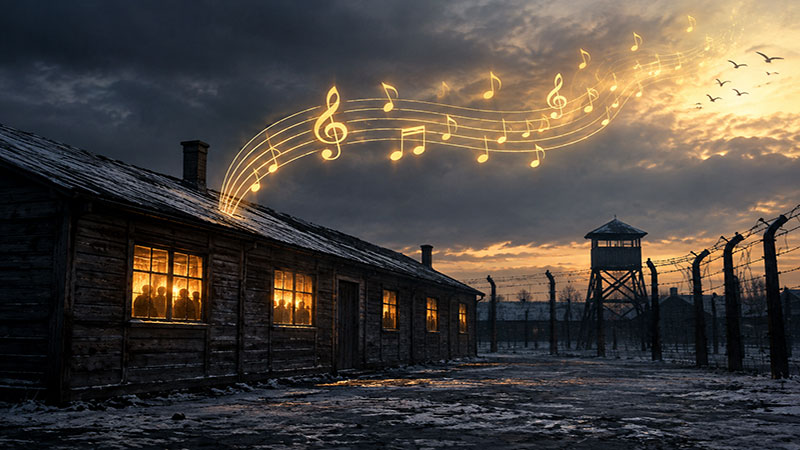
One of my father's stories recounts an extraordinary event that my mother witnessed during the Holocaust. In 1942, my mother was appointed head of her barrack in a Nazi labor camp. The thirty women were crowded into a wooden cabin, labored relentlessly from dawn until nightfall. Their only respite came for approximately one hour on Thursday afternoons. During that precious hour, my mother tried to create a fragment of normal human existence. Each week she invited one of the women to lecture, sing, tell a story, or do something, anything, that reminded them that they had once lived ordinary lives. Everyone participated, except for one silent woman who never spoke and always sat alone. No one knew very much about her.
Then came one of the dreaded selections that the Nazis conducted every few months. Scores of women were lined up while a Gestapo officer counted them off by tens. Every tenth woman was ordered to step forward and was shot. During one such terror selection, the officer counted and the tenth woman was the silent woman from my mother's barrack. As she moved toward the officer, she suddenly stopped. Nervously, she ran her hands across her shaven head, as though remembering the hair she once possessed. “Keep marching!” the officer shouted. In a trembling yet unexpectedly strong voice, she responded: “Every person condemned to death has the right to a last wish.” The officer asked: “And what do you want?” Her answer was astonishing: “I want to sing a song before I die.” “Sing!” came the unexpected reply. And she began. Her voice was mesmerizing and melodious. The women prisoners stood motionless. The forest itself seemed silent. The birds ceased their songs and listened.
When she finished singing, the officer said: “Sing another song.” Her perfectly pitched voice trembled as she began again. This time she sang a Yiddish song expressing the enduring hope and faith of the Jewish people, even amid unimaginable suffering. Then something extraordinary happened. The stone-like face of the Gestapo officer softened. And he declared, “No one will die today.” No one. Through her song, she had reclaimed something the Nazis could never destroy: her humanity and her Jewish soul.They could strip away her possessions, her dignity, and even her freedom, but they could not extinguish the sound of hope. For one brief moment, the Nazi’s machinery of death came to a halt.
(Amazingly, there are other documented stories of women whose lives were saved by a song, including Helena Citronova, Agi Geva (see the United States Holocaust Memorial Museum website, www.ushmm.org) and Judith Becker (https://www.yadvashem.org/).)
Perhaps the most remarkable aspect of this story is that it has deep roots in Jewish tradition. In Parshat Vayelech (31:10), Moshe warns the Jewish people about a difficult future that will include failure, suffering, and exile. Yet, immediately afterward he commands to write “this song” and teach it to Bnei Yisrael (Devarim 31:21). After delivering terrifying predictions regarding Israel's future, Moshe tells his people, Remember this song. Learn it.The Malbim (on Devarim 31:21) explains that this song serves as a timeless witness before G-d on behalf of Israel.
This idea is reminiscent of another defining moment in Jewish history. The Israelites stand at the Red Sea. Behind them is Pharaoh and his massive army. Before them stands an impassable barrier of water. They have escaped Egypt, but they are not yet free. Then the sea splits. Israel crosses. And the Torah records: “Then Moses and the Children of Israel sang.” Why is the first response to redemption a song? Because freedom is the ability to find one's voice.At this sea, the Jewish people discovered something Pharaoh could never control: their voices.
The same thing happened to this young woman in the concentration camp. The Nazis tried to reduce human beings to numbers, to laborers, and to bodies. Yet through song, she reclaimed her Jewish identity and saved so many lives. The Or HaChaim notices something extraordinary in the wording of Shirat HaYam. The Israelites proclaim: “Ashirah laHashem” “I will sing to G-d.” Why the singular? There were hundreds of thousands of Israelites. Why not “Nashirah” (We will sing)?
The Or HaChaim explains (Shemot 15:1) that the Jewish people sang with such perfect unity that they became like a single individual with one voice. Many individuals. One nation. One song. One voice. That may be one of the deepest powers of song. Song creates a unified community.At the Red Sea, hundreds of thousands of former slaves became one nation through a shared voice. And in a concentration camp, one solitary unknown Jewish woman found a voice powerful enough to unite souls that suffering sought to divide.
Song is more than music. The Gemara in Arachin 11a discusses the song of the Levites that they sang in the Temple and records a remarkable dispute. Rabbi Meir teaches that if the Levites failed to sing while a communal sacrifice was offered, the sacrifice was invalid. The Sages disagree. Yet even within that disagreement, the Gemara reveals something profound: Shirah is an essential category of Temple service.Song is not merely an emotional accompaniment to worship. It is itself avodah, sacred service.
At the climax of the Yom Kippur Musaf service, we sing Mareh Kohen, describing the appearance of the Kohen Gadol after successfully completing the Temple service. The message is clear: Yom Kippur does not end with our sins. It ends with successful avodah, celebrated with song.Why? Because words explain. Song reveals. Words communicate ideas. Song communicates the soul. There are moments when the intellect cannot understand G-d's ways. And so, as Jews, we sing.
Rabbi Akiva offers an even more striking insight. In his eyes, the most intimate human experience can become an encounter with G-d. That is why he called Shir HaShirim, the Song of Songs, “Holy of Holies.” Song can transform human love into a doorway to the Divine (see Rabbi Jonathan Sacks on Shir HaShirim 1:1). Perhaps this is the meaning of the verse we recite in Selichot: “The gates of tears are never blocked.”
The Or HaChaim further explains (Shemot 15:1:2) the Torah uses the future tense, Az yashir, (then he will sing). Why the future tense? Because Shirat HaYam was never intended solely for the generation that stood at the sea. This song is available to every future generation. Indeed, it became part of the daily morning prayers. The song never ended. The melody traditionally used for Ashamnu on Yom Kippur and during Selichot closely resembles the cantillation of Shirat HaYam itself (M. Nulman, The Concise Encyclopedia of Jewish Music, p. 227). Why should a melody be associated with redemption and triumph accompany a confession of sin? The Tiferet Yisrael (Yachin, Ta'anit 4:8) explains that sincere repentance has the power to transform transgressions into merits. This insight explains why we sing Ashamnu on Yom Kippur. We are not simply reciting a catalog of our failures; we are proclaiming our faith in the teshuvah process. We are proclaiming our faith that G-d still listens, still accepts teshuvah, even when it is incomplete, and always leaves open the possibility of beginning anew. Our songs survive throughout history. They survive catastrophe and exile. Perhaps that is the most haunting resonance of the Holocaust. The Nazis attempted to extinguish the Jewish voice forever; they failed.
There is another powerful lesson in my father’s story. I often think about the Gestapo officer's astonishing declaration: “No one will die today.” Just as G-d placed words of blessing into the mouth of Bilaam, transforming curses into blessings, perhaps He placed those unexpected words into the mouth of an executioner.
Today, the Jewish people once again confront individuals and nations that seek to intimidate us, isolate us, and destroy us. We witness antisemitism, hatred, violence, and terror. Yet our enemies misunderstand the source of Jewish survival. It is more than our dedicated armies, high-tech missiles, or fighter jets. We will always sing, especially during the High Holidays, when our lives rest in G-d's hands. For the ultimate freedom is the spiritual power embodied in our songs, something no government, weapon, army, or dictator can ever take away. The Jewish people have always understood that song is more than sound. The power of the Song is faith.And that GemarainArachin 11a teaches us that song can be an act of sacred service and that music can open the human being to the Divine.
As David HaMelech (Tehillim 30:6) promises: “Weeping may endure for the night, but in the morning, there is song.” The Radak there explains that night represents the darkness of suffering, while morning represents salvation. Jewish song is often born precisely from the tears that preceded it. Likewise Tehillim 126:5 tells us that those who sow in tears will reap in song (see Meiri on this verse). The tears themselves become the seeds from which the song of redemption grows.
The power of song is resistance, not only against the hatred of the nations but also against despair arising from our own failings (see Midrash Tehillim on chapter 40). And so, as we sing on Yom Kippur, perhaps we dare to ask for the greatest transformation of all: That the tears of this past year become the song of the coming year. That fear becomes hope. That mourning becomes joy. And that the Heavenly Judge should answer us with our impossible, dreamlike request and message: “No Jew will die this year.”
This is the immutable legacy of my father’s story. When forces rise to silence us, find your song. Because as long as the Jewish nation can still sing, our story is never over. The power of the song will always prevail.