 October 9, 2026
 Categories: In Print / Headline / Features On The Jewish World
Early Printing of Rabbi Menachem Recanati
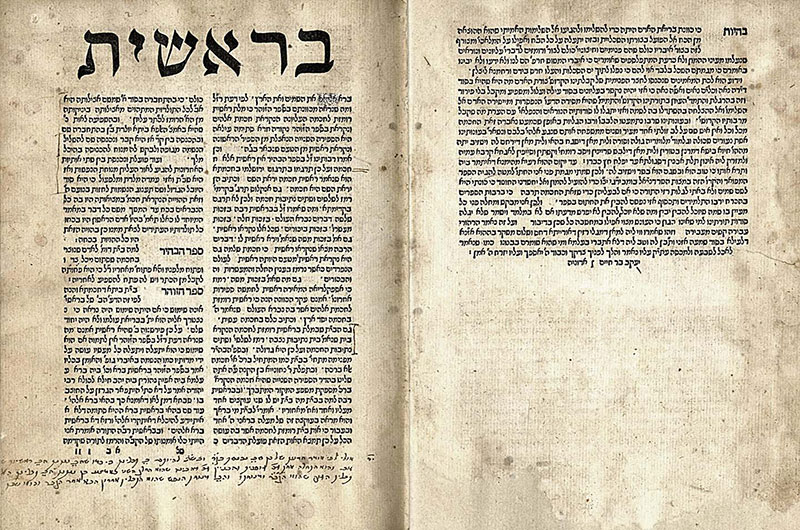


This week, I had the privilege of acquiring, on behalf of a client, a remarkable copy of the Perush al ha-Torah by Rabbi Menachem Recanati – Venice, 1523 – the first printed edition of this seminal Kabbalistic work, issued by the renowned printer Daniel Bomberg.
Rabbi Menahem ben Benjamin Recanati (late 13th – early 14th century) was a preeminent Italian rabbi, posek, and one of the earliest expositors of Kabbalah in Italy. Named after his native city of Recanati, much of his biography remains enigmatic. His Torah commentary stands as his magnum opus and is among the earliest printed works of Kabbalah – a pioneering synthesis of mystical interpretation and halachic insight.
Profoundly influenced by both the Gerona school – notably R. Yitzchak the Blind and his disciples – and the Castilian Kabbalists such as R. Yosef Gikatilla and R. Moshe de Leon, Recanati also drew upon Ashkenazi traditions, quoting figures like R. Yehudah HaChassid and R. Elazar of Worms. His legal rulings reflect a synthesis of Sephardic and Ashkenazic customs, evidencing his wide intellectual reach.
His Torah commentary is distinguished not only for its depth but also for its historical significance: it is the first known work to cite the Zohar extensively and by name – decades before the Zohar was first printed in 1558. He also references other foundational esoteric texts such as the Bahir. His work thus preserves numerous teachings from earlier Kabbalists whose writings have otherwise been lost to history. According to scholar Moshe Idel, Recanati serves as a crucial transmitter of these otherwise unknown voices (see R. Menachem Recanati HaMekubal, 1998).
The commentary spans the entire Torah, offering mystical interpretations rooted in early Kabbalistic doctrine. In some passages, Recanati describes celestial visions and divine revelations, revealing the deep spiritual orientation of his exegetical method. His reverence for earlier Kabbalistic sources, including apocryphal works, is unmistakable.
So influential was his commentary that it gave rise to at least two supercommentaries, by Mattathias Delacrut and Rabbi Mordechai Jaffe – the latter calling Recanati Rosh HaKablanim ("Chief of the Kabbalists") and Av LiNevonim ("Father to the Understanding"). Recanati's work was also translated into Latin by Renaissance humanists, including Pico della Mirandola, as part of their effort to integrate Jewish mystical thought into Christian theological discourse.
The edition acquired is of particular bibliographic significance. Printed by Daniel Bomberg in Venice in 1523, it represents one of the earliest appearances of Kabbalah in print. According to the colophon, the printing was completed on "Monday, the 35th day of the Omer [Iyar], 1523." This was only the second work proofread by the esteemed scholar Yaakov ben Chaim ibn Adoniyahu at the Bomberg press – the first being Tzror HaMor, published earlier that same year.
In his preface, Yaakov ben Chaim offers a sober caution to readers: only those capable of comprehending these mystical teachings should engage with them, and the secrets within must not be disclosed to the unworthy. His introduction itself serves as a brief but thoughtful meditation on the responsibility that comes with engaging in esoteric study.
Beyond this Torah commentary, Recanati’s corpus includes Ta’amei HaMitzvot (Constantinople, 1544) and Piskei Recanati (Bologna, 1538), along with several lost works referenced in later sources.
This rare acquisition not only represents a milestone in the history of Jewish mysticism and early Hebrew printing but also preserves the voice of a pivotal figure who shaped the trajectory of Kabbalistic thought for generations to come.