 November 6, 2026
Einstein’s Passionate Plea for Jewish Solidarity
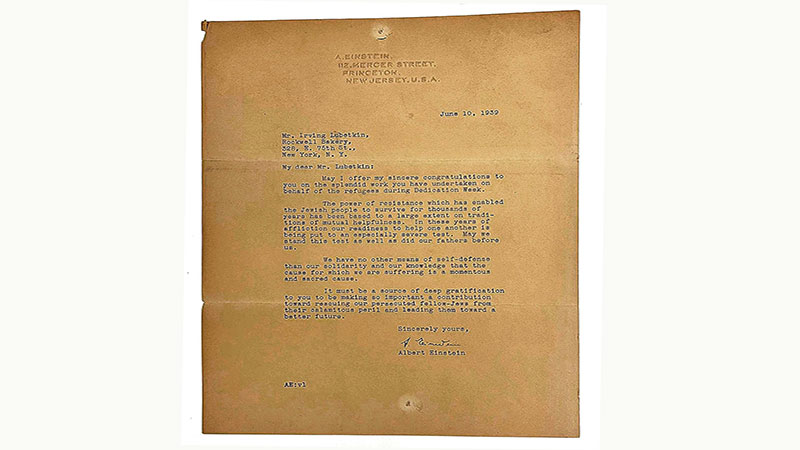


A letter I was able to obtain recently reverberated with me greatly, in light of the current environment for the Jews in the Diaspora and the world. This remarkable 1939 letter reveals Albert Einstein’s passionate appeal for Jewish solidarity as European Jews confronted an increasingly desperate search for safety.
On June 10, 1939, less than three months before Nazi Germany invaded Poland and plunged Europe into the Second World War, Albert Einstein sat at his home in Princeton, N.J., and composed a deeply moving letter to Irving Lubetkin, a Jewish activist involved in assisting refugees fleeing Nazi persecution. Typed on Einstein’s personal blind-embossed letterhead and signed simply “A. Einstein,” the letter offers a remarkable glimpse into the concern that occupied one of the world’s most famous Jews during a period when the fate of European Jewry was rapidly becoming more precarious, while also providing a powerful expression of the principle that Einstein believed had helped the Jewish people endure centuries of persecution: the obligation of Jews to stand together and help one another in times of crisis.
Einstein wrote to Lubetkin in recognition of his humanitarian work “on behalf of the refugees during Dedication Week,” praising his efforts at a moment when Jewish refugees escaping Nazi Germany and the territories under its influence were desperately seeking countries willing to receive them. Although the full dimensions of the catastrophe that awaited European Jewry could not yet have been known in June 1939, the danger was already unmistakable, and Einstein understood that the Jewish community faced a profound test of its willingness and ability to come to the assistance of its persecuted brethren.
“The power of resistance which has enabled the Jewish people to survive for thousands of years has been based to a large extent on traditions of mutual helpfulness,” Einstein wrote, placing the refugee crisis within the much longer sweep of Jewish history. “In these years of affliction our readiness to help one another is being put to an especially severe test. May we stand this test as well as did our fathers before us.”
Those words acquire an extraordinary poignancy when viewed from the perspective of what followed, because the letter was written at the very threshold of one of the darkest periods in Jewish history. Within weeks, the German invasion of Poland would begin the Second World War, and the persecution of European Jews would eventually develop into the systematic annihilation of six million Jewish men, women and children. In the summer of 1939, however, there was still an opportunity to save lives, and Jewish activists, communal organizations and individuals in the United States and elsewhere were struggling to find ways to help refugees escape the increasingly dangerous conditions in Europe.
Einstein was among the most prominent people lending his voice to that effort, using a reputation that extended far beyond the Jewish community to draw attention to the plight of Jewish refugees and to encourage those who were attempting to assist them. During the late 1930s, he wrote letters on behalf of refugees, signed affidavits and offered his support to people and organizations engaged in rescue and relief efforts, demonstrating that his concern for the Jewish people extended well beyond sympathy or private identification and into the realm of public action.
The timing of his letter to Lubetkin is particularly significant because just two weeks earlier, Einstein had delivered the inaugural address at the opening of the Jewish Palestine Pavilion at the New York World’s Fair, where he spoke before an enormous audience estimated at approximately 100,000 people. In an era before television and social media could instantly amplify a public figure’s words around the world, Einstein’s appearance provided an extraordinary platform from which to address the concerns of the Jewish people, and he used that opportunity to urge his listeners to “fight with all [their] might.”
That public appeal and the private letter to Lubetkin reveal the same underlying conviction: that Jewish survival depended not only upon the courage of individuals but upon the willingness of Jews to recognize their shared responsibility toward one another, particularly when their fellow Jews were facing persecution and displacement. Einstein understood that the refugee crisis was not simply a humanitarian problem affecting distant strangers, but a Jewish crisis that demanded a collective response from Jews who were fortunate enough to live in relative safety.
“We have no other means of self-defense than our solidarity and our knowledge that the cause for which we are suffering is a momentous and sacred cause,” Einstein wrote, expressing in remarkably direct terms the philosophy that runs throughout the letter. For him, solidarity was not merely an expression of Jewish sentiment; it represented a practical means of confronting persecution at a time when Jews possessed few other avenues through which they could protect their endangered brethren.
He then offered Lubetkin a deeply personal expression of appreciation for the work he was undertaking, writing that it “must be a source of deep gratification” to know that he was making such an important contribution toward “rescuing our persecuted fellow-Jews from their calamitous peril and leading them toward a better future.” The language is striking not only because of its emotional force, but because Einstein deliberately identifies himself with both Lubetkin and the refugees as part of a single Jewish collective, referring to the victims not as “the refugees” or “those Jews,” but as “our persecuted fellow-Jews.”
That sense of collective responsibility was especially significant during the refugee crisis of the late 1930s, when Jews fleeing Nazi persecution confronted formidable obstacles in their search for refuge. Countries that might have offered safety imposed immigration restrictions, while the number of people seeking escape from Europe continued to rise, leaving activists such as Lubetkin attempting to navigate an increasingly desperate situation in which every successful intervention could potentially mean the difference between a refugee reaching safety and being trapped in a continent moving toward war.
Einstein’s letter therefore provides more than an intimate glimpse into the humanitarian concerns of a celebrated historical figure; it captures a Jewish world standing on the precipice of catastrophe, at a moment when the need for rescue was becoming increasingly urgent and when individuals involved in refugee work required both practical assistance and moral encouragement. Einstein’s decision to write directly to Lubetkin, and his choice to emphasize the ancient Jewish tradition of mutual aid, demonstrate how deeply he viewed the refugee crisis through the lens of Jewish history and collective responsibility.
For Einstein, the story of Jewish survival was inseparable from the willingness of one Jew to help another, a tradition that he believed had enabled the Jewish people to withstand repeated periods of persecution throughout the ages. His appeal to Lubetkin to “stand this test” as the Jews’ fathers had done before them was therefore both a compliment to the activist’s work and a challenge to the broader Jewish community to rise to the circumstances confronting it.
The letter also serves as a reminder that Einstein’s relationship with the Jewish people was far more consequential than his popular image as a brilliant physicist might suggest. Although his scientific achievements made him one of the most recognizable figures in the world, he also became an influential Jewish public figure whose words carried enormous weight on questions involving Jewish security, refugee relief, Palestine and the future of the Jewish people. At a time when Jews in Europe were increasingly stripped of their homes, rights and security, Einstein used whatever influence he possessed to call attention to their plight and encourage others to act on their behalf.
Seen today, more than eight decades after it was written, the June 10, 1939 letter possesses an almost haunting quality because its author was writing at a moment when history was moving rapidly toward a catastrophe whose dimensions he could not yet have known. Einstein could not foresee the full extent of the Holocaust, nor could he possibly have known how many of the refugees whose plight concerned him would ultimately find safety and how many would not, but he clearly understood that Jewish lives were in danger and that those who had the ability to help could not simply stand by.
What makes the document particularly resonant is that Einstein did not present Jewish solidarity as a matter of convenience or even simply as an admirable virtue; he described it as a fundamental source of the Jewish people’s ability to survive. In his understanding, the strength that had carried the Jewish people through thousands of years of dispersion and persecution was rooted in traditions of mutual assistance, and the refugee crisis of 1939 represented another moment in which that tradition would be tested.
The letter to Irving Lubetkin thus stands as both a historical document and a personal testimony, preserving the voice of Albert Einstein at a critical moment in Jewish history and showing how one of the twentieth century’s most famous Jews sought to use his influence on behalf of refugees whose lives were threatened by Nazi persecution. Written only weeks before the outbreak of war and only a few years before the full horror of the Holocaust would become known, Einstein’s message remains remarkably clear: when Jews are threatened, their strength lies in their solidarity, their willingness to assume responsibility for one another, and their determination to ensure that those in danger are not left to face their fate alone.
More than eighty years later, those words give the letter a significance that extends far beyond its original recipient, transforming what might otherwise be viewed as a piece of correspondence between a celebrated scientist and a Jewish activist into a window onto one of the most consequential moments in modern Jewish history, when the ancient Jewish tradition of mutual aid was being called upon to meet an unprecedented challenge.