October 2, 2026
Categories: Halacha & Hashkafa / Torah
From the Mundane to the Sacred (Part III)
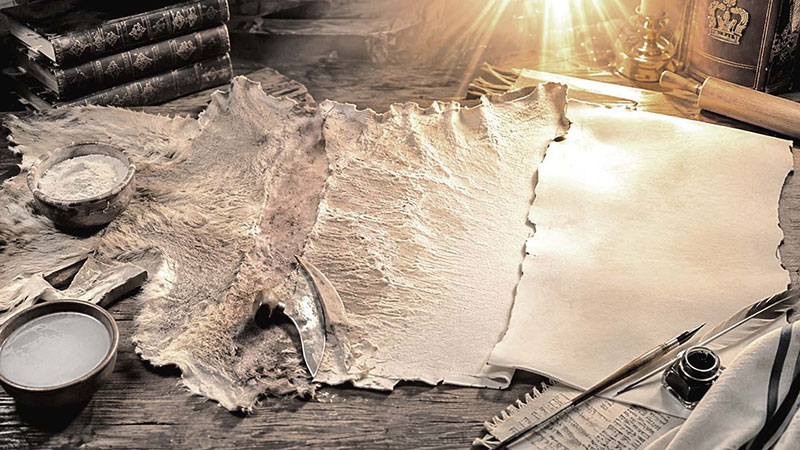


In the previous article, we discussed an unusual stage in the creation of STaM. Even before a single letter is written, the animal hide has already been deliberately prepared lishmah, for the purpose of becoming a Sefer Torah, tefillin, or mezuzah. Halacha begins treating that blank parchment differently from an ordinary piece of leather.
But what actually happens to the hide?
How Animal Hide Becomes Klaf
A finished piece of klaf bears surprisingly little resemblance to the material with which the process began. It is pale, relatively smooth, firm enough to hold a precise letter, yet flexible enough to be rolled. Getting from raw animal skin to that finished writing surface requires a substantial physical transformation.
The Rambam gives us one of the earliest detailed halachic descriptions. In Hilchos Tefillin, Mezuzah V’Sefer Torah 1:6, he describes removing the hair from the hide, salting it, treating it with flour, and then processing it with afatzim, generally identified with gallnut material, or similar substances that contract and strengthen the skin. When the entire hide is processed in this fashion, the Rambam calls the finished material gevil.
If the hide was split through its thickness, the Rambam explains, the resulting portions could instead become klaf and duchsustus. As we discussed previously, the terminology is halachically significant because different forms of parchment have different writing surfaces and different applications in STaM.
The parchment most sofrim use today developed somewhat differently. Later authorities discuss treating hides with sid, lime. The Shulchan Aruch HaRav explains that parchment must undergo a process that contracts and strengthens the hide, mentioning either gallnut treatment, lime, or comparable substances. Without sufficient processing, the hide retains the status of diftera, incompletely processed skin, and cannot be used for STaM.
The lime serves an important practical role as well. The hide remains in the lime until the hair loosens sufficiently to be removed. The same halachic source cautions against removing it prematurely: if the skin has not undergone sufficient processing, simply making it look like parchment does not make it acceptable parchment.
This is an important theme throughout sofrus. Appearance and halachic reality are not always the same thing.
Once the hair is removed, the hide must be worked down into an appropriate writing surface. Material is removed from the flesh side and the surface is scraped and refined. The goal is not simply to make the parchment attractive. A sofer needs a surface on which a quill can produce extremely controlled strokes. Changes in thickness, rough areas, scars, holes, or other irregularities can affect the writing.
The Keset HaSofer gives an especially useful description of the klaf used in more recent generations. He notes that “our parchments” are generally not split into two complete layers in the ancient manner. Instead, some material is scraped from the hair side as part of preparing and smoothing it, while considerably more is removed from the flesh side until the remaining material is considered klaf. He warns that the flesh side must be scraped properly so that a layer possessing the status of duchsustus does not remain on the writing surface (Keset HaSofer 2:9).
This means that the parchment maker is not simply producing a nice piece of leather for the sofer. The thickness of what remains and the surface upon which the writing will eventually be placed can themselves have halachic consequences.
Even thickness can be intentionally manipulated for the needs of STaM. Later halachic literature notes that careful parchment makers could prepare different thicknesses of klaf for the four parshiyos of the head tefillin. Since the passages contain different amounts of text, varying the parchment thickness helped the four rolled parshiyos fill their compartments more evenly, which was considered a noi tefillin, a beautification of the tefillin.
And throughout this physical work runs the requirement we discussed in the previous article: lishmah. Keset HaSofer identifies placing the hides into the lime as the beginning of the halachically significant processing and requires it to be done expressly for the sacred purpose of the parchment. He adds that it is proper to repeat that intention during later stages as well (Keset HaSofer 2:2).
The result is a remarkable combination of craft and halacha. Removing hair, soaking, scraping, thinning, and smoothing sound like the work of a leather craftsman. Yet each stage is being performed on material intended to become the physical bearer of Torah, and some of those seemingly technical decisions can determine whether the finished STaM will ultimately be kosher.
By the time a sofer receives a sheet of klaf, much of its story is already invisible. He sees a clean writing surface. Behind it lies an animal hide that has been cleaned, processed, strengthened, scraped, refined, and prepared lishmah.
Only then can the quill touch the parchment.
And only then does the next stage of the transformation begin.