 November 20, 2026
Categories: Torah
From the Mundane to the Sacred (Part IX)
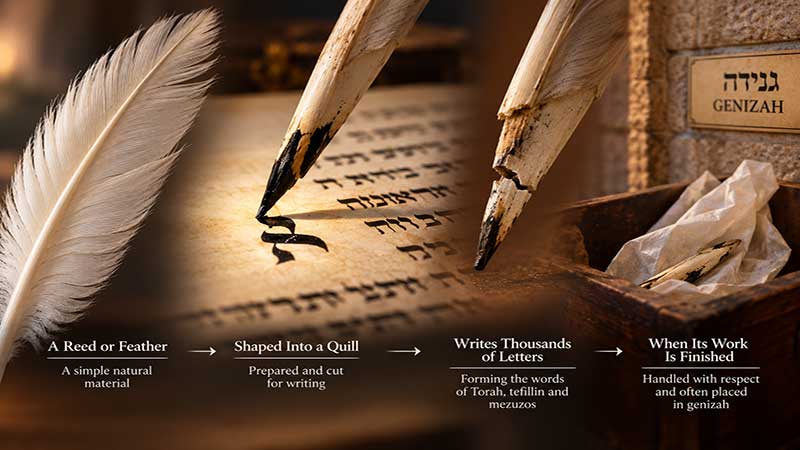


A sofer may use the same quill to write thousands of letters of Torah. It may form the words of Shema, entire parshiyos of tefillin and mezuzos, and perhaps the Names of Hashem themselves. Eventually, however, the feather wears down or cracks and can no longer be used. What happens then? Does a pen that has spent its life creating objects of kedusha become holy itself?
Does a Sofer’s Quill Need Shaimos?
The question is already addressed in a remarkably direct way by Sefer Chasidim, siman 894. It tells of someone whose kulmus broke after he had used it for writing sacred material. A chacham told him that because he had written devarim kedoshim with it, he should place it in genizah rather than leave it where people might step on it. Sefer Chasidim continues by warning against using such writing instruments for degrading purposes.
An adjacent passage in Sefer Chasidim, siman 893, is even more striking. It discusses shavings removed from a kulmus after it had been used to write Torah and Hashem’s Name, and warns that they should not simply be thrown on the ground. Whatever the precise halachic status of the pen, Sefer Chasidim clearly sees an object that has been used to write Torah as deserving unusual respect.
Later poskim ask whether this respect means that the kulmus actually acquires kedusha. Rav Mordechai Eliyahu, former Sephardic Chief Rabbi of Israel, in his Maamar Mordechai on hilchos STaM, rules that, strictly speaking, the pen itself does not possess kedusha. The main concern is the sacred ink remaining upon it. If the quill is cleaned thoroughly so that no meaningful ink remains, it does not technically require genizah. He nevertheless writes that one who is stringent and places the kulmus in genizah is praiseworthy, and that if it is discarded it should first be cleaned and wrapped respectfully.
Rav Yosef Shalom Elyashiv is cited in Ginzey HaKodesh as taking this respectful approach seriously as well. Based on Sefer Chasidim, he is quoted as saying that a kulmus used for writing STaM should preferably be placed in genizah. The point is significant because the concern is not necessarily that the pen has acquired the same kedusha as the Torah it produced. Rather, an object that has spent its life forming sacred words should not automatically be treated like ordinary refuse.
This distinction fits beautifully with the role of the kulmus that we discussed in the previous articles. The klaf eventually becomes part of the sacred text itself. The ink becomes the actual letters. The kulmus stands between the sofer and both of them. It carries the ink and translates the sofer’s lishmah, kavannah, and physical movement into a written letter of Torah. Yet when the writing is complete, the kedusha does not necessarily remain behind in the tool.
That may be exactly why there is room for both sides of the discussion. Strictly speaking, the pen may remain an ordinary object. At the same time, Sefer Chasidim, Rav Mordechai Eliyahu, and Rav Elyashiv remind us that halachic categories do not exhaust the Jewish instinct for kavod haTorah. Something can fall short of technically requiring genizah and still deserve to be treated differently because of what passed through it.
The quill therefore occupies a fascinating place in our journey from the mundane to the sacred. It may never itself become a cheftza shel kedusha, yet it is the instrument through which kedusha takes physical form.
Perhaps that is why, when its work is finally finished, many are reluctant simply to throw it away.