

 November 6, 2026
From the Mundane to the Sacred (Part VII)
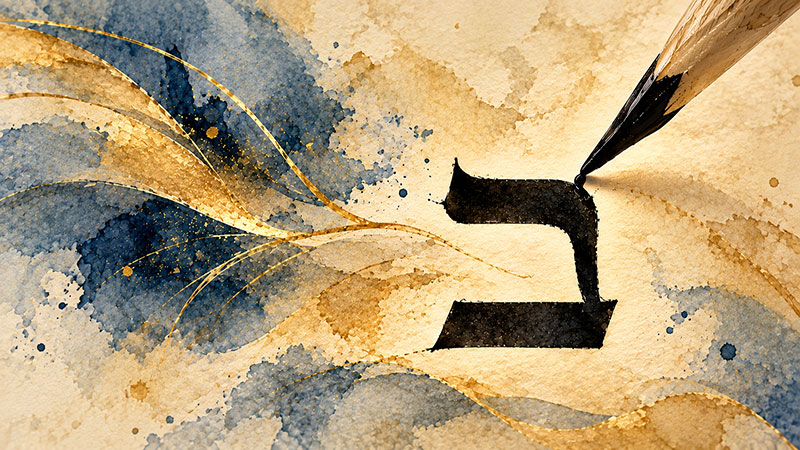


We have spent the last several articles discussing how ordinary physical materials become part of STaM. Animal hide becomes klaf. Ink becomes the visible form of Torah. Even the blank parchment surrounding the letters acquires a role in the sacred text. Eventually, however, all of those materials have to meet at a single point: the tip of the sofer’s pen.
The Sofer’s Pen
Today, the classic image of a sofer is almost inseparable from the feather quill. Yet Chazal give us a different image. The Gemara in Ta’anis 20b teaches that a person should always be “soft like a reed and not hard like a cedar.” It then adds that because of this quality, the reed merited that a kulmus should be taken from it to write a Sefer Torah, tefillin, and mezuzos. Avos D’Rabbi Nosson develops the image further, explaining that when the wind comes, the reed bends, but when the wind passes, it returns to its place. The cedar appears stronger, yet its rigidity can ultimately cause it to be uprooted. The Reishis Chochmah later includes this teaching in his discussion of anavah, humility.
That makes the kulmus more than simply a writing tool. Chazal connect the instrument used to create objects of kedusha with a middah that Torah itself demands. The reed is flexible without losing its identity. It bends without breaking. Perhaps that is an appropriate image for the sofer as well. He must be extraordinarily precise, but he must also submit his own hand to the requirements of halacha.
The Gemara in Shabbos 133b gives the pen another significance. In its discussion of “Zeh Keili v’anveihu,” beautifying mitzvos, Chazal say that a Sefer Torah should be written with beautiful ink, a beautiful kulmus, and by a skilled scribe. Even the pen participates in hiddur mitzvah. The Torah should not simply emerge kosher at the end. Care and beauty should be present in the very process through which kedusha is brought into physical form.
Perhaps there is a deeper way to understand the role of the kulmus. Until the pen touches the klaf, everything remains preparation. The parchment has been processed and designated for sacred use. The ink has been made. The sofer has studied the halachos and formed the required lishmah and kavanah. But none of that has yet become an actual written letter of Torah.
In that sense, the kulmus functions almost as a conduit. The sofer brings the intention. The ink supplies the physical substance. The klaf receives it. The pen is the point through which the sofer’s conscious act becomes a physical letter that now participates in kedusha.
This is not merely poetic. Halacha places tremendous importance on the act of writing itself. STaM cannot simply consist of correctly shaped Hebrew letters. It must come into existence through a valid act of kesivah, performed by a person with the required intention. The kedusha of the finished writing is therefore bound up not only with the material, but with the human act that creates it.
That may be why the image of the reed is so fitting. The instrument through which Torah passes from the hand of the sofer onto the parchment is associated by Chazal with humility and flexibility. The kulmus itself may remain an ordinary object, but for that moment it stands at the precise point where the mundane begins to become sacred.