 October 23, 2026
 Categories: In Print / Featured / Movie and Play Reviews
From The Shtetl to Shylock
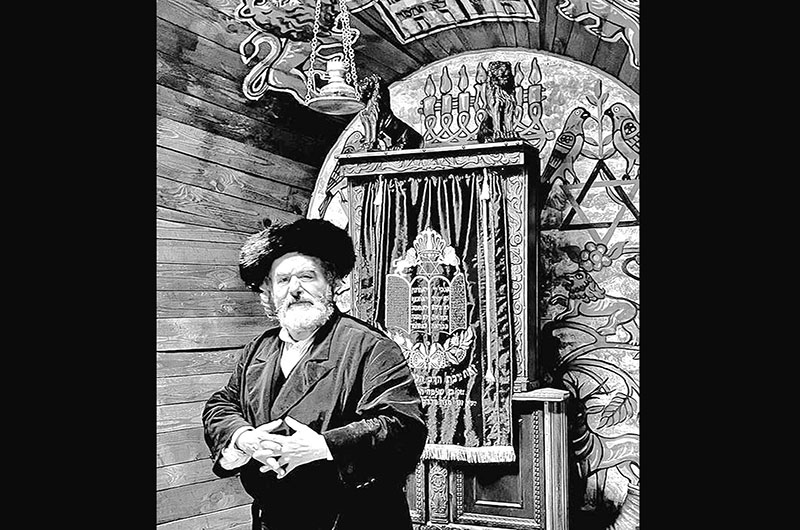


Saul Rubinek, 77, has appeared in numerous films and TV shows. But he said it is special to be able to see himself as a rabbi on the big screen and as an actor in an Off-Broadway show in Brooklyn. In the movie Shttl, which came out in 2022, he plays the rabbi of a community on June 21, 1941, the day before Operation Barbarossa – Hitler’s invasion of the Soviet Union.
Rubinek’s parents survived the Holocaust because they were hidden by Christian farmers. His father broke away from chassidism and was involved in the Jewish theater. Rubinek grew up in Canada, where he said there was hostility against Jews.
“I became an actor at the age of seven, partly because I grew up in an antisemitic Montreal where there was violence… There were street gangs and all that stuff,” Rubinek told The Jewish Press. “I spoke Yiddish and didn’t speak English until I was six or so… It was free for boys to go to children’s theater school. The story is I went and I never left.”
Shttl is a feature film in Yiddish, and he said his Yiddish skills came back to him while making the film. He plays a rabbi whose daughter, Yuna, is slated to marry a man who was the butcher and is now a rabbi. We can see, however, that he knows that a young man named Mendele might be more suited for his daughter, had Mendele not abandoned the shtetl and moved to Kiev to become a filmmaker. In his role, Rubinek engages with other characters who argue about religion, faith, Torah, work, assimilation, and politics.
Rubinek and the cast traveled to Ukraine to shoot the film. He said it was poignant to make the movie there and believes it presents “one of the most accurate depictions of shtetl life that’s ever been on film.”
Asked about his reaction to the rising antisemitism around the world, he said, “I’m the child of Holocaust survivors. My father always said what happened in Europe could happen to any nation.” He added, “Am I surprised? No, I think it’s terrible.”
Though his father was also an actor, Rubinek said that didn’t put more pressure on him. Rather, he felt an obligation to excel for a different reason.
“There’s a tremendous pressure on all immigrant children to do better than their parents,” he said. “Many children, no matter what nationality they’re from, feel they owe their parents something back [for] the hardships they endured. I was on my own financially from the time I was 18 and never had a regular job, other than acting, writing, and directing.”
He said his parents considered themselves fortunate because they were together, and survived the war while many members of their families were murdered.
In addition to his role in Shttl, Rubinek is starring in the new one-man show Playing Shylock at the Polonsky Shakespeare Theater.
In the play, he is an actor named Saul playing Shylock, the Jewish moneylender who is the villain in The Merchant of Venice. He tells the audience during intermission that the play is being canceled and he defends it as not antisemitic or dangerous, as there are more pressing things such as violent attacks against synagogues.
“There’s a line in my play where I go to the Jewish community center before The Merchant of Venice opens and one of the young men says, ‘I’m afraid to wear my Magen David on my college campus while you’re doing a racist caricature,’” Rubinek said, adding that his character defends why, as a child of Holocaust survivors, he is playing this role in the play-within-a-play.
The show doesn’t mention Gaza or Israel. Does he expect any protests?
“We prepared for protests in Toronto before we opened in case someone yells in the theater,” he said. “But I’m not a big enough star. I think people protesting want publicity. It is a Jewish-themed show, and that can be an excuse for anything. I don’t know what’s going to happen in Brooklyn…I don’t expect it, but is it possible? Absolutely.”
Rubinek said that while Shylock is a bad guy, he was the first three-dimensional Jewish character in British literature and that previously, in England, Jewish characters were evil caricatures. “He’s probably got more reasons to be a bad guy than Iago does,” Rubinek said, citing the villain in Shakespeare’s Othello.
In The Merchant of Venice, Shylock makes a famous speech in which he says, “If you prick us, do we not bleed?” – suggesting equality between Jews and Christians. But he demands his “pound of flesh” and even when offered multiples of the amount of money that he loaned, he refuses and says he prefers to cut Antonio, as he believes that to be in accordance with their signed contract, even if Antonio dies.
Rubinek, who appeared as a Jewish film producer in True Romance and a Jewish dentist who pulled up Larry David’s sleeve on an episode of Curb Your Enthusiasm, said the work he is doing is worth it.
“At 77, my memory, thank G-d, is still good and I have the energy to go on stage eight times a week. It’s part of my will to do something that I think matters.”