 October 23, 2026
Go at Your Own Pace


Parhsas Lech Lecha
There were several stages to Avram’s life journey from the idolatrous background from which he came to the ultimate destination of becoming the great Jewish nation. He had to leave his home town. He had to leave his parents behind. He had to sever ties with all his relatives, including his nephew Lot. He had to travel to an unknown country whose identity was not revealed to him when he started out on the journey.
But all of these things did not happen all at once. They had to happen gradually at Avram’s pace, not at G-d’s pace. That is the meaning of Lech Lecha, go at your own pace. Transforming a person from a believer in idols to a believer in G-d does not happen overnight. What happens too fast in indigestible. It was Avram who recognized his Creator. It was not His creator who forced this recognition on Avram. He had to come to this realization on his own. And the various stages of the journey culminating in the formation of the Jewish nation in its own land also had to be embarked upon in stages.
“I will make you into a great nation and I will bless you and make your name great and you shall be a blessing” (12:2). The Hebrew word for “you shall be” used by the Torah here is “Ve’heyeh,” written in the imperative tense. Great empires enjoyed their heyday for a while and then faded into oblivion. The great Jewish nation will never be referred to in the past tense, because the blessing G-d gave to Abraham will never recede. The Jewish nation will always survive and be a blessing to the other nations.
The blessing that we have been given and that will never fade is on two levels – the spiritual and the physical. On the spiritual level, the Torah, which has been given to us, will never become old. Each time we study it, we reveal something new that we never saw before. The Maseches Berachos we begin to learn today seems entirely different from the one we learned seven years ago. And on the physical level, the blessing of prosperity G-d gives will also not become a gift of the past. “Veysihmerechah” – G-d will protect us from the corrupting influence of money and from the envy of others.
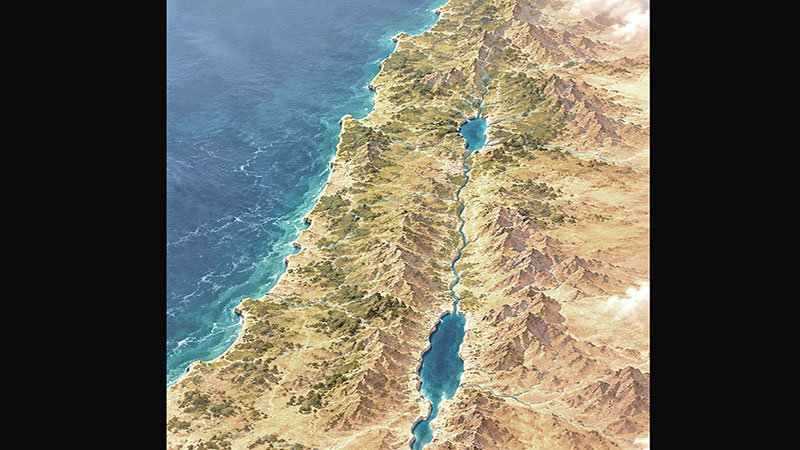
So Avram travels on until he reaches Shechem in the land of Canaan. Shechem is a trouble spot. That is where they would torture Dinah, where Shimon and Levi would kill all its inhabitants, where Yosef’s brothers would try to kill him and where the kingdom of David would be torn asunder (Sanhedrin 102a). Indeed, the entire nation of Canaan was so corrupt that the Torah tells us never to emulate their ways (Bamidbar 18:3). On the other hand, the city of Shechem is also known as Elon Moreh (Rashi 12:6), the place where the Jewish people at Har Gerizim and Har Eival would accept the Torah and take collective responsibility for its fulfillment. So Avram was confused. Is this the land that G-d meant when He ordered me to go to the Land that “I will show you”? Is it possible that a land that bred such hateful people could be the Promised Land? And the answer he gets from G-d is yes, indeed this is the land I meant to show you. It breeds people who have the potential to be passionate about good or about evil. As it says, “Where there is justice, there is also evil” (Koheles 3:16). It is the same people who are capable of immense evil who are also capable of immense goodness. It all depends upon where they channel their passion.
So Avram traveled south and set up his tent for the night between the cities of Bet El to the west and Ai to the east (12:8). Ai was the place where the Israelites in the future would suffer their first defeat in the battle for the conquest of the land (Yehoshua 7:2-9). The defeat came as a result of the greed of Achan who helped himself to the spoils of war after G-d crushed the city of Yericho, even though G-d has explicitly forbidden the Jews to do so. But Achan was too selfish to care. We are told that when Avram saw the city of Ai on his way down south, he had a vision of the future battle of Ai and so he first pitched the tent of his wife Sarai and only then did he pitch his own tent (Rashi 12:8). This was a corrective act aimed at trying to coach the Jewish people into concern and consideration for others and to warn them against acts self centeredness like those of Achan that led to disaster at Ai.
Avram continued on his journey down south, headed for Yerushalayim where the Beit Hamikdash would be erected (12:9). But he was rerouted by G-d to Egypt due to a famine which had broken out in Canaan.
Why this sudden change of destination? It was because G-d had to lay the ground for the future 210-year stay of the Jews in Egypt. We are told that when the Jews left Egypt, there were those who questioned their pure pedigree suggesting that the Egyptians who had enslaved them, had also coerced their wives into relations with them, as captors typically do (Rashi, Bamidbar 26:5). But in fact this did not happen for the following reason. The Egyptians at the time of the slavery of the Jews did not dare touch the Jewish women because they knew what had happened to their ancestor who tried that before. The story was recorded in their history books, just as it is recorded in the Torah, as it says, “And G-d struck Pharaoh and his palace with severe plagues because of Avram’s wife Sarai.”
In addition, when Pharaoh sent Avram and Sarai away (12:20), he awarded Sarai the land of Goshen (Pirkei De Rabbi Eliezer 26). The land of Goshen was therefore recorded in the registries of Egypt as belonging to the Jews and was later handed over by Pharaoh to Yaakov and his eleven sons when they arrived in Egypt (46:34).
So even though G-d had told Avram to go to the land of Canaan, and now there was an inexplicable change of plan and he was told to go to Egypt, Avram knew better than to question G-d’s ways. He trusted that there were reasons for this diversion that would become clear later on, even though he did not understand them at the time (Rashi 12:10).