With Gaza hermetically sealed by Israel and Egypt on land, its underground tunnels blocked, and closed off from the sea, where did Hamas get its rockets, mortars, drones, and explosives? This question is notably missing from most analyses of Hamas’ weapons used in the May 2021 Gaza conflict.
In research for this study, a surprising transformation of Hamas’ capabilities became apparent. The terrorist group was no longer a force fighting an asymmetrical war with asymmetrical tactics and weapons. Hamas is now manufacturing a large part of its own weapons, expanding its research, and developing drones and unmanned underwater vehicles, engaging in cyber warfare, and on the cusp of graduating from unguided rockets to precision GPS-guided drones and missiles. It explained why Israel focused on targeting Hamas’ “brain trust” – a score of military engineers and experts in aeronautics and cyberwarfare who were trained in Iran, Malaysia, and the United States and were training a new generation to match Israel’s technological superiority.
Some reports attribute the rockets shot by Hamas to its local manufacturing industry, and indeed, the Israel Defense Forces in May sought out and bombed Hamas workshops and stockpiles in Gaza. Clearly, however, the former “cottage industry” of rocket and mortar-making has advanced. “You now have a non-state actor that manages to strike targets in Tel Aviv using means that they produce themselves,” said one respected intelligence analyst. “In terms of a technological military shift, that’s quite something.”1
Admiring writers describe Hamas’ indigenous engineering workarounds. They collect unexploded Israeli ordnance for the explosives contained within, recycle streetlight poles or war detritus from the deserted Israeli communities in Gaza for launch tubes, and make projectile tubes from plumbing pipes. The destruction of several hi-rise buildings in May 2021 left much more wiring, pipes, rebar, cement, and metal available for “recycling.” In 2020, Hamas naval commandos managed to salvage large 170-kilogram naval shells from a British warship that sunk offshore more than 100 years ago during World War I.2 The artillery shells were brought ashore, but the gunpowder was reportedly unusable.
In 2019, Hamas leader Yahya Sinwar boasted, “There is enough [plumbing pipes] to manufacture rockets for the coming 10 years.”3
As creative as Hamas and the Palestine Islamic Jihad (PIJ) may be at manufacturing weapons – and aided by Iranian expert guidance – Hamas still depends on smuggling.
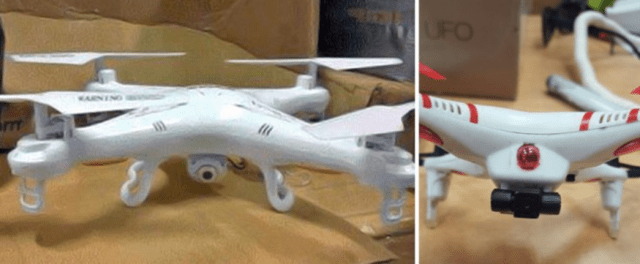
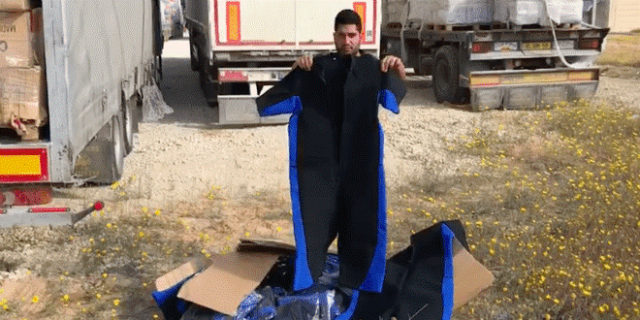
Some dual-use items are smuggled through established entry points like Rafah, Erez, Karni, and Kerem Shalom, hidden inside innocent-looking goods from Israel or Egypt. Examples include:
Quadcopter drones used for aerial filming, smuggled in as toys
Diving gear for naval commandos as part of a delivery of clothing
Tons of ingredients for explosives (ammonium chloride) concealed in a 40-ton shipment of salt4
Quadcopter drones used for aerial filming, smuggled in as toys
The weapons smuggling route through the Sinai Peninsula to Gaza from Libya and Sudan, run by Bedouin tribes, was supposedly blocked off by the Egyptian Army several years ago. However, one former Gazan, Hamas expert Ahmed Fouad Alkhatib, recently reported that “Hamas, with Iranian and Hizbullah logistical support, has mastered the art of sneaking in critical shipments coming from Libya or transiting via Sudan, using generous cash payments to tribes or even bribes to Egyptian military officers.”5
The Tunnels to the Sea
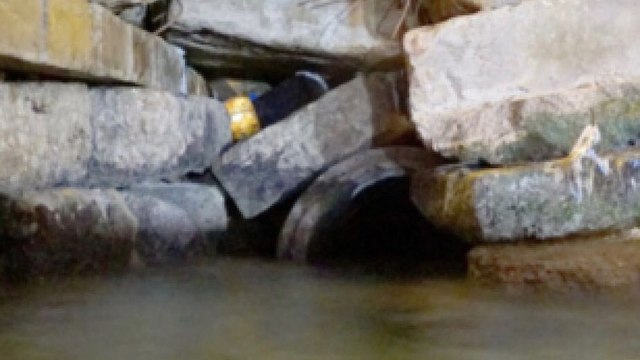
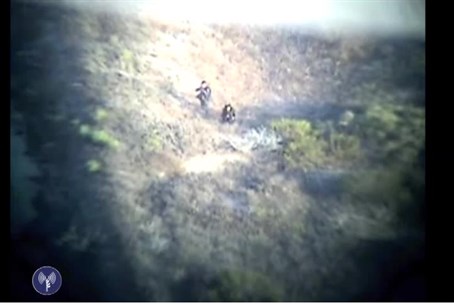
In June 2018, Israel’s Air Force struck a Hamas tunnel three kilometers south of the Gaza-Israel border. The tunnel entrance was under a Hamas military post, and from there, the tunnel continued dozens of meters to the sea. The “exit” was 2-3 meters underwater, according to the IDF.
The exit of a sea tunnel. (IDF Spokesperson’s Unit)
The IDF identified a Hamas naval base already in 2016, before announcing the sea tunnel. An investigation showed that it was financed “with funds siphoned from the United Nations Development Agency (UNDP).”62016 aerial photograph of Hamas “port” (Photo: IDF Spokesperson’s Unit)7The locations of Israel’s airstrikes on a Hamas naval commando base and tunnel in 2018
“Hamas has invested a lot of resources in the construction of this tunnel,” a senior Israeli Navy officer said. “We consider it a ‘blue tunnel’—from land to sea. The Hamas commando unit has dozens of fighters, with civilian diving equipment that allows undetected movement underwater,” he continued. “Such measures are effective in the three kilometers between the tunnel and the border.”8Hamas’ naval commando recruitment poster.
As late as May 2021, Israeli naval and intelligence officials expressed concerns over commando units infiltrating from Gaza into Israel, as they did in the July 2014 war.
For Every Naval Egress, There Is an Ingress
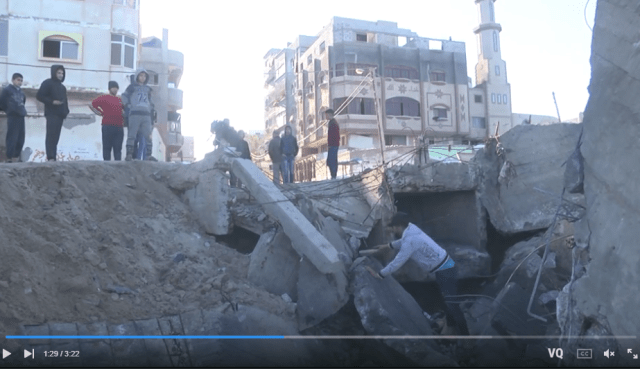
In February 2020, Israel aircraft struck a Hamas shoreline facility. One video of the damage to the site was posted on the internet, and the event left practically no media echo.9 The video showed heavy damage to a reinforced cement structure and young men collecting broken cement slabs and climbing out of what appeared to be a subterranean tunnel. Above the ruins was a wide beachfront promenade. The video’s significance could not be fully appreciated until the exposure of Hamas’ “Metro” tunnel system in the May war.
Today, after the 2021 Gaza conflict, evidence suggests that Hamas imported weapons through an underwater tunnel on the Mediterranean coast. The “stevedores” tasked with unloading the submersed arms deliveries were Hamas naval commandos, numbering some 400 divers.10 The underwater “dock” may have even hooked up with the “Metro” tunnel system beneath the promenade so that arms shipments could be directed to the appropriate al Qassam units.
On February 6, 2020, Israel struck a Hamas facility and the promenade along the Gaza shore. Are these the remains of a heavily fortified tunnel beneath it used to provide protected exit and entrance points for Hamas commandos and weapons?11
For many years, weapons for Hamas have been dropped into the sea in sealed capsules miles off the coast of Gaza by smugglers and ships. The Israel Navy keeps close watch on Gaza fishing boats, some of which are suspected of being sailed by Hamas commandos to bring the clandestine shipments closer to shore. In February 2021, Israeli forces sank a Hamas “fishing boat” two miles off the coast of Gaza.12 Along Gaza’s shores, an estimated 750 boats13 and 5,000 fishermen14 ply the waters. Israel limits Gaza fishing zones to 3-15 nautical miles, depending on security conditions.
Hamas naval commando attempt to infiltrate Israel in 2014
The IDF has been vigilant against Hamas (and Hizbullah) attacks from the sea since the 2014 Hamas commando raid on Zikim Beach. Under threat are underwater pipelines, the Israeli Tamar and Leviathan gas rigs in the Mediterranean, as well as Israeli ports, boats, and oil and electric facilities along the coast. Potential weapons for terrorist assault include drones, unmanned explosive speedboats, naval mines, commando raids, and torpedo-like submersible drones equipped with GPS. Weapons such as these are in use by the Iran-supplied Houthis in Yemeni waters, and they will likely show up in Hizbullah and Hamas hands, as well.
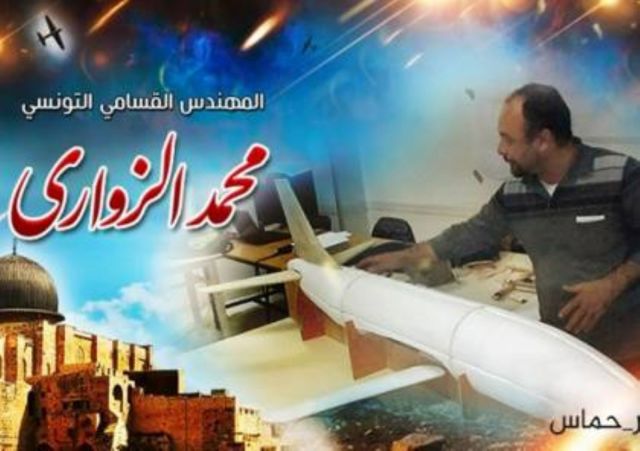
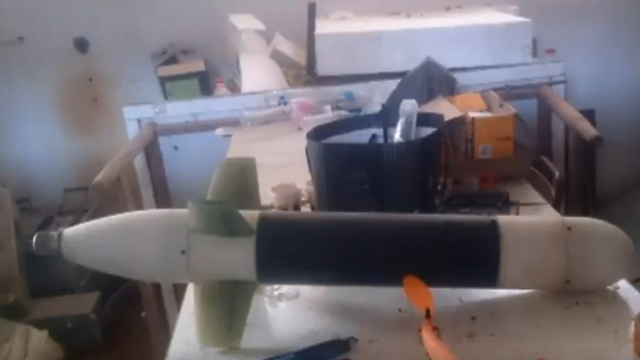
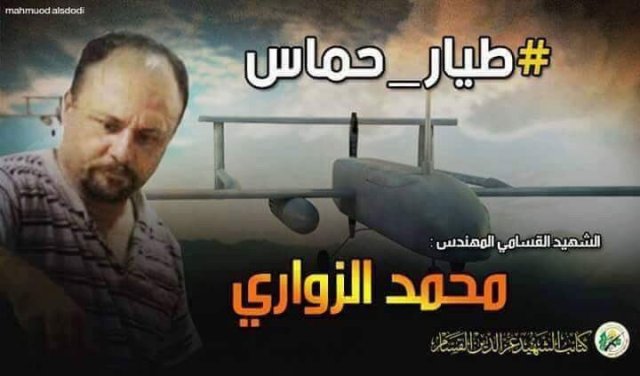
When a Hamas drone engineer, Mohammed al-Zawahri (trained in Iran), was assassinated in Tunisia in 2016, Tunis television filmed his laboratory. In the video, a prototype of an autonomous submersible weapon could be seen.
A 2016 Hamas obituary notice for engineer Mohammad al-ZawahriAn Unmanned Underwater Vehicle (UUV) found in Zawahri’s workshop in Tunis (Tunisian TV)
During the May 2021 Hamas-Israel war, Israeli forces destroyed an autonomous underwater vehicle carrying 50 kg. of explosives prior to its imminent launch from Gaza.15 The Hamas commando team carrying what could have been a small submarine was also killed. The IDF Spokesman’s office revealed that Hamas has “unmanned submarines that operate autonomously and navigate using GPS.”16 A video of the incident shows that the action took place above ground. If the Hamas “Metro” tunnels and the connecting underwater tunnel had not been taken out of action, could Hamas have launched the submersible undetected?
Hamas Rockets, Artillery, and Drones
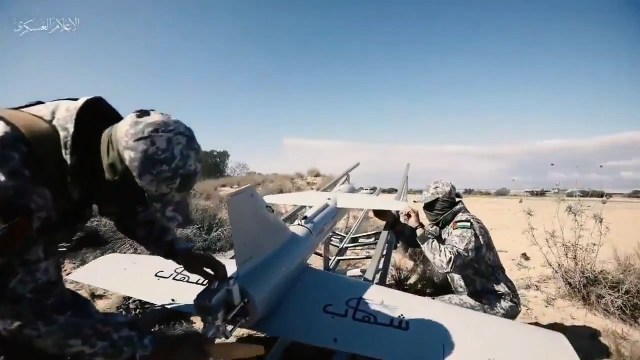
Hamas fighters prepare to catapult “suicide” Shehab (flaming meteor) drones at Israel.17
The preponderance of Hamas’ attacks on Israel in May 2021 came in the form of unguided rockets and artillery fire. Some 4,350 projectiles were fired at Israel, with 15 percent falling short and exploding in Gaza. Hamas, aided by Iran, seeks to upgrade and expand its sea weaponry, as discussed above, but the same is true for its land weapons. Do not be fooled by the poor man’s weapons of incendiary balloons, improvised explosive devices (IED), or even dumb unguided rockets. Iran, Hizbullah, and Hamas have enlisted expert engineers and the necessary materiel to bring GPS-guided missiles, suicide drones, and cyber threats into the Gaza terrorist arsenals.
“[Hamas and the Islamic Jihad] are very serious rivals in Gaza,” warned an expert involved in rocketry and guidance. “This is not an enemy to be underestimated. They are no less serious than the weapons developers in Iran or Hizbullah, and they are operating under much more difficult circumstances.”18
Israel had faced previously most of the rocket types fired by Hamas and the Palestinian Islamic Jihad, and the Iron Dome defense system intercepted about 90 percent. But there were some critical differences in the Hamas deployment. Over the course of the 50-day long war in 2014, Hamas fired approximately 4,500 rockets. In the 11 days of the 2021 war, Hamas launched 400 rockets a day, nearly four times the daily average number of launches in 2014.19 In one case, Hamas and the Islamic Jihad fired a barrage of 127 rockets at Ashdod and Ashkelon in a five-minute period.
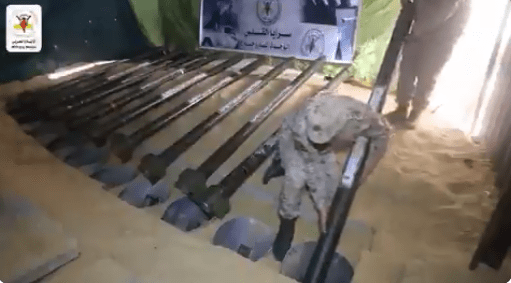
Screenshot of Islamic Jihad fighters loading underground rocket silos (Twitter, Emanuel Fabian)20
Unprecedented barrages of dozens of longer-range missiles targeted the Dan region surrounding Tel Aviv. Clearly, this was an attempt to overwhelm the Iron Dome radars and interceptors, possibly following Iranian instructions. According to the editor-in-chief of the Hizbullah-affiliated Lebanese daily Al-Akhbar, Ibrahim Al-Amin, Hizbullah, the Iranian Revolutionary Guards (IRGC), and Hamas established a joint military operations center in Beirut during the fighting. Al-Amin added that the commander of IRGC’s Al-Quds Force, General Esmail Qaani, visited Lebanon twice to attend operational meetings.21
Israel’s Iron Dome’s 90 percent interception rate may be impressive, but it still means 10 percent were not intercepted.
It is estimated that about 200 medium and long-range missiles were fired. After Israel diverted air traffic from the threatened Ben-Gurion Airport to the Ramon Airport in the south near Eilat, Hamas fired a 250 km.-range Ayyash rocket at the Ramon airport that exploded harmlessly in the vicinity. (The Ayyash is named after Hamas bombmaker Yahya Ayyash, who was assassinated in 1996 and whose portrait was plastered on the rocket.)
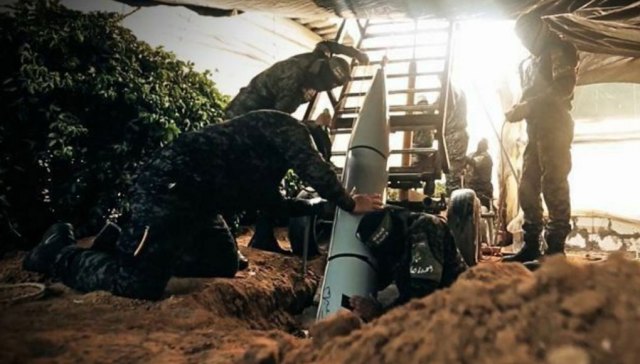
Screenshots from a Hamas video purportedly showing the loading of A-120 rockets into a multiple rocket launcher (MLR). (Janes, June 21, 2021, source withheld)Hamas fighters loading a heavy rocket in an underground silo under camouflage. (Arab press)
Over the years, Hamas’ rockets have gotten bigger, packed more explosives, and reached greater ranges, but its rockets can only be aimed at general areas and have no pin-point accuracy.
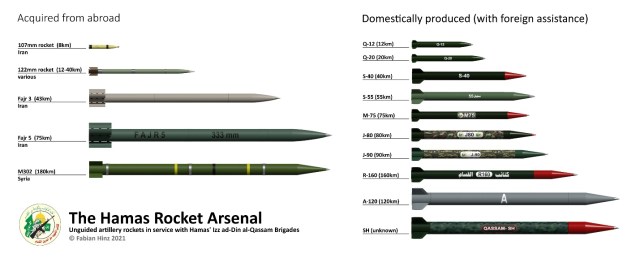
The Hamas and Islamic Jihad Inventories of Rockets22
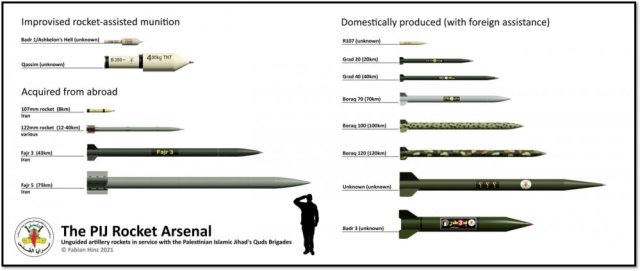
Iran is the supermarket for weapons for radical militias and proxies. The rockets in the arsenals of Hamas and Palestinian Islamic Jihad may have different names, but many are identical, as seen in these charts produced by arms expert Fabian Hinz for the Wilson Center.23
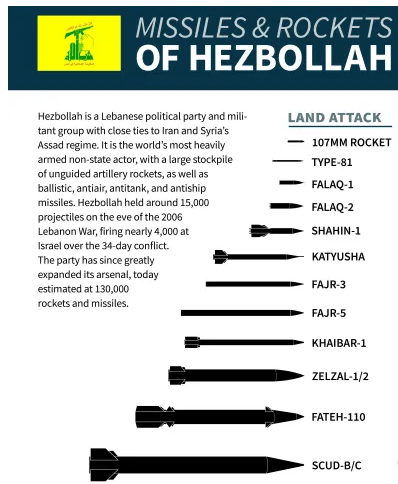
Compare the charts to Hizbullah’s Iran-supplied arsenal, shown in this chart assembled by the Center for Strategic and International Studies’ “Missile Defense Project.”24
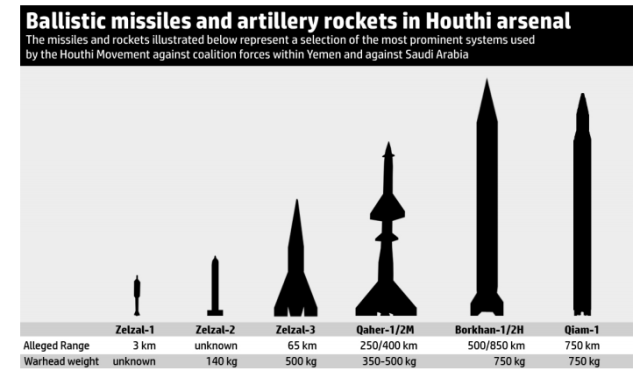
Below is a chart of Houthi rockets and missiles in Yemen. The names, designs, and ranges are similar to other Iranian-supplied or designed weapons.25 For instance, the Borkhan is considered to be in the “Scud missile family.”
Iran’s involvement in the development and growth of Hamas’ missile arsenal has not been missed by rocket experts. For instance, Ian Williams of CSIS’ Missile Defense Project recognized during this war “a larger Iranian footprint” on Hamas’ rocket program.” He elaborated: “We’re seeing this in just the volume that Hamas is able to put up, the intensity of them, the sizes of the salvos, and the coordination of those salvos, which is greater than we’ve seen in the past.”26
Drones
Rockets are not precision weapons and are used by Hamas, Hizbullah, and Houthis as terror weapons. They also generally have a predictable and unmaneuverable flight path – up and down and boom where they fall. Add guidance and maneuverability to that platform and the outcome is a precision missile. But other problems emerge: fuel, launch, thrust, heat, signal reliability and interference, and fuze dependability.
Drones solve many of those glitches. Drones are generally known for their utility as spy aircraft for intelligence, battlefield management, and signal relay.
However, drones also have an offensive capability. An easier path to a precision-guided bomb, especially for asymmetrical armies, is a suicide drone, also known as loitering munitions. Such a weapon would enable Hamas to accurately hit military bases, defense facilities, power stations, naval targets, force concentrations, and other vital targets. In 2019, a Houthi drone exploded above a Yemeni military parade, killing several officers on the podium.27
Drones can fly low to avoid radar, fly a complex route to a target, and can be used swarm-like with other unmanned aerial vehicles (UAVs) and cruise missiles to overwhelm defenses to hit a strategic target, as seen in the Iranian attack on Saudi Arabia’s Abqaiq oil facility. The attack in September 2019 shut down 50 percent of the Saudi oil industry.
Hamas and Iran have made great efforts to perfect a Gaza-launched drone. Drone expert Mohammed al-Zawahri received training in aeronautics and drones in Iran and became Hamas’ chief engineer, where he supervised the al-Qassam Brigades’ Ababil drone manufacturing program. He was assassinated in Tunis in 2016.
A Hamas memorial notice for Zawahri showing the Ababil drone.
Fadi Mohammed al-Batsh was a Gazan who graduated from the Islamic University in Gaza with an MS and PhD in electrical engineering. He moved to Malaysia where he was assassinated. The Malaysian press described him as a “rocket expert.” At his funeral in Gaza, he was eulogized as an “engineer commander.”
On May 12, 2021, the IDF destroyed an engineering R&D facility in Gaza. Meeting inside were some 15 engineers, workers, and cyber experts who were all killed.28 The chart below shows some of Hamas’ senior weapons manufacturing experts and R&D commanders.
Hamas launched six Shehab suicide drones during the 2021 war (a version of the Iranian Ababil and Houthi Qasef drones), each carrying approximately five kg. of explosives. All were intercepted: one by a Python air-to-air missile fired by an F-16 fighter plane and another by an Iron Dome missile (using a radar configured differently than normal). The other interceptions were classified.
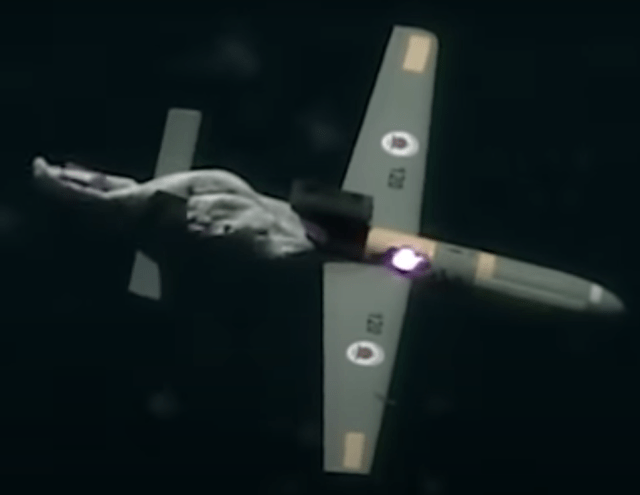
By coincidence – perhaps – the Israel Defense Ministry announced a month later a successful test to intercept UAVs with a new airborne laser.29 The laser system will eventually complement the Iron Dome system. Israeli and American aerospace companies will also work together to develop a ground-based laser system.30A screenshot of a test drone hit by an airborne laser prior to its crash (video)31
Another IDF innovation that was seen on the Gaza battlefield was a fleet of armed multirotor drones that “shared a network, autonomous capabilities, and artificial intelligence.”32 By operating together, the drones function as a “swarm” to share data and potential targets. On May 6, 2021, a new IDF search and destroy unit deployed drone swarms in combat. They sought and destroyed “dozens of hidden enemy targets [such as rocket launchers] in complex terrain in rural and urban areas.” Within days, the unit completed more than 30 missions, “destroying dozens of enemy targets several kilometers beyond the border.”33
Cyber Warfare
An Israeli laser weapon that also shoots down Hamas rockets is a wise addition to Israel’s quiver, considering Hamas’ active cyber efforts to neutralize the Iron Dome system and disrupt IDF communications at high and low frequencies in the May 2021 war. According to a senior Israeli officer, Hamas established “electronic warfare units in order to disrupt the accuracy of the IDF. Hamas wants to infiltrate or disrupt IDF systems on the spectrum, on the web, using GPS jammers and other capabilities.” He continued, “The aim is to lower the level of accuracy of the weapons and to impair connectivity.”34
On May 15, 2021, Israel demolished the Jalaa Building in Gaza after warning residents to evacuate. Heeding the warning, everyone left the building and no one was hurt. “The first five floors were offices, with floors six to 10 inhabited by families,” according to the Guardian. “On floor 11, the top floor, were the Gaza offices of the Associated Press and Al Jazeera.”35
The British paper went to great length to identify the residents on floors six to 10 and detail their fears and plight. But who inhabited the “offices on the first five floors?” Hamas special units.
“In the newsroom building, there were international media agencies,” explained Brig.-Gen. (res.) Nati Cohen, former chief of the IDF’s C4I (command, control, communications, computers, and intelligence) unit. “But in the same building, there was Hamas weaponry and units whose purpose was to disrupt the IDF’s systems. If you looked at the roof, there were a lot of antennas, ostensibly for communication. But not all of them were. Some of them belonged to Hamas.”
Cohen continued, “Hamas sought to disrupt the IDF’s cybernetic superiority and established elite units for that purpose. Some of the Hamas people killed were on this power accumulation axis. At least ten targets destroyed during the Guardian of the Walls operation were Hamas C4I and electronic warfare targets.”
A Hamas Computer Server Farm
There are indications that Hamas was running a cyber “server farm.” Was one of those IDF targets against Hamas the server farm used to process vast amounts of data like radio signals and process information for jamming transmissions? Maintaining a “server farm” of hundreds or thousands of computers entails running them 24/7, using massive amounts of power, and providing a stable cooling environment.
Brig.-Gen. (res.) Nati Cohen responded to a question about an IDF attack on a Hamas server farm, a topic that has not been discussed in the public media:
This is a dilemma between the intelligence officer who wants to collect information [presumably by hacking the Hamas cyber facility] and the C4I officer who wants to disrupt the capability. There is always tension between collecting and attacking. We exhausted the information, and it was decided that the server farm was producing excess power for Hamas. One of their goals is to produce messages. So the farm became a legitimate target.





 September 18, 2026






 Iran is the supermarket for weapons for radical militias and proxies. The rockets in the arsenals of Hamas and Palestinian Islamic Jihad may have different names, but many are identical, as seen in these charts produced by arms expert Fabian Hinz for the Wilson Center.23
 Compare the charts to Hizbullah’s Iran-supplied arsenal, shown in this chart assembled by the Center for Strategic and International Studies’ “Missile Defense Project.”24
 Below is a chart of Houthi rockets and missiles in Yemen. The names, designs, and ranges are similar to other Iranian-supplied or designed weapons.25 For instance, the Borkhan is considered to be in the “Scud missile family.”
 Iran’s involvement in the development and growth of Hamas’ missile arsenal has not been missed by rocket experts. For instance, Ian Williams of CSIS’ Missile Defense Project recognized during this war “a larger Iranian footprint” on Hamas’ rocket program.” He elaborated: “We’re seeing this in just the volume that Hamas is able to put up, the intensity of them, the sizes of the salvos, and the coordination of those salvos, which is greater than we’ve seen in the past.”26
 Hamas launched six Shehab suicide drones during the 2021 war (a version of the Iranian Ababil and Houthi Qasef drones), each carrying approximately five kg. of explosives. All were intercepted: one by a Python air-to-air missile fired by an F-16 fighter plane and another by an Iron Dome missile (using a radar configured differently than normal). The other interceptions were classified.
By coincidence – perhaps – the Israel Defense Ministry announced a month later a successful test to intercept UAVs with a new airborne laser.29 The laser system will eventually complement the Iron Dome system. Israeli and American aerospace companies will also work together to develop a ground-based laser system.30
Hamas launched six Shehab suicide drones during the 2021 war (a version of the Iranian Ababil and Houthi Qasef drones), each carrying approximately five kg. of explosives. All were intercepted: one by a Python air-to-air missile fired by an F-16 fighter plane and another by an Iron Dome missile (using a radar configured differently than normal). The other interceptions were classified.
By coincidence – perhaps – the Israel Defense Ministry announced a month later a successful test to intercept UAVs with a new airborne laser.29 The laser system will eventually complement the Iron Dome system. Israeli and American aerospace companies will also work together to develop a ground-based laser system.30