 September 25, 2026
 Heritage Is Worth More Than Inheritance
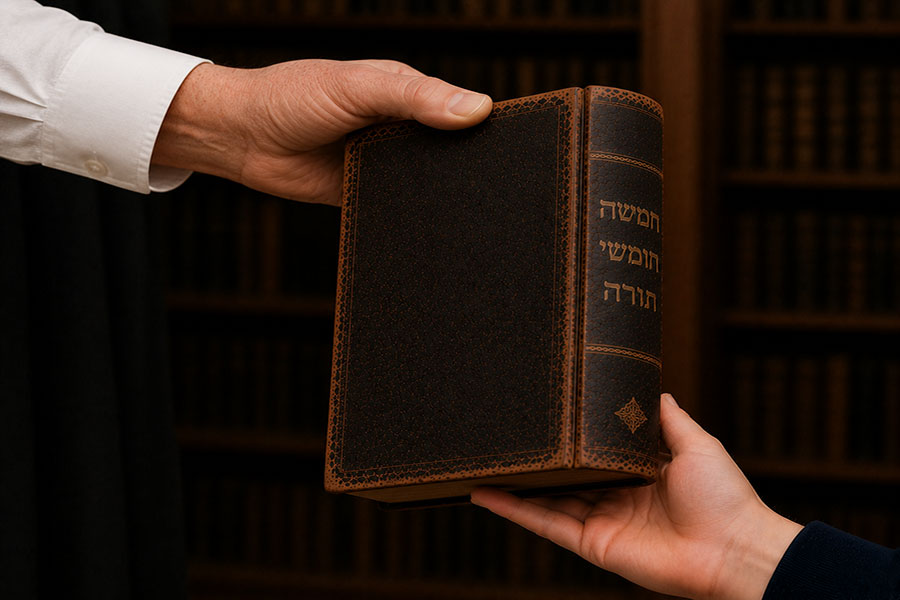


“You never actually own a Patek Philippe. You merely look after it for the next generation.”
Luxury Watchmaker, Patek Philippe’s Generations Marketing Campaign
A group of madrichim, youth leaders from across Europe, were touring Israel. On their final night, they asked for one last chavayah before flying home, one hour of Torah learning in a real yeshiva.
These were not observant young people. But they loved the Jewish people. They had given themselves to a Zionist youth movement, and now they were returning to Europe to start university and lead the next generation.
My brother was teaching at Machon Meir, a Jerusalem yeshiva for baalei teshuvah and converts. As the English-speaking rabbi, he was asked to give the shiur. He had one hour.
One hour. One shiur. One final word before they scattered home. What do you say?
For many of them, this might be the last formal Torah learning they would hear for a long time. Perhaps ever. My brother called our father with one question. What do you say to young Jews who love their people, have barely learned Torah, and may never learn it again? What is the one message worth carrying home?
Tell them, my father said, that Torah belongs to every one of them. Tell them it is far greater than they imagine. It is not only Gemara and halacha. It is a world that speaks to every part of life. And tell them this above all: Torah is waiting for them. Even if years pass without learning it, it remains theirs, ready for the day they choose to claim it.
The Torah describes itself in exactly those terms. “Torah tzivah lanu Moshe, morasha kehillat Yaakov.” “The Torah that Moses commanded us is the heritage of the congregation of Jacob.” (Devarim 33:4) Not merely an inheritance, but a morasha, a heritage. A sacred heirloom handed from generation to generation. It becomes ours in the deepest sense only when we choose to receive it.
An inheritance is yours by default. It comes whether you asked for it or not. A heritage becomes valuable only when you claim it.
Think of the objects a family keeps. A photograph of a great-great-grandfather you never met. A grandmother’s wedding ring. A great-uncle’s tefillin that survived the Holocaust. These items are priceless, or they are nothing. The ring is only gold unless it means something to the person holding it. The photograph is only an old face unless you decide it is family. The object does not change. You do.
Torah works the same way. It is a morasha, a heritage handed from one generation to the next, not a possession that lands in your lap. It waits. It calls. It asks to be claimed.
That is what makes Shavuot, and Torah itself, both a gift and a charge for parents and teachers. We celebrate the day our people received the Torah. And every year we face the same question our ancestors faced at Sinai: Can we hand this treasure to our children in a way that makes them want to receive it?
We cannot force a heritage on anyone. We can only live it, love it, teach it, and make it compelling enough that the next generation chooses to carry it forward.
I saw the same truth recently in a different setting. A friend and his wife were writing their wills, and they were wrestling with one question. If they die while their children are still minors, when should the children receive the estate? At eighteen, because the law allows it? Or later, in trust, when they are ready to manage it wisely?
The argument for the trust was not really about money. It was about maturity. It was about giving children time to grow and develop the ability to value what they receive.
I think of a friend from childhood. He was an only child. Both of his parents had died, and he inherited some wealth. At eighteen, he gained full access to it. A few days after his birthday, he pulled up to our house in a beautiful blue convertible. Over time, the rest went the way of the car. Eventually, nothing was left. Not the wealth. Not the convertible.
I do not judge him, or the people who tried to help him. But the lesson is hard to miss. Money handed to someone before he can carry it is not an asset. It is a liability.
Someone once put it sharply. Why would I rob my children of the self-fulfillment of achieving success? There is quiet dignity in becoming self-made. A parent who gives everything on a silver platter may think he is giving freedom. Too often, he is taking away the joy and self-respect of earning it.
That is the pattern. The moment something becomes only an inheritance, it stops being an heirloom. It stops being treasured. It stops being a heritage at all.
The Talmud saw this long ago. In Nedarim 81a, it asks a painful question. Why are the children of great Torah scholars so often not great scholars themselves? Rav Yosef gives a striking answer: “So that people should not say Torah is an inheritance.”
If Torah passed down automatically, by birth, like a last name or a plot of land, it would cease to be Torah. It would become property. And property is not earned. Torah must be earned, in every generation, by every person who wants it.
The Book of Ruth, which we read on Shavuot, shows how quickly a heritage can be lost, and how powerfully it can be reclaimed.
The Talmud teaches that Elimelech, the man who leaves the Land of Israel for the fields of Moav, was the son of Nachshon ben Aminadav. Consider who Nachshon was. When the sea had not yet split, when the people stood frozen at the water’s edge, Nachshon stepped forward. He walked into the water first. He was ready to risk everything for what was right.
One generation later, his son Elimelech faces famine and leaves the Land. His sons marry women of Moav. One generation. That is how quickly a heritage can unravel when it is treated as something owned rather than something earned.
Then look at Ruth. She is a Moabite princess, born into wealth, status, and security. Her inheritance is guaranteed. What she lacks is a heritage. No Jewish lineage. No family memory of Sinai. No sacred treasure passed down from her parents.
And yet she chooses it. She walks away from the palace, her homeland, and her people to claim a heritage that was never hers by birth.
Elimelech receives a heritage and lets it fall in order to preserve wealth. Ruth receives wealth and lets it fall in order to claim a heritage.
Heritage is not only about where you come from. It is about what you choose to claim.
That is the quiet message of Shavuot. The Torah our ancestors received at Sinai is offered to us, not imposed on us. It is the family heirloom. And like every heirloom, it is worth everything or nothing, depending on one thing alone: whether we choose to want it.
My late rebbi, Rabbi Berel Wein, zt"l, wrote: “The Torah describes itself as a legacy, rather than as a mere inheritance that is meant to be passed on from one generation to the next: it is, in itself, a piece of eternity that is bestowed upon its recipients. Inheritances rarely survive for more than one or two generations at most. But a legacy is always present, a matter of vision and spirit, not subject to the deterioration or loss of value that time inevitably brings to all things physical.”
Our task is not simply to inherit Torah or bequeath it to the next generation. Our task is to earn it, live it, love it, and hand it to our children in a way that helps them earn it too. Perhaps this is why we read The Book of Ruth on Shavuot: to remind us that Torah is morasha kehillat Yaakov, the heritage of every Jew. Even if years pass without your learning it, it remains yours, ready for the day you choose to claim it.