 October 9, 2026
 Categories: Arts
Hundred-Year-Old Letter Lays Bare Struggle to Finance Yeshivos
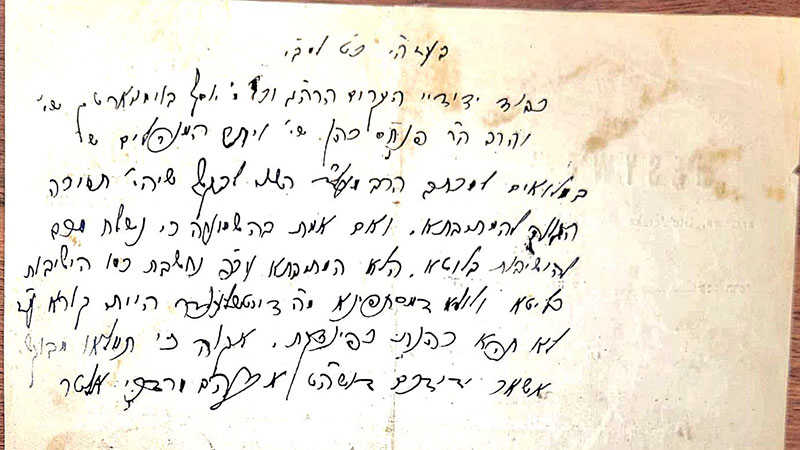


Every so often, a single page surfaces that does more than preserve ink on paper; it captures a pivotal moment in our history. One such document that was consigned to the shop this week was a single, extraordinary sheet of a two-sided letterhead from Warsaw, dated 1920. It bears the official stationery of a Gerrer chassidic mesivta. On one side, you see the unmistakable, bold handwriting of none other than Rav Meir Shapiro, the legendary visionary of Daf Yomi and Lublin. On the reverse is a letter by the Imrei Emes of Ger, Rav Avraham Mordechai Alter.
The recipient of this heavy-hitting letter was Rabbi Yosef Baumgarten (1864-1933), the distinguished dayan and later av beit din of Vienna's famed Schiff Shul. Rav Baumgarten was a man deeply involved in the global communal affairs of the era, making him the perfect address for this urgent appeal.
We have to remember the context of 1920. The First World War had left much of Eastern European Jewry completely devastated. Hundreds of yeshivos were literally starving, struggling simply to keep their doors open from one week to the next. To address this catastrophic crisis, international fundraising efforts were organized through the Keren Olam HaTorah HaKlali, a central fund established to support Torah institutions throughout Europe.
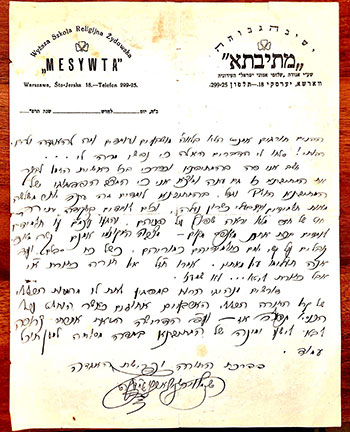
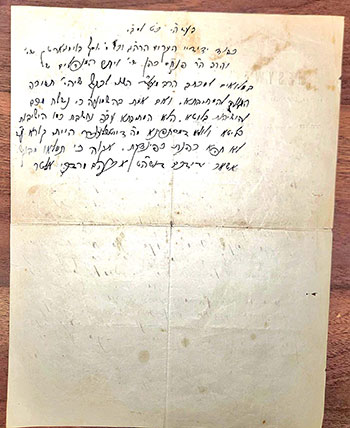
But as is so often the case with communal funds, how that money should be divided quickly became a source of bitter, passionate disagreement. In this remarkable letter, both Rav Meir Shapiro and the Imrei Emes stand up and argue that Polish yeshivos, particularly the massive network of chassidic institutions, were being unfairly neglected and left out in the cold. Meanwhile, an outsized, disproportionate share of the available global funds was being directed straight toward the Lithuanian yeshivos.
Far from a mild complaint, the language used here is incredibly passionate and direct. Rav Meir Shapiro pulls no punches. He reminds Rav Baumgarten that this very matter had already been ironed out at an Agudath Israel conference, where it was officially agreed that 40 percent of the available funds must be allocated to the Polish yeshivos. Rav Meir’s letter insists that this commitment be honored immediately, demanding that the agreed-upon allocation not remain merely a worthless resolution on paper.
The Imrei Emes laments that funds specifically intended for the established, traditional yeshiva world were being diverted elsewhere. Here, he makes what appears to be a subtle, fascinating historical reference to the newly emerging Bais Yaakov movement. His closing words are absolutely striking. He writes that were it not for his immense personal deference to the great Rabbi Leo Deutschlander, he would invoke the sharp Talmudic expression:
"The daughter of a priest should not be treated like an innkeeper."
This expression is used by the Sages to protest a complete inversion of priorities, to ask why those with greater standing or longer-established claims should receive inferior treatment. The Imrei Emes appears to have believed that the traditional yeshivos, which had single-handedly sustained Torah learning for generations, should not find themselves competing for limited crumbs while newer educational initiatives received substantial funding. Yet, even in expressing this heavy criticism, he deliberately tempers his holy words, explicitly acknowledging his deep respect for Rabbi Deutschlander.
But perhaps the most unforgettable, classic passage comes right at the tail end of Rav Meir Shapiro's letter. Writing in the spirited, sharp style of a public protest flyer, he concludes with a brilliant line that combines his famous wit with unmistakable sarcasm:
"Our Sages taught that there is no Torah like the Torah of the Land of Israel, but that there is no Torah like the Torah of Lithuania, that we have never heard."
Behind the sharp humor lies a dead-serious point. Rav Meir Shapiro was fiercely objecting to what he saw as an emerging assumption that Lithuanian institutions alone represented the absolute pinnacle of Torah scholarship, and therefore deserved a monopoly on communal resources.
Today, with the benefit of more than a century of hindsight, it is very easy for us to view the pre-war yeshiva world of Eastern Europe as one singular, unified, harmonious whole. This remarkable document comes along and reminds us that the historical reality on the ground was far more complex.
Behind the towering, historic accomplishments of Agudath Israel, the flourishing of the great yeshivos, and the emergence of Bais Yaakov, stood incredibly difficult, candid conversations about priorities, representation, and the allocation of scarce resources.