 August 14, 2026
 Categories: Collecting / Arts
Is Barbie Jewish?
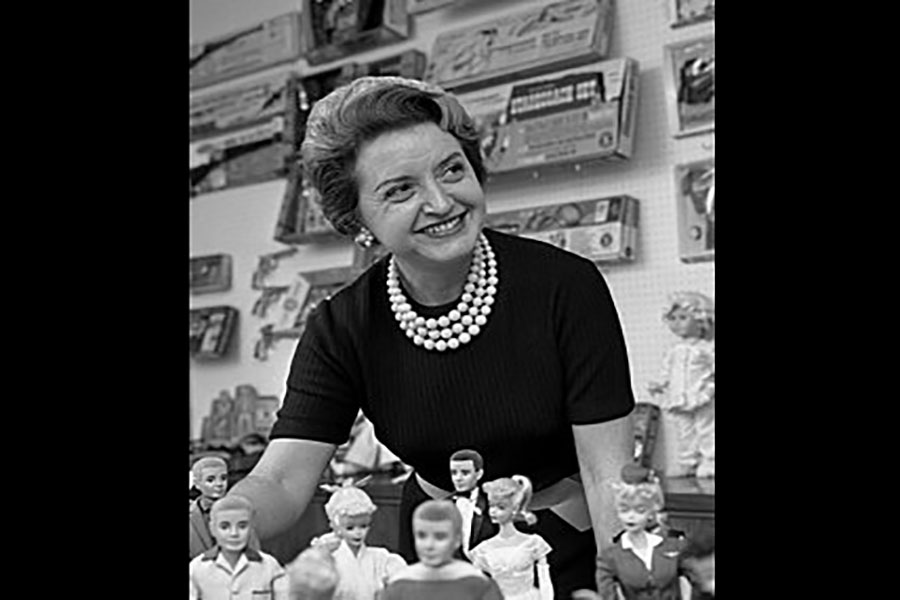


Ruth Marianna Handler (1916-2002) occupies a singular place in twentieth-century American cultural and business history. She was a co-founder of Mattel, Inc., one of the most influential toy companies ever created, and the conceptual force behind the Barbie doll, a product that reshaped children’s play, global consumer culture, and debates about gender for more than six decades. Yet, her life cannot be fully understood without careful attention to her Jewish origins, her family background, the nature of her Jewish upbringing, and the ways in which Jewish identity – sometimes explicit, sometimes muted – shaped her experiences and choices, and her biography exemplifies a distinctly American Jewish trajectory: immigrant roots, limited religious observance, cultural continuity rather than doctrinal rigor, and remarkable upward mobility combined with encounters with prejudice and exclusion.
Handler was born Ruth Marianna Mosko in Denver, Colorado, the youngest of ten children. Her parents, Jacob Mosko and Ida Zippin Mosko, were Jews from Poland who immigrated to the United States in the late nineteenth and early twentieth centuries; Jacob was born in Poland, had been drafted into the Russian army, and went AWOL when the army was sent to Turkey and Ida, who had never learned to read and write, came from territory that was then part of the Russian Empire, an area marked by economic deprivation and pervasive antisemitic restrictions. Like many Jews of their generation, they came to America seeking safety, opportunity, and the possibility of a dignified livelihood. Denver was a significant center of Jewish settlement in the American West, attracting Eastern European Jews with its reputation for opportunity and, later, its climate, which was believed to benefit those suffering from tuberculosis.
The Mosko household was unambiguously Jewish in origin and self-understanding, but it was not strictly Orthodox. Available accounts suggest that the family observed major Jewish holidays, particularly Passover and the High Holy Days, and that there was an awareness of Jewish history, ancestry, and collective memory. At the same time, there is no evidence of strict Sabbath observance, daily prayer, or rigorous adherence to kashrut, a pattern that was typical of many immigrant Jewish families striving to balance tradition with the demands of American economic life. Judaism in the Mosko home functioned primarily as a framework of identity and continuity rather than as a comprehensive system of religious law.
Ruth attended South High School in Denver, where she met Izzy Handler, a fellow student with artistic inclinations. Izzy was Jewish, born in 1916 in Chicago to parents of Eastern European Jewish descent; his Ukrainian paternal grandfather was the Orthodox religious leader of his village, which his father totally rejected, so that his family background, like Ruth’s, reflected the immigrant Jewish experience of partial acculturation combined with cultural continuity. Their shared Jewish origins created a common ground, even though neither came from a rigorously observant household. Ruth and Elliott married in 1938 (Ruth reportedly encouraged her husband to go by “Elliott” when they moved to the west coast, a change aimed at avoiding obvious antisemitic bias in a period where overt discrimination could affect business and social opportunities) and the couple moved to Los Angeles, where Elliott pursued industrial design and Ruth worked in clerical and administrative positions to support the household.

In 1945, Ruth and Elliott Handler, together with Harold “Matt” Matson, founded Mattel (the company’s name was derived from a combination of “Matt” and “Elliott”) and, when Matson departed soon thereafter, the Handlers assumed full control. Initially, Mattel manufactured picture frames and dollhouse furniture, but Ruth, who possessed an unusual combination of intuition, marketing insight, and willingness to take risks, qualities that distinguished her in a male-dominated corporate world, quickly emerged as the strategic mind behind the company’s evolution into a toy manufacturer.
Handler’s most influential contribution was her reconceptualization of what a doll could be. Observing her daughter Barbara playing with paper dolls, she noticed that children often projected adult identities onto them, imagining careers, romances, and social roles. At the time, the American doll market was dominated by baby dolls designed to encourage nurturing and maternal play, a model that Ruth believed underestimated girls’ imaginative capacities and aspirations, and she envisioned a three-dimensional adult-figured doll that would allow girls to imagine themselves as grown women with varied futures.
The pivotal moment came during a 1956 family trip to Europe, when Ruth encountered the Bild Lilli doll in Germany, which was based upon a cartoon character from the German newspaper Bild and was marketed primarily as a novelty item for adults. She purchased several of the dolls and, upon bringing them back to the United States, she recognized immediately that the doll’s adult form embodied the concept that she had been seeking, even though its presentation and intent were unsuitable for the American children’s market.
The development of Barbie involved extensive redesign and recontextualization. Mattel altered the doll’s facial features, softened her expression, modified her proportions, and created an entirely new narrative identity. The doll was named Barbie after the Handlers’ daughter, Barbara, and she was presented as a “Teenage Fashion Model,” a framing that emphasized aspiration rather than sexuality. When Barbie debuted at the American International Toy Fair in 1959, she represented a radical departure from existing dolls.
Barbara has occasionally spoken publicly about her unique position as the living inspiration for one of the world’s most famous toys. From the outset, she emphasized that the doll was not physically modeled after her; for example, she stated in an interview that “It was not molded to look like me. That’s a misconception... It was only a doll to me, and it wasn’t [based on] my life.” Reflecting on the early experiences that ultimately inspired her mother, she recalled her fascination with a German doll she encountered on a family trip to Europe, remembering that “I was going crazy because I wanted different clothes for it, and they didn’t sell the clothes separate. You had to buy a different doll every time you wanted a different outfit.” She recounted that her mother observed her frustration closely, and it was this moment that prompted Ruth to conceptualize a doll with interchangeable clothing, an innovation that would become central to Barbie’s enduring appeal. As Barbara described the subsequent development: “My mother thought, why is this daughter of mine so crazed about this doll?... When we got back, I never saw them again. They were torn apart and researched, and they got the idea of the separate clothes, and the rest is history.” Barbara thus positions herself not as a model in form, but as a catalyst and inspiration for her mother’s creative insight.
Barbara has also addressed the social ramifications of being linked to Barbie, describing the experience of public attention as “very odd; people were coming up to me, asking me for my autograph. When people came up and say to me, ‘Oh, you’re the real Barbie,’ I couldn’t understand it because that’s just a name that was given to the doll.” But, despite her initial discomfort, she has expressed a measured and positive perspective on her mother’s legacy and the broader cultural significance of Barbie. Regarding contemporary adaptations, such as the 2023 Barbie film, she commented that the portrayal by Margot Robbie was apt and that she anticipated the movie with enthusiasm: “My mother never imagined her creation being turned into a Hollywood production but would have been delighted.” She further noted that although the family was not involved in the production, the enduring popularity of Barbie as both a toy and a cultural icon reflects the continuing influence of Ruth innovation.
Throughout these reflections, Barbara consistently balances a personal sense of distance from the doll with recognition of the significance of her mother’s work. She underscores that her connection to Barbie is nominal and inspirational rather than physical while affirming her appreciation for the lasting impact of her mother’s creativity on generations of children worldwide.
From the beginning, Barbie provoked controversy. For one thing, some parents and critics objected to her adult figure and perceived emphasis on appearance and, over time, feminist critics would argue that Barbie promoted unrealistic beauty standards. Ruth consistently defended the doll, arguing that Barbie empowered girls by allowing them to imagine a wide range of adult roles and, over the ensuing decades, Barbie was depicted in hundreds of professions, including astronaut, doctor, business executive, and political candidate, reflecting Ruth’s original belief in aspirational play.
One of the most enduring controversies surrounding Barbie concerns the question of originality; critics argued that Ruth had appropriated the idea from the Bild Lilli doll and that full credit should therefore not accrue to her. In fact, while it is beyond dispute that Bild Lilli served as a direct inspiration and that Mattel eventually purchased the rights to the Lilli doll in 1964, scholars generally agree that Barbie was not a mere copy, and transforming a European adult novelty item into a mass-market children’s product required conceptual innovation, engineering, branding, and marketing on a scale that was unprecedented. Ruth’s role in that transformation was central, even if the initial spark came from an external source.
The Ken doll, introduced by Mattel in 1961 as Barbie’s male counterpart and longtime romantic partner, was created in direct response to fan demand; children playing with Barbie increasingly paired her with male figures in imaginative play, and Mattel wanted an official companion to extend the doll’s narrative possibilities. Ken debuted just two years after Barbie’s successful launch at the 1959 American International Toy Fair. Ken’s full name is Kenneth Sean Carson Jr., and, like Barbie, he was named after someone very real: Kenneth Handler, Ruth and Elliot’s son.
According to Mattel lore and historical summaries, Ken met Barbie on the set of a television commercial in the fictional Barbie mythos, and he has been portrayed as her boyfriend ever since in most official narratives. Over the years, Ken has held many occupations, from astronaut to chef, but he has largely remained defined by his relationship with Barbie. Thus, although Barbie’s cultural identity has often been discussed through lenses of gender, race, and even Jewishness, Ken’s origins are parallel to hers: he is named for a Jewish boy, the son of the Handlers, and there is no evidence to suggest he was created with an identity that was anything other than the same cultural background shared by his namesake family.
In the grand, imaginary world of Barbie lore, and in the real world of toy history, Barbie Millicent Roberts and Ken Carson Jr. are more than just plastic figures in coordinating outfits; they are, at their core, the product of familial love and Jewish American ingenuity. Thus, not only was Barbie Jewish, but she remained true to her faith and did not “intermarry” with a non-Jew. Playwrights of our collective imagination might say that Barbie and Ken represent not only a couple, but also a joyful celebration of Jewish continuity through names, stories, and enduring cultural presence, a pairing that some might whimsically describe as marrying within the faith of the toybox.
Ruth’s rise within Mattel occurred in an environment that was often unwelcoming to women and Jews. Although she rarely framed her experiences explicitly in terms of antisemitism, she operated in business circles where Jewish identity could be a source of implicit exclusion and her assertive leadership style drew criticism that was frequently gendered and occasionally carried antisemitic undertones. Nevertheless, she became Mattel’s president in 1959 and later its chief executive officer, one of the few women to hold such a position in a major American corporation at the time.
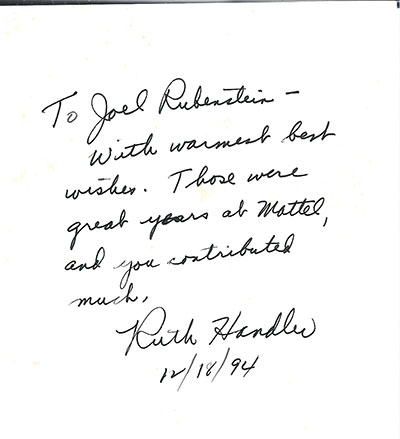
Exhibited here is a rare “Babiana” item, Ruth’s handwritten inscription in her biography, Dream Doll, to Joel Rubenstein:
With warmest best wishes. Those were great years at Mattel, and you contributed much.
Rubenstein (1936-2004) was a Jewish-American marketing and business executive who served as Director of Marketing for Mattel and who worked with Ruth at the company during the period when it was expanding its product lines and developing its marketing strategies, contributing to the company’s efforts to promote its toys to wide audiences. He later became Executive Vice President for Marketing for Major League Baseball and co-founded the Baseball Assistance Team, an organization that has provided millions of dollars to former professional baseball personnel in need.
Ruth’s personal religious practices appear to have been, at best, limited. While she did not convert to another religion, nor did she repudiate her Jewish background, and her Judaism remained a fact of origin and identity rather than a system of daily practice, she tellingly included nary a mention of her Judaism in Dream Girl, her biography.
News commentary about Ruth’s life notes that police reportedly stopped her car in Denver and made antisemitic remarks, suggesting that she experienced at least some prejudice growing up. Moreover, when her older sister, Sarah, took a trip to Warsaw at the very time that Hitler was seizing power, their Polish Aunt, sensing the coming cataclysm, asked Sarah to help get her two sons (Ruth’s cousins) out of Europe to the United States. Because of tight American immigration quotas, the family was only able to get one of the two boys out of Europe; the other ended up in a concentration camp, but he survived and the family was able to bring him over after the war. The aunt and most of Ruth’s other European relatives were murdered during the Holocaust. Thus, although antisemitism was not the defining force of her life, it formed part of the social context in which she operated.
Ruth’s involvement with Jewish communal organizations was selective and understated. She contributed to Jewish charities, particularly those related to children, health, and education, and she supported Jewish philanthropic causes in Southern California. She and Elliott helped to found Temple Isaiah in Los Angeles, a Reform Jewish congregation that became a prominent center of Jewish religious life in the city, and they were longtime donors to the United Jewish Appeal, a major Jewish philanthropic organization that historically raised funds for a range of Jewish causes, including support for Israel, refugee aid, immigration assistance, and communal welfare programming. In the wake of the 1967 Six-Day War, Ruth personally volunteered at UJA offices; when she learned that local fundraising efforts were overwhelmed with phone calls for assistance, she went to the UJA office, helped answer phones, and organized donation processing. She later described this as a form of public service about which she was very proud. Ruth was honored by Jewish philanthropic groups for her work and visibility, and one of the most clearly documented honors was her designation by the United Jewish Appeal as its first “Woman of Distinction.”
This award signals formal recognition of Ruth’s support and prominence within the Jewish philanthropic community. However, she did not position herself as a public Jewish leader, nor did she seek prominence within national Jewish organizations. Rather, her philanthropic profile reflected a broader pattern: engagement without ideological or institutional leadership.
Ruth did not publish essays or deliver speeches articulating a detailed position on Zionism, and there is no evidence that she was an ideological Zionist, nor that she opposed the Jewish state. Like many American Jews of her generation whose primary focus was domestic business and family life, her relationship to Israel appears to have been sympathetic but not central. Claims that she was deeply involved in Zionist advocacy or Israeli political life are not supported by verifiable sources. Similarly, there is no well-documented record of extensive travel to Israel or to Mandatory Eretz Yisrael. She traveled internationally for business, particularly to Europe and Asia, in connection with Mattel’s manufacturing and expansion, and, if she ever visited Israel, such visits were not central to her public biography and were not widely reported in reliable sources.
In 1974, Ruth’s career at Mattel ended abruptly following an investigation by the U.S. Securities and Exchange Commission into accounting irregularities, when she was charged with filing false financial statements and eventually entered a plea of no contest, receiving a fine and community service. The episode, which was personally devastating, removed her from the company she had helped to build. While the scandal was not framed explicitly in antisemitic terms, some contemporaries and later commentators have suggested that the coverage of Ruth and Elliott’s malfeasance occasionally echoed longstanding stereotypes about Jewish business practices, reflecting broader cultural biases rather than documented intent.
Handler’s later years were marked by a new chapter of innovation. After surviving breast cancer and undergoing a mastectomy, she was dissatisfied with the available prosthetic options, and, drawing once again on her entrepreneurial instincts, she founded Ruthton Corporation and developed a more realistic and comfortable breast prosthesis called “Nearly Me.” By around 1980, Ruthton’s Nearly Me products had generated over $1 million in sales, a strong outcome for a niche medical-consumer product in that era. This work earned widespread respect and demonstrated that her creative and problem-solving abilities extended far beyond toys.
Ruth died in 2002 in Los Angeles at the age of eighty-five and she was buried at a Jewish cemetery, Hillside Memorial Park Cemetery in Culver City, California. In death, she was widely commemorated in both the general and Jewish press; mainstream obituaries emphasized her role as a pioneering businesswoman and cultural innovator, while Jewish publications highlighted her immigrant roots and Jewish family background.
Ruth’s legacy is, of course, inseparable from Barbie, but it also encompasses a deeply American Jewish narrative. As a Jewish woman in mid-twentieth-century corporate America, she faced barriers that were structural rather than overt and her response was not public protest but persistent achievement. She neither concealed her Jewish origins nor made them a focal point of her public identity, choosing instead a path of integration that reflected the broader experience of many American Jews of her generation.