 August 21, 2026
 Categories: In Print / Features On The Jewish World
Malice In Wonderland
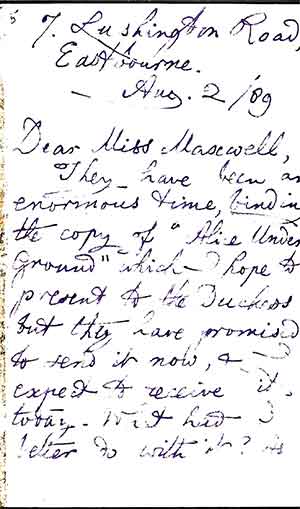
Carroll’s letter regarding sending a copy of Alice's Adventures Under Ground to Helen.


One hospital manager wrote that he knew a place where there were a number of sick children, but he was afraid I wouldn’t like to give them any books – and why, do you think? “Because they are Jews!” I wrote to say [that] of course I would give them some! Why in the world shouldn’t little Israelites read Alice’s Adventures as well as other children?However, Carroll’s love of children may have trumped his contempt for Jews; note his characterization of Jews as “obsequious unless very young,” suggesting that his animus against Jews in general may not have extended to children. Furthermore, when a number of prominent Oxford graduates joined in sending a memorial of solidarity to British Chief Rabbi Nathan Adler expressing sorrow and amazement regarding the Russian persecution of Jews, Carroll was one of the 245 signatories. Perhaps his exercise of cognitive dissonance may be harmonized by observing that, although many cultured and refined British citizens like Carroll were antisemitic, as per the prevailing social fashion at the time, many nonetheless considered themselves to be moral and ethical people who cared about discrimination against all minorities, including Jews – so long as the Jewish riffraff remained far away from British shores and did not seek to contaminate Great Britain by seeking to immigrate there. Carroll was known as a logophile who delighted in puzzles, metaphors, wordplay, and invented words (see, most famously, “Jabberwocky”) and many theories exist seeking to discover the cryptic allegorical meanings of the Alice stories. Various scholars ascribe a wide-ranging variety of symbolic interpretations to the tales, including analytical approaches that are political, metaphysical, philosophical, theological and psychological – and, as we shall see, Talmudic. One writer sees Alice as a secret history of religious controversies in Victorian England. Some philosophers see the books as a metaphor for the monstrous mindlessness of the universe, as seen through a nonsense tale told by an idiot mathematician, As Martin Gardner argues in The Annotated Alice, the entirety of Through the Looking Glass is a chess game “in which living pieces are ignorant of the game’s plan and cannot tell if they move under their own will or by invisible fingers.” Others argue that the two Alice books are expressions of Carroll’s subversive protests and that he used children’s literature as a way to confront the horrors of Victorian respectability, and still others see them as satires of non-Euclidian mathematics featuring imaginary numbers (the very idea of which Carroll rejected as ludicrous). Noting that Alice is the only mature and rational character in Wonderland – “We are all mad here,” says the Cheshire Cat – many logicians argue that Alice is actually a satiric exercise of Carrollian logic wherein he explores the repercussions of suspending common sense in favor of dysfunctional intellectualism and fantasy thinking wholly removed from the world of rationality and logic. Perhaps the most common theories see Alice in purely psychological terms, including particularly through the Freudian lens of Carroll’s infatuation and ostensible erotic attraction to the ten-year-old Alice Liddell, a daughter of the dean of Christ Church Oxford who, according to almost all scholars, was the inspiration for the Alice stories. It was on one of Carroll’s many boating trips with Alice and her sisters on July 4, 1862, that he originated the framework of the stories and, at Alice’s enthusiastic urging, decided to write the stories which, according to the Freudians, represented an outlet for his repressed desires. But one of the most intriguing hypotheses was described by Dr. Abraham Ettelson in his pamphlet “Through the Looking-Glass Decoded” (1966), in which he argues that Alice is actually a cryptogram of the Talmud written in code. He notes the frequency and importance of mirrors and inversion in the Alice stories and concludes that Through the Looking Glass and the Talmud are mirror images of each other. He argues that the principal subtext of Alice and Looking Glass is “the Jewish way” and sees the books as Carroll’s use of a Midrashic approach that employs layered interpretations and ethical analysis to expound on the pshat (the primary meaning of the text). As Ettelson would have it, Jabberwocky is a code name for the Baal Shem Tov. He divides the word “Jabberwocky” into two halves and then reads each part in a mirror; the result is “Rebbaj Yckow,” or Rabbi Jacob. (This gamesmanship evokes Charles L. Dodgson’s construction of his own pseudonym; he formed the name by translating his first and middle names, Charles Lutwidge, into Latin, which became Carolus Ludovicus; reversed their order; and translated the name back into English as “Lewis Carroll.”) Ettelson further observes that the first stanza of “Jabberwocky” – the famous “`Twas brillig, and the slithy toves did gyre and wimble in the wabe . . .” – contains no less than half of all the Hebrew letters; that one of Carroll’s nonsense words in “Jabberwocky” is frumious – which, of course, is a fusion of the words frum and pious; and that the ferocious jaw-snapping Bandersnatch contains an anagram for “Satan.” The “ball of worsted wool” that Alice’s kitten plays with symbolizes the woolen tzitzit, a proposition not all that far-fetched when one considers that worsted wool is a twisted woolen thread and that tzizit is a tassel of twisted cord. Moreover, Carroll adds that Alice’s kitten “curled up in a corner” which, according to Ettelson, evokes the “four corners” upon which tzitzit are worn. While most commentators dismiss the “Talmud theory” as, at best, sheer fantasy, most nonetheless agree that Ettelson’s methodology and analytical framework favorably compare with Carroll’s own logomania.
They have been an enormous time, binding the copy of “Alice Underground” which I hope to present to the Duchess: but they have promised to send it now, & expect to receive it today. What had I better do with it? As I see in the papers that H.R.H. [a reference to Helen] is gone, or just going, abroad. Shall I send it to you to forward to her? Or is she so constantly moving about, that it would be better to keep it until she returns to England?Alice Liddell’s parents tried to arrange a match between their daughter and Prince Leopold, the youngest son of Queen Victoria. A romance blossomed but, after Queen Victoria – who is broadly considered to be the inspiration for John Tenniel’s rendering of the nasty Queen of Hearts in the Alice stories – blocked the marriage to a “commoner,” Leopold married Helen, the Duchess of Albany. Helen employed Ethel Heron-Maxwell, the recipient of our letter, to care for her young children, Princess Alice (almost certainly named after Alice Liddell, whom Leopold never forgot) and Prince Charles-Edward. Carroll began writing his Alice manuscript under the working title Alice's Adventures Under Ground. He presented the original handwritten manuscript to the story's inspiration, Alice Liddell, in 1864, and a facsimile edition of this original was released at Christmas 1886. Carroll was the darling of the royal household beloved by all – particularly by Princess Alice, who adored him and his stories – and in 1889, he commissioned a finely bound version of this facsimile which, as our letter evidences, he presented to Helen.
* * * * *
Carroll wasn’t the only antisemite to play an important role in the Alice books. John Tenniel (1820-1914) was an English illustrator, graphic humorist and most prominent and popular political cartoonist of the day who served as the principal political cartoonist for the popular Punch magazine, but he gained immortality for his 92 illustrations for the Alice books. Carroll originally drew the artwork for the books himself but, as a perfectionist who recognized his own limitations, he convinced Tenniel to do the work – quite a coup, given the unlikelihood that a publicly renowned artist and cartoonist would agree to illustrate a children’s book written by an Oxford lecturer who was essentially an unknown of no importance. Tenniel’s portrayal of Jews included the usual antisemitic features such as a hooked nose and dark, oily hair. In particular, he frequently lampooned Benjamin Disraeli as Fagin, the Jewish leader of a crew of child pickpockets and robbers in Dickens’s Oliver Twist; for example, in one drawing, he has Disraeli instructing his fellow politicians how to effectively pick the pockets of the public.